Notes From Darcy’s Bench
Weather-wise, camping in western Washington State in late summer is at best a roll of the dice. As autumn approaches, the calm northerly coastal winds of midyear begin their annual dance around to the south. During this shift, they also absorb more moisture from the Pacific Ocean and gain intensity as they bear down on the mountainous Olympic Peninsula that constitutes Washington’s western shore. As they encounter the Olympic Mountains, the winds are severed by the topography. Some of the wet sea air is forced up and over the peaks, losing so much moisture as rainfall in the process that actual rainforests grow and thrive there. A portion is channeled roughly east into the Juan de Fuca Strait between the peninsula and Canada’s Victoria Island to the north, and the remainder shears south along the range’s western slopes. As they reach the southern tip of the range, they bend to continue east as well. If the Olympics act like a rock in a river, then the inland Cascade Range acts more like a dam. It traps the current coming in from the Strait and turns it south, while cornering the flow coming off the southern Olympics and turning them north. These now-separate winds of common origin collide and rise over the Puget Sound, causing highly unstable updrafts. This instability, meteorologically known as a convergence zone, usually brings rain but can also cause strong thunderstorms and hail. Later in the season as the temperature drops, even snow down to sea level is possible.
The volatile nature of the phenomena makes it extremely difficult to predict the weather with any true degree of accuracy, and the forecasts leading up to our annual late summer camping trip had changed daily. This year we opted to alter both the location and the timing of the excursion, bringing us further into potential conflict with the deteriorating weather. For the last few years, we had been meeting up with a group every August to camp on Mayfield Lake in southwestern Washington, about 70 miles north of the Oregon border. This year, with one of the key couples being absent, the remainder of us elected to move the assemblage north to Whidbey Island, and postponed the gathering until a month later.
In the Northwest — perhaps in trade for the uncertain and often inclement weather — we are fortunate in that we don’t need to travel far to find locales ideally suited to camping, and our destination on Whidbey was only about two hours away by car and ferry. In a portentous moment, the first raindrops actually began to fall as I backed the gear-laden car out of the driveway on a Wednesday afternoon in the middle of September. Owing to late-breaking schedule conflicts, another difference this year is that my wife and I planned to travel and arrive separately — I would head out midweek to set up camp, and she would join us all later on Friday. Heading north on interstate 5, I had to keep increasing the tempo of the wipers to maintain visibility, and a small level of climatic concern began to set in. I beat it back with the knowledge that I was on vacation, and that a little bad weather here and there wouldn’t matter. Driving the freeway while on holiday in some ways sets you apart from the hurried and purposeful stream of drivers, as if you possess a secret independence to which they aren’t privy, and soon I let any sense of disquiet trail out behind me like the passing lane markers.
Despite a forecast calling for “mostly cloudy with a slight chance of showers,” by the time I arrived at the ferry landing in Mukilteo the rain had increased to a steady downpour – more testimony to the impact of the convergence zone on local meteorological accuracy. After more than two decades of living in Washington, I still admit to being somewhat confused by forecasts that distinguish “rain” from “showers”. It must speak to a native observational faculty which I have not yet fully absorbed, the way Inuit peoples are reported to have multiple words for the subtle varieties of snow. The ticket booth operator eyed the outdoor paraphernalia piled up nearly to my interior roof and asked, “Camping?” When I nodded over the splashes from behind my mostly rolled-up window, he smiled and said “enjoy” in such a uninflected tone that it didn’t seem to be offered so much in mockery as in acknowledgment , as in, “that’s how it goes around here this time of year.”
Even in our wondrous mechanical age, any journey over water is still a journey of consequence. A ferry ride offers the additional benefit of being a clear border in the process of travel; a physical demarcation between the past and what lies ahead, on some level signaling the leaving of one life for another. For the short twenty minutes it took to cross, I was held in wonder at the act of motion over water, and the transition from work-self to vacation-self was greatly and appreciatively accelerated. I doubted that the trip ever became ordinary or mundane even for the islanders who crossed over regularly.
Whidbey is a long, narrow, ragged C-shaped island situated near the geographic center of what is now known as the Salish Sea, a vast, spidery network of waterways consisting of the Juan de Fuca Strait, Puget Sound, the Canadian waters of the Strait of Georgia, and all their connecting channels and adjoining waters. Open to the Juan de Fuca Strait on the west, Whidbey is bordered to the east by the Saratoga Passage which separates it from Camano Island and the mainland. Our chosen campsite in Fort Ebey State Park lay about two-thirds the length of the island – all of about 30 miles — from the ferry landing at the southern end. Built in a time when some sort of attack or invasion from the Pacific was considered a viable possibility, Fort Ebey occupies Whidbey’s westernmost spur, and this outpost forms the bearing point for wind and waves making their way east from the Strait. Following the rural highways that negotiate the island’s mostly north/south axis is an exercise in gently rolling terrain flanked by tall evergreen forests, with occasional glimpses of water through the trees. The already-light traffic thins as you make your way further north, and just when you begin to feel that you may be leaving civilization altogether you reach historic Coupeville (founded in 1852 and boasting a population of around a similar number), from which you head west to Fort Ebey.
A lighter but persistent rain was still falling as I drove into the campsite. Our companions in the annual outing had arrived a few hours earlier, and were relaxing in the adjacent site. The spot we had reserved appeared to be a good one: located in the quiet periphery of the complex, not too near the park entrance or the restrooms, plenty of room and good drainage. The best feature, though, was that several small footpaths led a short distance west to intersect the park’s Bluff Trail. A mere fifteen steps or so yielded a panoramic view of the entire headlands and the shoreline hundreds of feet below. There were a series of wooden slat benches along the trail that offered respite to campers and day hikers, each bearing a small plaque with a dedication. The plaque on the bench closest to our campsite had three simple lines:
In Memory Of
Darcy Ringstad Hawkshaw
Love You Always & Forever
In subsequent searches I discovered that Darcy Hawkshaw was a fifty-five-year-old Vancouver wife and mother of two daughters who “passed away peacefully in the arms of her beloved husband, Bruce, after a courageous and strong battle with cancer” in 2005. While I never uncovered a specific connection to Whidbey Island or to this spot, in the moment it was somehow enough to know that she was loved and missed, and that someone chose this quiet setting of exceptional beauty in which to honor and preserve her memory. The bench is situated so that its occupants gaze due west, into the Strait and nearly out to sea. If there were no low rainclouds sweeping the horizon they would see the dark, undulant profile of Victoria Island in the distance on their right, unobstructed ocean in front of them, and Washington’s wind-shearing Olympic Peninsula far to the left. Even in the obstinate drizzle, the view was so captivating that I spent a few minutes with our neighbors just taking it in before returning to unload the car.
In recent years setting up camp has made me progressively more incredulous, as our equipment choices over the years have marked a steady evolution towards comfort and convenience and away from the conservation of space or weight of earlier days. On many trips in my past I have carried everything I needed to eat, sleep, travel and navigate in any weather in a pack on my back, and so I can’t help but marvel at the carload of gear we now use for just two of us. At some point the novelty of scurrying on our hands and knees to enter and exit my old alpine climbing tent wore off, and we moved to a ridiculously large walk-in model. The product literature says it sleeps six, which provides more than luxurious sleeping accommodations for two. I laugh whenever I set it up, remembering the heavy canvas tent known as the “Green Monster” our family used in my teenage years in which five of us slept like uncomfortably close deck planks. An inflatable queen-sized air mattress with an automatic inflation pump and actual sheets and pillows is an immeasurable improvement over the separate sleeping bags of former adventures, though as it has increased our comfort it has also perhaps blurred the distinction between the uniqueness of camping and the ordinary life at home. For decades, zipping up a sleeping bag was a quintessential experience of camping life, and I must admit to feeling a modicum of sadness when slipping into my now zipperless bedding. The humble zipper holds a valued place in memory, as my very first camping sleeping bag — a genuine goose down U.S. Army surplus bag you sewed shut with long leather laces — had no such luxury.
Other pieces of our camping menagerie have taken on a similarly modern bent. We replaced our first camp stove — a heavy, suitcase-sized, three-burner white gas range – several years ago. It could run on unleaded gasoline if that’s all that was available, and it could bring a gallon of water to boil in almost no time at all, but it scorched the pans and was prone to clogging. We now have a more compact and efficient two-burner stove that uses the ubiquitous small green bottles of propane gas. In perhaps a fond and sentimental nod to tradition, we still keep the white gas lantern we have had for nearly 20 years. Beyond the magic of lighting the mantles and watching them flame and then glow with increasing intensity, the hissing of the gas strikes a remembrance in me whose familiarity offsets the necessity of pumping and priming absent from newer models. The light given off by the lantern itself has a different quality to it, a softness I associate with more distant memories. A few years ago, in the middle of a rainstorm at Mayfield Lake, we drove hurriedly to the nearest town and purchased a collapsible canopy to put over the Park Service table to provide some escape from the rain other than the tent or the car. Two years ago we added a folding camp kitchen with shiny prep surfaces and storage shelves. There are new pots and pans and coffee makers and tablecloths and clotheslines and washing buckets and all manner of utensils geared to make us more comfortable and efficient. Of course this complexity didn’t simply happen, it has evolved over many years and many trips and I have been complicit in its expansion, but when compared to the relative simplicity of our early outings it does give us pause.
By around seven (do traditional notions of time really matter when camping?) the sun was already setting, abandoning the sky nearly two hours earlier than its peak in late June, and I found myself rushing to prepare dinner — partly because I had not yet slowed to the more measured pace of camp life, and partly from the experience that nightfall adds a degree of complexity to even simple tasks. In the absence of electricity, it takes other resources (usually fuel or batteries) to extend the day into night. Dinner itself was a simple and hearty affair: a bowl of reheated stew with bread and an apple for dessert, accompanied by a decent merlot. I ate steadily, with a slightly affected unhurriedness, scribbling in my journal and listening for changes in the rain’s constant patter on the canopy overhead. There is something comforting and almost ceremonial about lighting the lantern and putting water on the stove to boil for cleanup. It’s the final chore, a sign that the day is drawing to a close, a further enticement to slow down. Like taking the ferry between fixed points of land, the first night in camp is a transition, a shift to a new and more gradually unassertive normal.
With dishes done and wine refilled, I returned to journaling. My earliest recollections of camping — other than in living-room forts made from chairs, couch pillows and bed sheets — are of trips with my family and grandparents to Child’s Meadow Resort, a year-round resort outside the entrance to Lassen Volcanic National Park in northern California. We made the trip north from my home town of Elk Grove for several summers in the late sixties and early seventies, though our accommodations varied. Sometimes we stayed in the resort cabins, another year I remember a pop-up trailer tent, and one year my parents even rented a full-size RV. Mostly I remember nonstop outdoor activity: shuffleboard, swimming, fishing, horseback riding and hiking. I remember excitement at the prospect of exploring the nearby ice caves, though even in our later trips I was considered too young for this particular undertaking. A favorite fixture was the resort general store where I remember walking on the squeaky, uneven floorboards to buy a comic book or a U-No candy bar with my pocket change. Smell has an uncanny way of grounding us in a particular time and space, and every now and then I will catch a hint of something, a mixture of food, dust and age, that makes me feel like I’m six years old with a pair of quarters in my hand. The resort still exists in the same location today, but I imagine the shuffleboard courts and the general store as I knew them have long since gone.
From trips to the beach at Fort Bragg in a neighbor’s aluminum trailer, to backpacking and summer camps in the Sierra Nevada Mountains to fishing retreats on the Feather River, camping became a life-long avocation. My formative years were punctuated with camping trips throughout the western United States: Yosemite, Lake Tahoe, the Redwoods, and an epic (by adolescent standards anyway) cross-country loop through Nevada, Utah, up into Wyoming for a few days in Yellowstone National Park, then swinging back through the southwestern corner of Montana before visiting family in Idaho and Washington, then south through Oregon and home. After a hiatus for college the practice continued, from the high deserts of Anza Borrego to Magdalena Bay in Mexico to mountaineering in the Cascade Range to our current Washington state park exploits.
In all their myriad forms of camping, each of these trips involved its own unique experiences and added their individual touch to my abundant memories: Cold, itchy nights at 4-H camp in that first sleeping bag, sneaky conspirators who put snow in my backpack on a junior-high climbing trip to Pyramid Peak, the trailer heater that infused everything with the scent of kerosene, watching stars crossed with the occasional satellite between the tall shadows of the Redwoods at night, the process of hauling all our gear off the roof rack of our VW bus, building the family camp, then packing it all up again after a day or two becoming second nature, the taste of fresh, pan-fried cutthroat trout caught just hours earlier from a rowboat on Yellowstone Lake, digging drainage trenches around the tent during rain and hail storms of biblical proportions outside Jackson Hole, listening to my Grandfather talk around a Yosemite campfire about watching the famous firefall, a venerated tradition for nearly a century in which burning hot embers were pushed from the top of Glacier Point and cascaded 3,000 feet down in a fiery waterfall to the valley floor below, and too many s’mores and games of cribbage and Parcheesi by lantern-light to count.
Pitching a tent in the somewhat curated surrounds of a state park, often amidst motorhomes and generators, in a campsite that required reservations up to a year in advance, may strike some as being a rather benign and ersatz adventure, and some may argue that “true” camping doesn’t include access to electricity or permanent structures, but I believe all outdoor experiences speak to us on a level that defies such rigid definitions. “Camping” and “Camp” come from the Latin campus, meaning simply field, and I always found something inspiring and refreshingly unassuming in that etymology. Field implies the spacious, the open and welcoming, ripe with potential and possibility. And therein lies the enticement and the promise. Camping in its true purity is a state of mind, not an activity; a simultaneous process of disconnection and connection. It is a conscious attempt to shed our everyday personas and responsibilities, and see and experience something outside our contemporary urban surrounds. It is a reconciliatory offering from nature herself, connecting us to our own history as well as the history of the terrain we choose to temporarily inhabit. For many of us, the connection is to more than just our childhood — it’s a pattern of tradition; a ritualistic continuity that reaches back to our fathers and our father’s fathers. In its deeper significance, it is a subconscious yearning to embrace something more primal and atavistic, to answer a call from something we don’t quite recognize; a search for something simpler and somehow more authentic. Pared to its core, it is an invitation to pause, to suspend the process of becoming and exult in the humble act of being.
When relative silence announced a lull in the rain’s steady rhythm, I turned the lantern down to a small yellow circle on the table and headed back out to Darcy’s bench. A brisk wind was now blowing west/southwest, sending ribbons of gray-black clouds galloping overhead. The first quarter moon shone intermittently through the clouds in the southwest sky, while a lone, bright star kept watch above the horizon in the west. Jupiter was rising as close to the moon as it had in decades, but the clouds precluded any consistent view. I could hear the low surf rolling on the rocks below, and caught the faintest ripples of motion on the black water when the moon emerged. The wind brought the temperature down to where I could just begin to see my breath, but owing to the combination of fleece and wine I felt no discomfort. Poised on a bluff above the timeless intersection of the land and sea, I was simply grateful for this remarkable moment, for the literal and perceptual vantage offered by this bench, the fleeting universality it engendered, and even for Darcy and those she left behind to remember. After allowing this brief but weighty interlude, the rain began to fall in earnest, and after a last look off into the darkened distance I shuffled back to the campsite. I doused the aging lantern and retreated to the dryness and warmth of our spacious shelter where I fell quickly to sleep, grounded and content.
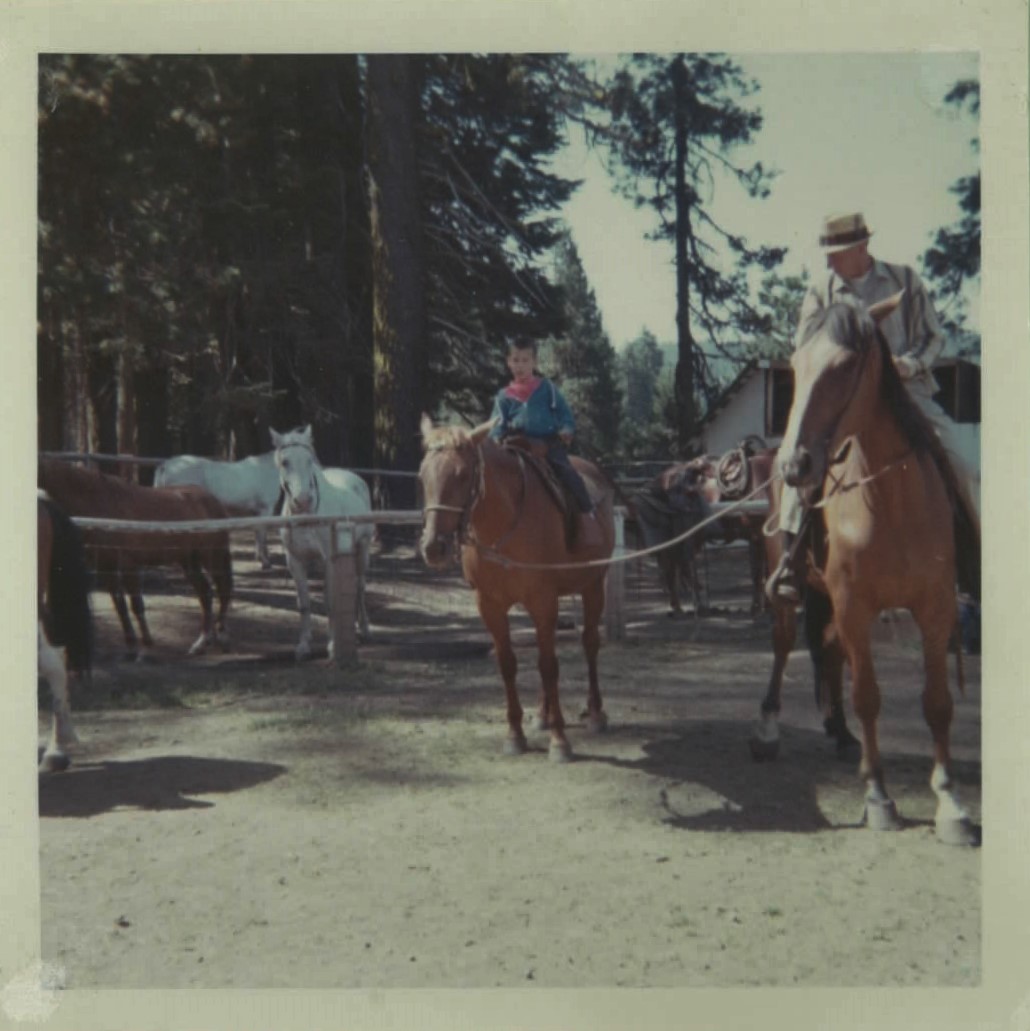
Horseback riding with my grandfather
Child’s Meadow Resort, July 1969

 Somewhere Near There