Snow Day

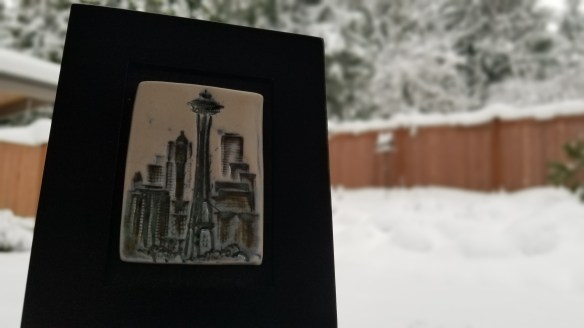
As acclimated as we Northwesterners are to rain, snow is a different matter entirely. The rain may fall on the just and unjust alike, but it appears to have no lasting or transformative effect on their character. Snow, on the other hand, is the great equalizer. The just and the unjust, the sacred and the profane, all are afforded at least the outward guise of innocence under new-fallen snow. Unfortunately, this lovely initial veneer often quickly turns into substantial civic inconvenience and even danger — Seattle and surrounds are simply not built to function in snow. This reality often goads the rest of the nation into making light of Seattle’s ostensibly excessive preparations when a snowstorm of any magnitude is projected as it is for today and into tomorrow.

I believe we live in an era in which we all tend to take ourselves a bit too seriously, so on many levels I genuinely appreciate the national attention ridiculing our preventative measures for a storm only expected to drop 4-6” of new snow. While there’s no question that other areas regularly get hit with much more severe weather and higher snowfall in particular, there is actually a bedrock of validity beneath our otherwise overhyped preparation. The biggest contributing cause to all the clamor and tumult is that this doesn’t happen too often here. Seattle averages only about three snow days a year (with an average accumulation of about 5 inches), so this naturally engenders a few consequences. First, it simply isn’t economically feasible for any local municipality to maintain a fleet of snowplows and sand trucks (salting isn’t allowed here for environmental reasons) capable of dealing with any sort of major storm. If they did, the populace would complain – and rightly so — about the cost of supporting something used so infrequently. Topography also makes large-scale plowing impractical. Seattle is nestled among both hills and waterways, but the same widely-varying terrain that restricts and inhibits the building of roads and bridges also make it difficult to clear existing roads under any kind of icy conditions.

If you take the fifty cities in the US with the largest populations, and re-rank them by the difference in elevation between their highest and lowest locations, Seattle ranks 15th with a net 520 feet between its highest and lowest point (sea level, in our case). Five cities ranked above Seattle are coastal California cities, and with the possible exception of Cincinnati (13th), I don’t associate any higher-ranked city with significant annual snowfall in its metropolitan area. For some comparisons, New York is 20th, Boston is 27th, Detroit is 43rd and Chicago is 44th. Not looking to pick any fights, but it seems like our loudest critics are denizens of relatively flat environs, and I guarantee that an icy ride down one of Seattle’s steeper hills (some with up to an 18% grade) under snowy conditions would make the most weather-hardened midwestern driver cringe.

Our latitude also seems to enable fallen snow to hang around for a while, with patches lingering in the shadows and on the northern edges of buildings and long-parked cars. I find that people tend to forget just how far north Seattle actually is. Sitting at 47° 36′ north, Seattle is generally considered the northernmost major city in the contiguous 48 states, and the low and sparse winter sunlight is often insufficient to aid in melting. For all its heavy winter reputation, the northernmost point in all of Maine is 47° 28′ north, whereas Washington state continues still further north to join the borders of Idaho, Montana, North Dakota and Minnesota along the 49th parallel. To be fair, the Northwest Angle in Lake of the Woods County, Minnesota, lays claim to the northernmost point of the contiguous 48 states at 49° 15′.

There are a few additional circumstances that could possibly increase the impact of the present impending blizzard, which is now being called “a once every decade or two occurrence.” While the overall amount of snow forecast is moderate, it is predicted to fall fast and hard in a relatively short period (~24 hours). It’s also the second storm this week. Four days ago we received 6-8 inches on our property (roughly 20 miles north of downtown Seattle), while slightly less fell in the city proper. With high temperatures hovering near freezing all week, much of this snow remains. This means surface temperatures are still near freezing, and any new snow will stick and begin to accumulate almost immediately. This storm is expected to hit in the middle of the peak Friday commute. Anyone familiar with Seattle already knows our traffic woes, and this won’t help. Complicating things further is that this week marks the opening of the new Highway 99 Tunnel, which just replaced the aging, above-ground roadway structure known as the Alaska Way Viaduct. This is one of only two north/south freeway passages through the city, and traffic at this location is already slower as drivers adjust to the new route.

One of the phenomena that invariably attends any regional forecast of snow is our local news media seeming to overreact with nonstop weather alerts and tense, highly-animated forecast coverage. This appearance of hyperbole feeds the national skepticism and draws out local cynics as well, who lampoon these broadcasts and the situation at large with intentionally embellished expressions like “snowmageddon” and “snowpocalypse”. Because the reality is that neighborhood-level non-arterial streets aren’t likely to be cleared, there is the very real risk that emergency service vehicles will not be able to reach most residences should something happen. This, combined with the general population just not being used to dealing with snow on a recurring basis, to my mind warrants some degree of repetition and perhaps even a hint of bombast as the repercussions of underpreparing could potentially be severe. For this storm, however, social media appears to have played a significant role in upping the ante even further. With the intensifying aspects layered on the already breathless media reporting, locals appear to have made a run on nearby stores for both groceries and items like firewood, snow shovels and de-icing chemicals. As a result, many stores were caught off guard and ran out of such staples. Photos of bare, ransacked shelves and long checkout lines began to permeate Twitter and Facebook, which prompted yet another layer of intense local news coverage, which drove more people to stores in search of basic supplies, which drove more social media posts (with new cynics and reactionaries piling on), and so on in a self-perpetuating frenzy. It never seemed to quite reach the panic stage, but there was clearly an element of urgency.

For myself, I love to cook on snowy days and had planned on stopping by a store this morning to pick up a few things. My experience with the lingering ice after a northwest snow also indicated I might not be able to do my normal Sunday shopping. The copious images of shortage led me to believe I wouldn’t be able to get the things I needed, and so I ventured out last night and perhaps contributed to the problem. Many shelves were in fact empty and lines were certainly longer than usual, but I was largely able to find what I wanted. It may fall as expected, or it may all be a bust. Either way, we took basic precautions in case we are snowed in and/or lose power. Our cars are gassed up and we have spare batteries for flashlights. We have shelter and sustenance for ourselves and our animals. Looking outside, the first flakes have now begun to fall. One of nature’s most intimate and perfect moments is the instant rain turns to snow. The sky moves in, low and heavy, and the temperature drop is palpable. We witness the extemporaneous transformation of water into ice, and the noisy splatter of rain is replaced with the hush of these small crystalline miracles alighting without sound. When merely wet, the visual horizon retains all its details, savory and otherwise, but all is rendered pristine under the benediction of fresh snow. For now, we watch in warmth and anticipation.

20190212_083457


Father’s Day, Redux

I wrote the original Father’s Day blog entry back in 2011 to celebrate what would have been my father’s 81st birthday. It was a soft, adulatory piece that overlooked many of the rougher edges of family life with this man, but while it is the harshest truths that bring the most perspective, there is limited virtue in total disclosure. The seed and focus of the piece was not that he was a flawless or even sympathetic character, but more my growing awareness of habits and behaviors I mockingly attributed to him that I myself was beginning to manifest, and the more subtle ways in which my own contemporary actions appeared to be at least in part the result of his presence in my early life.

On this, my twentieth Father’s Day holiday since his death, this burgeoning awareness still continues. My father was a glazier by trade, and in addition to working for several Sacramento-area firms (Basco, Combustion Engineering, and Western Shower Door are the ones I remember) he also owned his own business. As children, we often spent time in his shop on weekends, though in retrospect I think this was to get us out of my mother’s hair. We would “work” at tasks like sorting screws (separating the various fasteners used in assembling shower door frames from a large pile that had become inexplicably combined) and sweeping the shop floor. In addition to being paid some actual money, there was compensation by way of forklift rides and lunch at McDonalds.

In addition to household chores, these were unknowingly my first lessons in business: being paid an hourly rate for a specific job with a specific definition of completion and success. Both my parents were believers in the nobility of hard work and self-esteem through accomplishment, and my father’s approach to parenting was one of hands-on demonstration accompanied by clichés: “Measure twice, cut once”, “A job worth doing is a job worth doing well”, “Every job has three parts – the preparation, the doing and the clean-up”, etc. To my adult ears these still sound hopelessly simplistic and trite, but words were not my father’s forte. I think he used them to simply fill the air around his hands showing us what needed doing and how it was to be done, whether he was teaching us chess or racquetball or how to line up a bevel cut on the chop saw.

What I am only now beginning to realize is that there were also larger lessons in play. My siblings and I continued to work in his shop on and off for years, including full-time during a few summers all the way into our college years. This was actual work, and not only introduced us to the broader economic reality of taxes and withholding, but also gave us a front-row seat from which to observe the dedication and sacrifice required to run a successful business. My father was the owner, but he was also the primary sales person, did all the invoicing and accounting, and still did much of the actual installation work. I can still see him sitting at his messy office desk, poring over the details of inventory and payroll.

We also got to see the toll this job took on his body. Moving both the materials required to construct mirrors and shower doors into and around the shop as well as lifting the finished products onto and off of his truck rack was seriously physically demanding. Even with employees who eventually took over most of the lifting duties, he developed back issues and severe bursitis in both elbows, which required ongoing cortisone injections to manage the pain and inflammation. His own vices, chief among them drinking, smoking and a penchant for large quantities of red meat, cannot have helped his condition. Although he stopped both drinking and smoking in his later years and remained very physically active, the corrosive course of heart disease that would later claim his life was established early in his working years.

After nearly 30 years of working for other companies, I am approaching the midway point in my first year as a business owner. While I am fortunate both to be in a services industry that doesn’t require inventory (let alone inventory that requires forklifts or other heavy lifting) and I have a business partner that shares responsibility for day-to-day operations, I now sit at my own messy desk and tussle with questions of sales, revenue, margin, staffing, payroll, taxes, insurance, and a thousand other details. I have a new and profound respect for this aspect of my father’s life, and am once again surprised by the ever-evolving parallels to my own.

I don’t know if my father was actually the best businessman or not. I was only really just getting to know him as an adult when he passed away. He died at a relatively young age of sixty-seven, barely fifteen years older than I find myself now. By comparison, his identical twin brother is alive and nearing ninety. What I do know is that he worked hard, provided jobs for other people, and kept his business going for several decades. Whether this atones for any other shortcomings is not for me to say. Another fatherly aphorism comes to mind: ”There are only two kinds of jobs – shower before and shower after”.  I’ve done my share of both, and like to think I’ve done each with the same thoughtfulness and integrity. I can confidently say that this approach did not come wholly from the tutelage of my father (my mother was clearly a strong role model as well in this regard), but there is no question that he was a major influence. For this reason I hold him among the better coaches and mentors I’ve had, and on this holiday above most his absence is keenly felt.

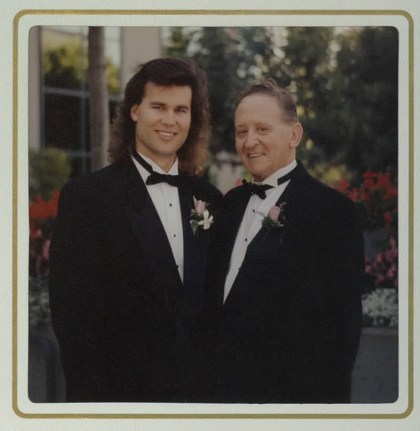
FD2My father and I at my wedding in September 1993. This would
turn out to be the last picture taken of just the two of us.


Catching Daylight

In the summer of 1977, I had only one goal: to be cool. As a young man a few months away from his thirteenth birthday, there were of course many aspirational definitions of cool. One was the fashion kind of cool, embracing the sartorial trends of the day in hopes of drawing the attention of the girls at school. This helps explain my predilection at that age for overly long hair, overly short cutoff jeans, and overly high white athletic socks. Shoes were another matter. Being one of four kids and living on acreage on the outskirts of a small town, our budget for shoes was both meager and divided, and our parents tended to steer us towards mostly functional footwear.

“Town” was the small farming community of Elk Grove, a mostly rural former stagecoach stop south of the California state capital of Sacramento. After several years in Sacramento proper, my parents had decided to move to this quiet little township that boasted fewer than 3800 residents in the 1970 census, and after about two years decided to move again about six miles out to the east end of Sheldon Road in the open country that surrounded the small civic center.

But even small country schools have social trends, economic strata, ruthless peer pressure, and children struggling to find a way to just fit in; to belong. I did well academically, but this was no basis for cool if you didn’t have wardrobe to back it up. When the hip shoes became brown suede oxfords with wavy plastic bottoms, I was still sporting the plain black Keds I’d worn for (what seemed like) an eternity. When I finally convinced my parents that my standing in school and my future success depended on me getting the right shoes, they eventually relented. I remember the day I showed up to school proudly displaying my new oxfords — made by Kinney, with the “GASS” logo (an acronym of Kinney’s “Great American Shoe Store” tagline) molded into the bottom, only to find that the cools kids were now wearing blue athletic shoes with a white swoosh on the side. It appeared that the combination of our financial circumstances and the need to have shoes that could stand up to heavy outdoor chores would dictate that I would always be at least one fad behind, and that this kind of cool would be difficult to achieve.

As pressing as my footwear needs were, the latter part of the seventies was also marked by the disintegration of my parent’s marriage. In just a few short years, they had shifted from building their dream home in the country to becoming precariously estranged. This particular summer marked nearly a year since my father had moved out in what they called a “trial separation”. I look at their struggles now with adult sensibilities, but at the time I had no experience or even the vocabulary to process what they were going through, and consequently I mostly found ways to ignore or escape their foundering reality.

Fortunately, life in the country offered ample avenues of escape. Our house was situated in the middle of a rectangular parcel of land that ran north/south off of Sheldon. The property was approximately three acres in square footage, though technically an acre is (perhaps archaically) defined as a rectangular area measuring one chain (sixty-six feet) by one furlong (six hundred and sixty feet), while our land was nearly nine hundred feet long by about a hundred and fifty feet wide. The southern or “back” third of the property – the rough equivalent of a single acre — was fenced off for livestock, as was the northern or “front” third aside from the driveway, which left the middle third open for the house and yard. After dodging the cattle and/or sheep we regularly kept on the back acre, you could also hop the very back fence into another large field that adjoined our property. The field was large enough that my father and uncle often took us skeet shooting there, and it was also home to a wide array of rodents and snakes. I remember bringing home two large gopher snakes I had tracked and killed in this field, only to discover that my father was actually deathly afraid of snakes.

This field also contained a huge oak tree just a few yards from our fence. I spent countless days and hours in this tree, climbing up to branches thinner than my wrist, gyrating on the tire swing we rigged to a large overhanging branch, and just hanging out in the nook of the trunk where the major limbs converged and contemplating my juvenile universe while trying to avoid the ubiquitous red ants. Further south and over yet another fence was a set of railroad tracks. Many pennies met their untimely and compressed end on these tracks, accompanied by intense (and largely fact-free) debate as to whether a penny could actually derail a full-size locomotive. A short walk southeast along the rails led to a large warehouse paralleling the tracks that housed the local feed and tack shop – Sheldon Feed and Supply. At any given time we had some combination of a few Polled Hereford cattle, Suffolk sheep, pigs, chickens, rabbits, ducks, and geese to go along the with the family dog and various cats, and “going to the feed store” was a routine occurrence. Here was where we bought nearly everything to keep our growing ranch running – bales of hay and huge bags of pelletized food for the larger animals, bales of straw for bedding, the grainy chicken feed (and ground oyster shells to make their egg shells stronger), food troughs and water bubblers for our menagerie of smaller animals, steel fence posts, wire fencing (both the large-meshed “hog wire” and the smaller, honeycombed “chicken wire”), rope, tarps, and all manner of tools. The best part of the feed store was the Coke machine, a true chest-type dispenser with refrigerated Coca-Cola in glass bottles. After putting in a quarter, you lifted the lid, grabbed the top of an available bottle by the tips of your fingers and guided it along the metal rails to the corner mechanical flaps where you pulled it up and out. A quick flick under the bottle opener and you could sit in the shade on the loading dock and watch the business of farm commerce unfold with bored adolescent indifference.

If I tired of the fields, trees and tracks to the south, I could traipse around the neighbor’s property to the east of us through the thick groves of foxtails to a rainwater-fed lowland we called The Swamp. In retrospect it was probably highly unsanitary if not outright unsafe to swim there, but it offered a refreshingly muddy way to cool off from the California Central Valley heat in the absence of a swimming pool. There was also a wide variety of bugs, birds, turtles and crayfish (which we called “mudbugs”) to harass with rocks and sticks in the way that young men seem compelled to do. On a dare I once crawled through a culvert from The Swamp to another fetid, brackish pond that lay on the opposite side of Sheldon, which bent south at Excelsior Road on its way to meet Grant Line Road towards the Sheldon Feed and Supply.

The property to the west of us was owned by a family named Torgerson, who primarily used it to graze horses and raise alfalfa hay for sale. At harvest, the pungent and slightly earthy scent of the freshly-cut alfalfa would drift over our property for days as it lay drying before being baled. Fenced, flat and featureless, it offered no real opportunities for adventure other than occasionally feeding the horses across the fence. During my parent’s separation my mother went back to college at night to earn an updated teaching credential, and the older Torgerson girls would watch us on the evenings she attended classes.

Nearly three hundred feet of gravel driveway connected our house to Sheldon Road, which provided a first-rate bicycle racetrack. At twelve, I was just beginning to be allowed to ride my bike to school and around the spread-out neighborhood. As an added thrill, our eastern neighbor’s aggressive Australian Shepard would leap from his perch on their steps and chase us down the driveway, barking until he lost interest in us amidst the dust our bikes kicked up or was called to heel by his owner — an older gentleman named Frank Butler. Frank and his wife (the dog’s name was Prince, but the wife’s name now escapes me completely) lived on a tract nearly identical in size and shape to ours, except that their house was situated north on the parcel, just off the road, and the remaining acreage was divided into various pens and training paddocks for the stately Arabian horses they raised. Many ranches in the Elk Grove area bred and raised horses, mostly Appaloosas, Pintos, Quarter Horses, Morgans, and Palominos. The electrified fence that surrounded most of the Butler’s pens provided additional fodder for youthful dares.

The first six trees lining the driveway were older almond trees that were on the property when we moved there. Their brilliant white blossoms in spring were beautiful, but their relatively short height, fragile branches, and rough, scaly bark made them less than ideal for climbing. In our first few years there my parents planted nearly thirty more trees along the driveway, both to provide shade for the driveway and to prevent soil runoff from the natural drainage ditch that bisected the front acre.

The copious outdoor recreation aside, the house itself also offered ways to isolate myself from the marital turmoil that seemed to pervade our lives. This was the first house in which I had my own room, and I could close off the world by shutting the door to the hallway and sliding shut the vinyl divider to the space occupied by my older brother’s room. My walls were adorned with science fiction movie posters and pop culture pinups, and various model airplanes I had painstakingly constructed hung from the ceiling. An added feature was the Nutone intercom system my parents had opted to have installed. In our main living room was a wall-mounted console that contained an AM radio, a set of switches that corresponded to each room in the house, and a record player that actually folded up into a cavity in the wall. You could use the intercom to converse with any or all the rooms, and you could also broadcast the radio or record player to any selected rooms. I soon discovered that I could load the record player with up to ten of my favorite albums (each album would drop down the spindle into position to be played as soon as the preceding album had finished), set the intercom for just my room, and raise the volume to the point where my parents and siblings would complain. AM and FM radio at that time wasn’t as differentiated as it is today, and nearly every station offered a wide variety of programming. I could hear John Denver, Crystal Gayle and even Sammy Davis Jr. on the same station as Peter Frampton, the Steve Miller Band and the Eagles. I filled my room and my ears with these artists along with Kiss, Boston, Ted Nugent, Led Zeppelin and Aerosmith – a far cry from my mother’s preference for the Kingston Trio, Andy Williams and Herb Alpert. In the days when our television had to be manually adjusted between the seven channels we actually received (with an additional manual adjustment of the antenna for better reception), this was pure magic.

In addition to working on models, most of my time in my room was spent reading. I was a voracious reader, and devoured everything from borrowed library books on lasers and spaceflight to monthly selections from the Science Fiction Book Club (all of which I still own) to various magazines. Even as a pre-teen I subscribed to multiple periodicals, including Starlog (a fledgling sci-fi publication started in 1976), National Geographic (which in addition to its educational value offered titillating images of topless native women) and Boy’s Life (the official magazine of the Boy Scouts of America). But the mag that occupied most of my attention was Skateboarder. Driven by a surfer ethos that combined the laid-back Southern California beach lifestyle with a healthy dose of punk rebellion, skateboarding as a sport was just beginning to take off. Skateboarder offered page after page of long-haired SoCal rebels cranking their way through public parks, viaducts, and emptied-out backyard pools with their ever-expanding repertoire of gravity-defying tricks playing out on any available patch of concrete. For me, the beaches of Malibu or the urban Los Angeles skate scene might as well have been on a different planet, but I was fascinated nonetheless. Day after day I would lay on my bed listening to the music coming through the small, tinny intercom speaker in my room and reading about the exploits of Tony Alva, Doug “Pineapple” Saladino, Stacy Peralta, Shogo Kubo, Tom Inouye, Micki Alba and others, and imagining myself pumping up the vertical walls of a pool and “catching air” – actually jetting up and out of a pool clutching the edge of my board and then reentering in a smooth graceful arc.

I was reasonably good at many sports, but not overly athletic. At this age baseball was my clear sport of choice, though the filled-out body that would eventually bring me some high-school conference-level success in both baseball and wrestling was still a few years away. In 1977 my physique remained trapped in a kind of lanky, coltish awkwardness, but it seemed to mirror the skaters I saw in the magazines – these weren’t musclebound jocks, these were skinny punks. In this comparison I found both inspiration and a potential path to cool: I would become a skateboarder.

The first and most immediate barrier was that even with some limited exposure to the sport, I really didn’t know how to ride a skateboard. Despite growing up near the Sacramento River Delta and only about two and half hours from Lake Tahoe, I had never skied on water or snow, let alone surfed, which according to my magazine research was the natural transition sport to skateboarding. Undaunted, I decided that my roller skating experience would be sufficient. The nearby town of Franklin (a scant seven miles southwest of Elk Grove) had a roller rink – King’s Skate Country – which had been a staple of school field trips and birthday parties for years. A session at the rink consisted of various kinds of skating activities called out by a disc jockey that played the accompanying music – separate skate sessions for boys and for girls, rounds just for couples, rounds only for skating backwards, reverse skate (moving around the rink clockwise instead of the usual counterclockwise), games like Red Light / Green Light (in which you made your way on skates laterally across the rink, moving only when the DJ said Green Light! and freezing when they said Red Light! – any kind of movement on Red Light got you eliminated) and Limbo tournaments where you had to duck and skate under an adjustable bar that got set progressively lower.

Even here the hierarchies of proficiency presented themselves – beginner couples moved around the rink simply holding hands. The more experienced couples would skate with one arm around the waist of their partner and the others clasped together in front of them. This required their legs to move in unison, lest their skate wheels collide and send them tumbling onto the hard, urethane-coated wood rink floor. The most advanced couples were those that could skate facing each other like ballroom dance partners, with one partner moving with his or her back towards the direction of travel. This required moving in tandem with the added difficulty of one partner skating backwards. The top of the skating social pyramid, however, were the roller hockey players. In addition to their superb skating skills, honed through years of playing competitive hockey on roller skates, they also had cool-looking team jackets that proclaimed them members of a fairly exclusive brotherhood. Yet another avenue of hip where I was unable to trespass, let alone belong. In addition to not playing hockey, I never mastered skating backwards and never lasted many rounds in Limbo. But what I could do is to go around the rink at relatively high speed – “Speed Skate” was always my favorite round. Accordingly, I figured that my familiarity with moving along on wheels and using my body to control turns could be parlayed into the skills necessary for skateboarding.

I wasn’t totally unfamiliar with skateboards themselves, either. When we lived “in town”, among the four children we owned two secondhand skateboards, and had brought them to the country with us. One was a small plywood board on which you could barely place both feet, with small aluminum wheels containing steel ball bearings that allowed the wheels to turn – very similar to our lace-up “outdoor” roller skates. The other was a slightly longer fiberglass board that had a little more room and a little bit of flex you could feel when you stood on it. It, too, had essentially metal roller skate wheels, which was the principal limitation of this type of construction. Being small and hard, these wheels tended to trap any small bit of debris the rider encountered against the ground rather than rolling over it. If the debris was hard, like a small bit of wood or stone, this would stop the forward turning of the wheel. The same was true of our skates, but if one wheel of one skate stopped, you had the potential of quickly moving the other foot forward and catching your balance. This was not true of these skateboards – any wheel skid would send the unlucky rider sprawling forward with essentially no warning. Having led to a few bloodied knees, these boards were only used sparingly and were why – despite my skating experience – I hadn’t yet developed any real feel for skateboarding.

The next obstacle was that, unlike the streets and sidewalks of our more urban setting, the house in the country offered very little in the way of places to skate. The only relatively flat, paved surface of any size nearby was at our local elementary school, about a two-mile bike ride away. Even though the distance was manageable, most surfaces at the school were coarse asphalt that was nearly impossible to ride, especially as a relative beginner. On the east side of our house, immediately outside the garage, sat a twelve foot by twenty foot pad made of poured concrete. I think my parents put it there with the intent of using it for parking, but they always parked their cars on the gravel in front of our house or the continuation of the gravel driveway than ran past the parking pad to the edge of our back yard. In our years there, the pad had been used mostly for holding the contents of our garage when it needed sweeping or hosing out, but also occasionally for play – bouncing tennis balls against the garage door, serving as the court for a basketball hoop mounted on a post at the southern end, and even providing a small skating rink. This, then, would be my skateboard training ground.

I had pretty much learned to stay balanced and upright on the board when the wheels would actually turn, but this was nearly as problematic on the parking pad as it was on the school’s asphalt. Even when I swept it clean from the dirt and gravel that would inevitably find its way from the driveway, there was still the problem of the wooden dividers that sectioned the pad and served as stress-relief joints in the concrete. While they produced a moderate and tolerable thump-thump under our roller skates, they tended to catch the skateboard wheels and send me stumbling. Worn-out jeans and skinned knees were more a part of everyday life in the country, but it quickly became clear that if a change of venue couldn’t be found, then a change of equipment was in order.

With money earned from my weekly allowance (based on the successful completion of the many chores needed to keep an agrarian household functioning) and my summer job of working in a neighbor’s orchard, I bought a new skateboard at a local garage sale. It was about the same size as the fiberglass one we already owned, but was made of molded plastic and had slightly larger urethane wheels, which were more forgiving on uneven surfaces. This allowed me to actually begin to skate in small ovals on the pad, with two or three quick push-offs with my foot along the length of the pad to prepare for the tight turn at either end. I quickly moved from doing simple loops around the pad to adding in a few tricks and maneuvers gleaned from Skateboarder. I started with simple slalom turns, using my hips to turn the board left and right in small repeated chicanes that combined to form an elongated, serpentine motion. Where the pro riders in the magazines did seemingly insane slalom courses down steep streets, weaving in and out of a line of obstacles – usually orange traffic cones – in timed competitions, I was content to string together one or two turns around bits of scrap lumber or the previously unwelcome small stones I had set spaced out in a single-file line.

I then graduated to kick turns, shifting my back foot and my weight to the very trailing edge of the board (the tail) to raise the forward wheels off the ground and turn the front, or nose, of the board in alternating directions. From here there was a natural evolution to three-sixties – keeping the nose of the board in the air and seeing how many times I could spin around in a complete circle. The learning curve here was a bit steeper, and practicing three-sixties often sent the board skittering away while I fell backwards. The seats of my shorts were now seeing more wear than my knees, but I took this as a sign of my maturing skills.

As invested as I was in learning these basic moves and tricks – collectively called freestyling in the skater lingo – I was beginning to get a bit bored with it all occurring on the flatness of the pad. I longed for the opportunity to leave the horizontal world – skating down into a pool and actually achieving enough speed to scale the vertical deep-end wall and catch some air or run the axles of my board along the coping in a move called a grinder. Grinders could be either frontside or backside, depending on whether the front or back of your body faced the wall of the pool during the move. Skateboarding at the time was generally uncharted territory, and skaters made up tricks and the associated nomenclature as they went along. Terms like Ollies, inverts and handplants peppered the Skateboarder articles. The axle housings themselves became known as trucks, ostensibly after railroad cars. The trucks on a railroad car consist of an assembly of wheels, axles, bearings, and suspension, which pivots flexibly underneath the deck and chassis of a railroad car. The layout on a skateboard is conceptually nearly identical, though none of my skateboards to date had any form of suspension. All these tricks and the tantalizing possibilities of the vertical world seemed out of reach until once again Skateboarder provided inspiration: To extend my skills and move beyond the flat confines of the pad, I needed to build a ramp.

As often occurs in rural environments, you make do with what you have. My father’s other faults aside, he was both industrious and resourceful. For a businessman (a glazier by trade), he proved himself quite adept at building fences and chicken coops and rabbit hutches and pen shelters to keep our animals out of the sun and rain. I never learned what inspired him and my mother to move to the country (both are now gone, so the question fades unanswered), but perhaps this was part of the draw for him – to work with his hands on his own land. Whatever the motivation, he was prone to keeping building materials around, and with his departure I felt free to use these resources for my own purposes. Around the back of the house I found a four by eight foot sheet of plywood in relatively good condition that would form the basis of my new endeavor.

My first attempt was to align the short edge of the plywood with the center of the driveway-side edge of the parking pad, raise the board up about thirty degrees to the ground, and block the higher end up with other scrap lumber. This met the technical definition of a ramp, but there were two key flaws. First, the angle at which the plywood met the concrete was too severe, and threw me headlong onto the ramp on my first attempt. After picking splinters out of my palms and making a second run in which I elevated the nose slightly as I hit the ramp, I discovered that the plywood flexed too much under my weight. This caused any momentum I had to evaporate, and I never made it more than a few feet up the ramp. I played with digging the edge a little further down and adding support to the middle of the ramp, but could make no further progress. After further study of photos of makeshift backyard ramps in Skateboarder, it occurred to me that what I needed was some curvature in the ramp. This would put the “takeoff” edge of the ramp closer to level with the parking pad for a more continuous transition, and would more closely approximate the curved bottom edge of a concrete pool.

Plywood by its very nature doesn’t want to bend, so I had to resort to a bit of ingenuity combined with brute force. After several unsuccessful approaches to getting the plywood to bend and hold its new shape, I ultimately succeeded by soaking the plywood with a garden hose to make it more pliable, loading the heaviest thing I could find (in this case, our garden rototiller combined with several large logs from our woodpile) onto the middle of the ramp to induce a curve, and then nailing the bent plywood to a post anchored in the gravel below the ramp. While not a thing of particular grace or beauty, and without enough length or bend to achieve a true vertical surface, it nonetheless appeared to be a bona-fide skateboard ramp on par with some of the photographs I had seen, and I set about conquering it.

Mastery proved elusive, replaced instead with a slow, tedious process of increasing frustration and pain. No matter how much speed I could get up, I could never seem to get more than halfway up the ramp before my inertia would fail and I would have to do a rapid hundred and eighty degree kick-turn and descend. Falls were frequent, and I had taken to wearing pads for my elbows and knees. The pros in the magazines didn’t seem to bother with helmets, so nether did I, and it was probably a small caliber miracle that I didn’t break any bones or sustain any major head trauma.

Day after day I plied the ramp with no apparent improvement, until one afternoon I spied a kid walking slowly down our driveway with something under his arm. When he got closer I realized two things: I had no idea who this was, and the thing he was carrying was a skateboard. Not just any board, but something right out of the magazines. It was nearly a foot longer than mine, and made from some kind of dark, polished wood. I recognized the Independent brand of trucks from ads in Skateboarder, and they sported big, red urethane wheels that were easily twice the diameter of mine.

He was taller than me and clearly older, and was wearing shorts that appeared to have been made as shorts rather than having been converted to shorts by shearing off the legs of a pair of jeans. Above the shorts was a Left Bank velour shirt, the kind most of my contemporaries would only wear for school picture day. In the v-shaped neck opening was a strand of puka shells. He introduced himself as Kevin, Frank Butler’s grandson. He had been sent to stay with his grandparents for a few weeks (“in the country”, he said almost derisively). He had seen me and my ramp, and was wondering if he could give it a shot. My first reaction was to reflect on the strangeness of him having brought his skateboard from wherever he lived to a place that had very little odds of having suitable surfaces, but I didn’t say anything. On the one hand, he smelled of city and of money, but on the other I was dying to see how that skateboard performed, and I told him to go ahead. He strolled casually to the far end of the pad, then did a few quick pumps and shot up the ramp. On his first run the nose of his board cleared the far end of the ramp during his kick turn. On the second run he actually caught air, grabbing the side of his board with his hand to guide it around for the landing. He came down smiling, rode back to the far edge of the pad, dismounted and gave me a quick chin-up nod, indicating that it was my turn.

I was somewhere between mesmerized and stupefied. I had never actually seen anybody catch air in real life, let alone right outside my garage. His mechanics also threw me. I rode with my right foot on the tail and my left foot forward – facing to the right of the direction I was moving. He rode with his right foot forward. While I approached the ramp from the left side, then kick-turned clockwise to descend on the right side, he did the complete opposite. In baseball, left-handed pitchers used to be a bit of a novelty and became known as southpaws – the same with left-hand dominant boxers. In skateboarding, right foot forward riders were also somewhat unusual and were called goofy-footers. Goofy-foot also applied to right foot forward surfers, but there is some controversy about whether it originated from a 1930’s Walt Disney film in which the animated dog character Goofy surfed with his right foot forward, or if it just derived from the older and quintessentially American expression goofy, meaning ridiculous, silly, nutty, etc. Etymology and equipment envy aside, one thing was clear — Kevin wasn’t goofy, he was cool.

Rattled, I lined up and made my run. I made the same feeble ascent up half the ramp that I had made hundreds of times, punctuated by the loud thunk of my front wheels returning to the ramp as opposed to his smoothly rolling reentry. I skated sheepishly back to the far side of the pad and awaited his critique. Rather than commenting, he just made another run. Following another beautiful liftoff – I could see all the way to Sheldon road between the end of the ramp and the edge of his board – he made another perfect landing. We spent another few hours trading runs and not talking, until his grandfather called down the driveway — in tones just a few degrees more pleasant than when he called his dog — that it was time for dinner.

Kevin came shuffling down the driveway the next afternoon as well, and we took up the alternating run rhythm where we had left off the previous day. After one of my more dismal attempts, Kevin made an unpleasant face. I thought he was going to say something snarky or derisive, but instead he asked if he could try a run with my board. I happily obliged. He put one foot on the board, then eyed the ramp and shoved off. Instead of his usual gravity-defying ascent, he managed to get about a third of the way up the ramp before the board shot out from beneath him. He landed on his feet in the gravel next to the ramp in such a casual fashion that a bystander would have thought that the entire maneuver was intentional. He retrieved the board and walked back to the far side of the pad making the same unpleasant face. Still silent, he set off towards the ramp again. He made it about the same distance up, but was able to stay aboard and make a noisy, awkward turn to descend. It was the only clumsy maneuver I would ever see him make. He skated back to me, and said simply, “This board sucks…try mine”. I declined, worrying that I would somehow break it and never be able to pay for it, but he insisted. I acquiesced, and took a few warm-up laps around the pad to get used to it. The ride was nothing short of amazing. Between the large wheels and the suspension in the trucks, I never even felt the wooden dividers. But the most astonishing thing was how fast I seemed to be able to go – there was no feasible comparison with my smaller plastic board.

Once I had a bit of comfort with the way his board moved, I backed up and took a run at the ramp. To my surprise (and delight), I easily made it more than halfway up the ramp. After a relatively smooth turn I skated back to Kevin, sporting a massive grin. He smiled and gave me another quick chin-up nod in wordless acknowledgment. From that point we alternated runs, but both used his board.

Over the next few days this process repeated, and I slowly made it closer and closer to the top edge of the ramp. On the day that Kevin announced would be his last before returning to his parent’s home (I don’t think I ever caught where this was, but his limited conversation implied that it was some distance), I was determined to lift off the ramp the way he could. Despite my best effort, I couldn’t seem to get anywhere close – I was hopelessly earthbound. On my last run on his board, I finally managed to get the at least the front wheels past the edge of the ramp. As I handed his board back to him and thanked him for its use, he said, “Well, you didn’t catch any air, but you caught some serious daylight on that last one!” With that, he turned and headed back up the driveway. I would never see him again.

In the days that followed, I returned to my plastic board and a clipped-wing exploration of the lower third of the ramp. Later my high school and college physics classes would give me concepts and formulas to explain what I knew intuitively from my flailing – speed was essential. Rolling on flat ground you were mostly fighting the friction between your wheels and the ground and a negligible amount of air resistance, but once you moved up an incline like a ramp, gravity comes into more significant play. Inertia is a function of both mass and speed, so the higher the speed the higher the inertia. This is somewhat intuitively apparent, but what isn’t as obvious is the energy component. In classical physics, the kinetic energy of a body, or the energy a body possesses due to its motion, is also a product of mass and speed, but is a function of the speed squared, so a doubling in speed is a quadrupling of kinetic energy. For a certain mass, a certain kinetic energy is required to overcome both the friction and gravity, which in turn requires a certain minimum speed. With my board’s small wheels and heavy friction on the concrete and plywood, there was simply no way to get up enough speed in the limited distance of the parking pad for me to make a serious attempt at the far edge of the ramp.

It was clear that I needed another equipment upgrade, and with a newfound confidence in my skating skills I returned to my magazines for more research. Based on my fresh experience with Kevin’s rig, I now had a much more refined sense of what I was looking for. I priced out the components I wanted, and convinced my mother to make up the difference between what they cost and what I had on the promise of more chores and future earnings from my orchard labors. I further convinced her to write a check to be sent with my order form to a post office box address in Los Angeles – not something she was used to doing.

In a few short weeks my new board arrived. The board itself, or the deck, was a 27” solid oak board made by Sims, one the leading skateboard manufacturers of the time. It was a “taperkick” model, which meant the tail had a built-up section of wood to give additional leverage on turns and maneuvers that required the nose to be raised. I had added the extra-wide “full” trucks from the Tracker Truck Company – rapidly becoming famous for their suspension and smooth ride. Wheels in those days ranged in diameter from about 45mm to about 75mm (one of my first exposures to the metric system), and were made in a variety of compounds for different stickiness or grip for different skating applications and styles. I wanted something in a medium diameter (large enough for overcoming the roughness of my skating environment, but not as large as those used purely in downhill skating) and with a harder compound made for a combination of speed and grip, so I had ordered a set of 60mm “Hot Juice” wheels in neon orange from the OJ (“Orange Juice”) Wheel company.

Within minutes of assembling this new instrument of diversion I was out doing laps on the pad and adjusting the suspension, and I quickly renewed my acquaintance with the upper portions of the ramp. Bolstered by this success, I kept at it into the evening hours, and almost every day for the remainder of the summer I would find time to go out and get a few runs in. Pumping and turning, further and higher. Pushing against gravity. Pushing against my parents. Pushing against the cool kids. Pushing. While I never did catch any true air, I got to the point where I could reliably get three wheels off the end of the ramp during my turn. Over time my movements became smooth and practiced, and I began to feel a hint of what the skaters in the magazines called flow – the seamless and almost meditative interaction of the rider, the board and the ramp, where the universe slows down and narrows in to just the singularity of the next move and a free and unencumbered sense of motion.

As all summers do, this one gave way to fall and school and other distractions, and my time on the ramp became sparser as the changing weather brought more domestic distress. A separation would become a nasty and contested divorce. There would be divisions of property and court-ordered visitations. In the coming precipitous fall from middle class grace the house would be sold (with the ramp still standing), and we would move away from our town, our schools, our friends, and our community. Yet in the midst of the burgeoning chaos, skateboarding had provided a welcome distraction. Practiced in solitude outside my house it never brought the social acknowledgment I hoped it would, but I was still too young to understand the folly of that kind of thinking. What skateboarding did bring was not only a welcome escape, but also intense excitement and the deep, personal satisfaction of accomplishment – another seed of self-esteem that, given time, would eventually lessen the need to find acceptance elsewhere. There were other seeds – a first leap from the high-dive platform at the community college pool where we learned to swim, a first “real” kiss outside a junior high school dance (thank you Kelly Robinson, I owe you immeasurably) – but to a large degree my ability to recognize and appreciate my own self-worth really began to take shape here, in a music-saturated bedroom and on a rectangular concrete stage. Months of dreaming, of trying and failing and trying again, the aid of a stranger I only knew for a few days, practice and more practice, all culminating in sublime moments of near perfection, catching daylight on a small town summer afternoon.
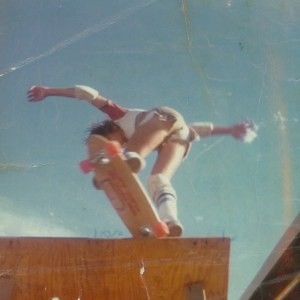
Daylight

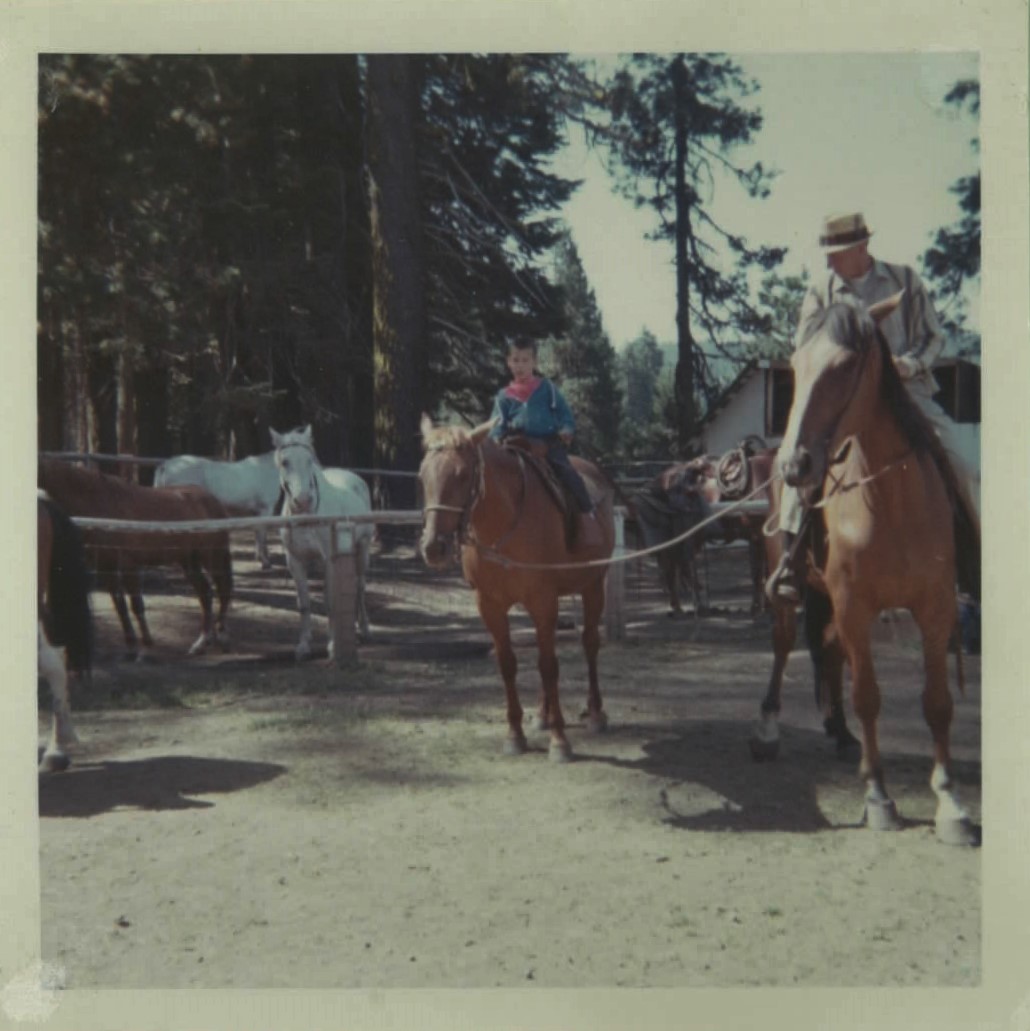
 Catching Daylight, Summer 1977


Coda: Memories are wondrous and powerful things, but as the Chinese proverb goes, “The palest ink is better than the best memory”. As my readers will attest, I feel a fierce gravitational attraction to the autobiographical narrative, and this piece was inspired by finding the photograph above while sorting through my “childhood box” during our recent move. A fleeting but tangible instant of cool, captured forever. I don’t actually remember who took the photo, but the rips and crinkles attest to the innumerous timed I have held it and simply stared at it in a sort of recollective awe.  I also found the photo below, which gives a better sense of the pad and the ramp:
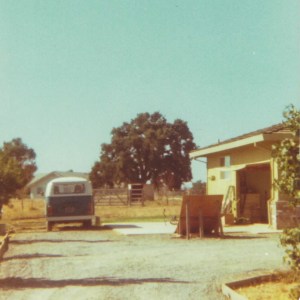
Ramp

Although the perspective is foreshortened, the large oak in the background is the one I described, and the house to the left is the first of several to be developed on the adjacent property to the south – not the first or only harbinger of change. This was taken in December 1979, just days before we piled the last of our belongings in that blue and white Volkswagen Bus and drove away for the final time.

From the views offered by the latest satellite mapping the house at 10460 Sheldon Road still exists, though there has been significant growth and development in the area. The town of Elk Grove itself has grown to a population of over a hundred and sixty thousand people, and by most reports has long lost any resemblance to the quiet town of my youth. In the outlying areas, entire subdivisions occupy what I remember as open fields. The new houses are mansions compared to the older and relatively austere farmhouses, but the overall locale appears to have retained pockets of its former rural character. Sheldon Feed and Supply still operates (they even have a Facebook page), though the last time I visited nearly 20 years ago the Coke machine had long since been removed. What looks like a large barn now sits roughly where our pigpen and chicken coop once stood. The trees along the driveway have reached heights unimaginable to a child who saw them planted and spent hours weeding and watering them. The front and back acres are still pasture, and the large oak over the south fence still stands, though now nestled in someone else’s back yard. On the east side of the house the concrete parking pad still sits in its gray patience, awaiting the dreams and imagination of yet another generation.

Another Cup

Her name is Moon (like the moon, she says in Korean-accented English, pointing to the sky). I wandered in to her coffee shop when we were in the early stages of moving to Snohomish County and it was apparent that her store would be the closest source of non-corporate coffee to our new house. Neighborhood coffee shops are one of the few experiences I cling to desperately as we complete our flight away from Seattle and King County, and her business (Hot Shots Espresso) is one of the very few in our new surrounds where one can actually walk in and sit down. Not that it’s built for the sit-down coffee enthusiast – despite having an exterior deck and ample room inside, there’s a total of one old table inside with four chairs and two stools at the Formica counter. Located a stone’s throw from the shores of Martha Lake, Hot Shots reminds me of the resort stores in the lake town where I went to high school — somewhat dilapidated, with fading signs advertising specials no longer available, supplies stacked up in the corners, and security cameras dotting the ceiling. Everything cries out for attention and updating. It is a business that appears to run on the edge, where there is only time, energy and money for fundamental upkeep but not improvement.

On my first visit it appeared that she caters to what I call the novelty coffee crowd, who favor their brew imbued with flavored syrups and crowned with various and sundry toppings. Her menu board boasts a startling variety of convoluted coffee concoctions from Snickers and Red Bull Lattes to White Chocolate Mochas and other fabricated confections that seem more at home in a bakery than a coffee shop. I don’t begrudge anyone their sweetened drinks, I just prefer my coffee less sugar-encumbered. While the board does list an “extra shot” for fifty cents, nowhere does just it just say “drip coffee” or “espresso”, so I was skeptical from the get-go.

I think of myself not so much as a coffee snob, but more as a coffee enthusiast, albeit with preferences as I grow older. I worked construction in my teenage years and developed an affinity for large quantities of convenience store coffee and survived college largely on various brands of instant, so I am certainly not above the most pedestrian of brews. In my book, even bad coffee is still, well, coffee. But having had the good fortune of moving to the Pacific Northwest during the ascendancy of the artisan coffee movement and having been able to travel much of the world and be exposed to really, really, really good coffee, over time I have developed a certain quality bar and a predilection for espresso in the afternoon. I am quite capable of creating my preferred beverage at home (via an older Jura/Capresso Impressa E8 machine with illy dark roast for those scoring at home), but there is something about the sensuous environment of coffee shops. I love the intoxicating smells and the intriguing hissing and gurgling sounds of hot beverages being prepared, not to mention the convenience of having someone else make your coffee. There is also the fact that smaller home espresso machines, no matter how high the quality, simply cannot generate the water pressure that commercial machines can, which (along with the romantic fog of memory) is the predominate reason it’s essentially impossible to reproduce that amazing espresso you had on that trip to Tuscany.

My first test of any coffee shop is always a dual barometer of their product and their knowledge. I nonchalantly order a doppio like I have been speaking Italian my whole life. If they have no idea what I’m talking about, I apologize and clarify that I would like a double espresso (doppio being nothing more than Italian for “double”). My experience is that those working retail counters are often just punching the clock at a job and are not overly concerned with the subtleties of the industry in which they are employed. Having also spent time in food service, I don’t necessarily hold their ambivalence against them.

When I ask Moon for a doppio, she has no idea what I’m talking about. Assuming a potential gap in our understanding due to language differences (while noting that her relative command of English is certainly better than my handful of Korean words), I change my order to a double espresso. She still seems a bit confused, puzzled by my seeming lack of interest in the dozens of bottles of flavored syrups and powders that line her counter. Correct, I say — no milk, no syrup, no ice, no whipped cream, no cocoa sprinkles. Still shooting me a quizzical look, she turns to her large, red La Marzocco commercial espresso machine like a conductor facing an orchestra and sets about pulling my shot. Mounted to a sturdy bench perpendicular to her counter, the machine is nearly her equal in height, and she leans forward and plays it like a seasoned pro — grinding, measuring, leveling, tamping, locking, and brewing in swift, practiced movements.

Coffee is a dance between the mystical bean itself and everything that happens to it after being picked, integral to which are the quality of the initial product and the processes of harvest, transport, roasting, grinding, and brewing — including the skill of the operator for non-automated brewing. Over the years I’ve paid extravagant sums for imported, fair-trade co-op shade-grown beans craft-roasted then hand-ground and brewed in a pour-over using specially filtered water that ultimately I thought tasted like muddy crap, and I’ve had mass-brewed truck stop coffee to die for, so there is clearly a complicated connection between all the various parameters.

It’s impossible to know which of these many facets influenced the cup that Moon set in front of me, but the net result was mostly unappealing. While the texture and consistency were good (not too thick or too watery) and it had the rich, creamy layer of crema characteristic of commercial machines, something just tasted off. Not burned or anything, but it just didn’t have the nice bitter bite of a good espresso. I found no fault with her preparation, and therefore suspect that the quality of coffee may be the culprit – using lower quality beans to keep costs down in what must already be a low-margin operation. I reflected that it probably tasted just fine when inundated with other flavors and sugary substances, so in one sense she may simply know her market.

At this point I made what in retrospect strikes me as a curious choice. Perhaps sadly, it would not be unprecedented for me to roll my eyes and exit the establishment while complaining loudly about the quality. But on this day something made me stay. My best guess is that if this was my closest non-Starbucks coffee store, at some level I felt it deserved more than one shot, literally and figuratively. It was also a gray and rainy March day, and there are certainly worse ways to spend time on such days than pausing over of a shot or two of bad coffee. Further, as part of our newness and transition to this area we were consciously looking to make new connections, and this seemed like a splendid opportunity.

As Moon singlehandedly worked both the counter and the drive-through (as I’m discovering, there must be some sort of ordinance in Snohomish County that requires coffee joints to sport drive-throughs, and Hot Shots is no exception), we began a staccato conversation. Interspersed by attending to customers, and in sometimes halting English, we took our first steps beyond the regular airy shopkeeper/customer banter.

She has owned Hot Shots for the last 15 years. She actually used to own and run two different locations, but found it exhausting to split time between them. She also had a significant problem with theft by employees when she wasn’t on the premises – caught red-handed by the cameras in plain view. So she now prefers to operate one store full-time with the help of a single trusted employee during the busier summer season.

There is a quickness and a borderline abruptness to her diction, which combined with English not being her native tongue makes parts of our conversation difficult. Perhaps confused by my insistence on sitting and savoring my coffee, and looking at my causal clothing, she asks “Not working today?” in her rapid-fire manner of speaking. It’s a reasonable question, given that her establishment clearly isn’t set up for patrons to work (no Wi-Fi and the aforementioned lack of tables), and I appear to have time to loiter. I took it as an honest inquiry, phrased as best she could, and not as any sort of observational judgement. I explained that I now work from my home and was just taking a coffee break. I tried to expound further that since I didn’t have any meetings scheduled, I was in my “non-client” wardrobe of jeans and a tee-shirt, but the language gap precluded mutual comprehension of most of the supporting details. The additional upside of this portion of our exchange is that it gave me the most insight yet on the lack of sit-down coffee shops in this area – do only non-working people here have time to sit? It’s as practical an explanation as any other so far.

This veneer of abruptness manifests as a negative in her shop’s mixed internet reviews, but my take is that a hurried dash through a drive-up window doesn’t leave much room for deeper understanding. Having spent time in countries where I had a near-zero grasp of the local language, I know it’s entirely possible have a meaningful conversation composed of nothing more than smiles and awkward pantomime, but this takes time, patience, and willingness by both parties to try. I once spent over an hour in a small tea shop at the Lo Wu train station on Hong Kong’s northern border with a proprietor who spoke absolutely no English, and we had a magnificent time finding ways to communicate while tasting various teas. I also know it’s possible – easy, actually — to come off as unintentionally rude when trying to communicate in a language that is not yet your own. I have both compassion and deep respect for anyone that has come to this country and made sufficient linguistic inroads to run an entrepreneurial business.

After a little more back and forth, it becomes clear that I’ve actually caught her on a bad day. The son of a good friend of hers had been taken to a nearby hospital that morning after suffering a heart attack. He was only twenty-six years old, and was not expected to recover. Her own mother passed away just two months ago, and the feeling of loss is magnified with this latest news. I learn that she has a daughter, but her subsequent mention that with her mother’s passing all her remaining family lives in South Korea makes a curious omission of any current or former husband. Having lost my mother a few short years ago, we quickly find ourselves on common ground. But just as quickly the customer traffic picks up and she breaks off, wistful and preoccupied. Before leaving I surprise her by thanking her in Korean, which prompts at least a sliver of a smile.

In a previous career I had the opportunity to travel extensively, with an emphasis on the Asia-Pacific rim countries. These trips were always a combination of business and social, as my hosts were always eager to share of their country and culture. Over several trips to Seoul, I was repeatedly shown an important aspect of Korean culture — the preeminence of harmony and order. This is more than just everybody looking to get along with everybody else, it also surfaces in not trying to stand out or be highly individualized. I had one colleague illustrate this by pointing out the highway running near the office building in which we were meeting. He had me notice that there wasn’t a great variety of types of vehicles on the road, and nearly all were very utilitarian and painted some tone of blue, silver or beige. No flashy red or bright yellow sports cars. This concept applies to everything from art to architecture, and is most intimately expressed in the importance of family and community. They regard family as the basic social unit, and consider harmony at home the first step toward harmony in the community and ultimately in the nation as a whole.

I cannot imagine coming from a culture with such an emphasis on the connected family, and then being essentially alone and over five thousand miles from your nearest relatives. Yet here she is, on her personal version of the American frontier, working and scraping to make it happen. Even if we come from very different places and only cross paths in a small coffee shop many miles later, our current worlds are not so far apart. We both call this our neighborhood, but that’s just geography. Community is built by engaging and building relationships on an individual human-to-human level, and so despite any lingering qualms about the coffee, I’ll be back. Another cup. Another conversation. Another chance to connect.

A Fine Grind

This is the first of what is probably going to be a series of adventures in adjusting to our new life just outside Seattle. The first major cultural shift we’ve encountered is at the local grocery stores. As fully-conditioned former denizens of the People’s Republic of Seattle, we dutifully throw our reusable shopping bags on the checkout conveyor, and the hapless checkers stare at us like we’re two-headed circus animals. The first time we were asked if we wanted “paper or plastic” we nearly fell down. The first time we allowed ourselves to have something put in a plastic bag we skulked furtively back to our car, wary that the King County Bag Police would somehow find us out and declare us apostate. Even worse was trying to sort our food court debris at the Alderwood Mall. We pre-sorted everything and walked over to the trash area, only to encounter a single bin. One bin? What savage devilry is this? True Seattleites can’t even speak or function unless there’s at least three (and preferable five) bins. Mind you, no one’s ever proved out the economics of recycling or shown the true environmental efficacy of citywide composting (especially when all that compost is stored in large bins made of petroleum products and hauled away by large, fossil fuel burning vehicles), but in the Emerald City a nod to a vague civic morality repeatedly passes for regulatory justification.

All this we can live with, but on the other hand the coffee shop thing has me fundamentally vexed. Those who know me know I love my afternoon coffee. Truth be told, I actually love my breakfast, midmorning, and afternoon coffee. For me and many like me, coffee is life in the Pacific Northwest, but I’m now learning that there appears to be a wild geographic inconsistency in how one may obtain and enjoy this caffeinated nectar. With my last job transition, my local coffee shops became critical venues for team gatherings, meeting clients and often just escaping the confines of the home office, and I had a multitude of options within a short distance of my house — Diva, Herkimer, Caffe Fiore, Holy Grounds, Ballard Coffee Works, Firehouse, Caffe Ladro, Grumpy D’s, Zoka, Bauhaus (until it folded), and, of course, the ubiquitous Starbucks. There were also all the bakeries and confectioners that offered decent coffee — Larsen’s, Chocolati, Honore, and the rest. What I appear to have missed is that the locally-owned sit-down coffee shop that has good coffee, knowledgeable baristas and quality baked goods appears to be a city neighborhood thing, not a suburban neighborhood thing.

When we were in the middle of purchasing our new home, I made it a point to locate and try the nearest coffee establishment (“Hot Shots” on 164th at East Shore Drive). It’s been run by a very nice Korean woman for the last 15 years, and we had a lovely conversation. Even with its location right on the southern shore of Martha Lake (offering an apparent summer monopoly on gelato for those enjoying Martha Lake Park), I was put off by the run-down state and lack of tables. You can get all manner of novelty coffee drinks (e.g. a “Snickers Latte”), but unfortunately when it comes to straight up espresso it’s just not very good coffee.

According to one website, of the 25 businesses that serve coffee near our new home, 12 are Starbucks and 6 are 7-Elevens. The remainder, with one exception, are drive-through coffee stands. Hot Shots, with its one plastic table, is classified as a drive-through. Now don’t get me wrong – I’m a shareholder and general fan of Starbucks, but I don’t always find their stores conducive to work (tables are too small, music is too loud, and lights are too low), and what they’ve done to La Boulange Bakery in the course of turning their products into bland, overpriced crap is a treatise for another time. I am also a fan of supporting local businesses and most times I just want something other than corporate coffee.

Given this questionable array of choices, I made a beeline for the lone sit-down, the Vienna Coffee Company. My first warning sign was when I asked for my usual afternoon doppio, and the young woman behind the counter had no idea what I was asking for. Actually, my first warning sign was that they too had a drive-through, which their own website calls a “vulgar & ghastly burdensome drive-thru”. That aside, I realize that many coffee counter servers are just retail employees and aren’t necessarily steeped (pun intended) in the coffee culture, and so I clarified that I just wanted a double espresso. She continued to stare at me as if I had asked her to perform brain surgery. Finally she managed to communicate that they only serve traditional Viennese coffees, which involve taking coffee and adding varying combinations of steamed/frothed milk, liqueurs, chocolates and whipped cream. When I asked if I could just get two shots of espresso in a cup, unadorned, the somewhat surprising answer was “no”. At this point I left. Not without a certain amount of respect for having a traditional view reflected in the menu, but I left nonetheless. Later research showed they actually harbor no small disdain for the larger northwest coffee vibe. Again their website: “We share no solidarity associations with “Third Wave Coffee” movements or trendy artisanal coffee preparation methods. We do not and will not prepare coffeeshop styled drinks such as Americanos, Lattes, Mochas, Drip Coffee, Cold Brew, Pour-Overs, Smoothies, Frappuccinos and absolutely no Latte Art! These considerations are contrarily subordinate to Traditional Viennese Kaffeehaus Culture and 900 years of Chatillonesque histoire.” All well and good, and I was heretofore unaware of the term “Third Wave Coffee” (apparently a movement to consider coffee as an artisanal foodstuff, like wine, rather than a commodity), but count me out.

At this point I really tried to understand what was happening here. Were Lynnwood and Mill Creek simply bedroom communities, and consequently the drive-through phenomenon was fueled by people needing to get their coffee quickly and on the way to somewhere else? Was the University of Washington Bothell Campus just far enough away that no students needed a place to hang, study and caffeinate? Was Snohomish County so insular and unfriendly that no one ever wanted to meet and sit and chat over coffee? Was it really just an urban vs. suburban thing? How is it possible that the experiential environment is so very different just a few short miles north of the coffee capital of North America? I doubled down on my research, and discovered the Spotted Cow Coffee Company in Mill Creek Town Center. Temporally forgetting it was essentially in the middle of a conventional if upscale strip mall, I gave it a go. When I asked for a doppio, not only did the barista not bat an eyelash, she asked if I wanted it served in the traditional Italian way with seltzer. I nearly cried. Scattered about the boho-sheik interior were friends deep in conversation, students bent over books, and professionals discussing business. It was good coffee served in an atmosphere in which I could see myself meeting clients, hunkering down to work on a proposal, or just catching an afternoon pick-me-up. I have found at least one oasis in a sea of mediocre, on-the-go coffee. I can see myself spending serious time there, and I will conscientiously return to Hot Shots (for the community if not the coffee), but mostly I remain mystified as to why this establishment seems the exception and the apparent lone outpost of its kind in my immediate vicinity. Any insight from my Lynnwood and Mill Creek neighbors?

Notes From Darcy’s Bench

Weather-wise, camping in western Washington State in late summer is at best a roll of the dice. As autumn approaches, the calm northerly coastal winds of midyear begin their annual dance around to the south. During this shift, they also absorb more moisture from the Pacific Ocean and gain intensity as they bear down on the mountainous Olympic Peninsula that constitutes Washington’s western shore. As they encounter the Olympic Mountains, the winds are severed by the topography. Some of the wet sea air is forced up and over the peaks, losing so much moisture as rainfall in the process that actual rainforests grow and thrive there. A portion is channeled roughly east into the Juan de Fuca Strait between the peninsula and Canada’s Victoria Island to the north, and the remainder shears south along the range’s western slopes. As they reach the southern tip of the range, they bend to continue east as well. If the Olympics act like a rock in a river, then the inland Cascade Range acts more like a dam. It traps the current coming in from the Strait and turns it south, while cornering the flow coming off the southern Olympics and turning them north. These now-separate winds of common origin collide and rise over the Puget Sound, causing highly unstable updrafts. This instability, meteorologically known as a convergence zone, usually brings rain but can also cause strong thunderstorms and hail. Later in the season as the temperature drops, even snow down to sea level is possible.

The volatile nature of the phenomena makes it extremely difficult to predict the weather with any true degree of accuracy, and the forecasts leading up to our annual late summer camping trip had changed daily. This year we opted to alter both the location and the timing of the excursion, bringing us further into potential conflict with the deteriorating weather. For the last few years, we had been meeting up with a group every August to camp on Mayfield Lake in southwestern Washington, about 70 miles north of the Oregon border. This year, with one of the key couples being absent, the remainder of us elected to move the assemblage north to Whidbey Island, and postponed the gathering until a month later.

In the Northwest — perhaps in trade for the uncertain and often inclement weather — we are fortunate in that we don’t need to travel far to find locales ideally suited to camping, and our destination on Whidbey was only about two hours away by car and ferry. In a portentous moment, the first raindrops actually began to fall as I backed the gear-laden car out of the driveway on a Wednesday afternoon in the middle of September. Owing to late-breaking schedule conflicts, another difference this year is that my wife and I planned to travel and arrive separately — I would head out midweek to set up camp, and she would join us all later on Friday. Heading north on interstate 5, I had to keep increasing the tempo of the wipers to maintain visibility, and a small level of climatic concern began to set in. I beat it back with the knowledge that I was on vacation, and that a little bad weather here and there wouldn’t matter. Driving the freeway while on holiday in some ways sets you apart from the hurried and purposeful stream of drivers, as if you possess a secret independence to which they aren’t privy, and soon I let any sense of disquiet trail out behind me like the passing lane markers.

Despite a forecast calling for “mostly cloudy with a slight chance of showers,” by the time I arrived at the ferry landing in Mukilteo the rain had increased to a steady downpour – more testimony to the impact of the convergence zone on local meteorological accuracy. After more than two decades of living in Washington, I still admit to being somewhat confused by forecasts that distinguish “rain” from “showers”. It must speak to a native observational faculty which I have not yet fully absorbed, the way Inuit peoples are reported to have multiple words for the subtle varieties of snow. The ticket booth operator eyed the outdoor paraphernalia piled up nearly to my interior roof and asked, “Camping?” When I nodded over the splashes from behind my mostly rolled-up window, he smiled and said “enjoy” in such a uninflected tone that it didn’t seem to be offered so much in mockery as in acknowledgment , as in, “that’s how it goes around here this time of year.”

Even in our wondrous mechanical age, any journey over water is still a journey of consequence. A ferry ride offers the additional benefit of being a clear border in the process of travel; a physical demarcation between the past and what lies ahead, on some level signaling the leaving of one life for another. For the short twenty minutes it took to cross, I was held in wonder at the act of motion over water, and the transition from work-self to vacation-self was greatly and appreciatively accelerated. I doubted that the trip ever became ordinary or mundane even for the islanders who crossed over regularly.

Whidbey is a long, narrow, ragged C-shaped island situated near the geographic center of what is now known as the Salish Sea, a vast, spidery network of waterways consisting of the Juan de Fuca Strait, Puget Sound, the Canadian waters of the Strait of Georgia, and all their connecting channels and adjoining waters. Open to the Juan de Fuca Strait on the west, Whidbey is bordered to the east by the Saratoga Passage which separates it from Camano Island and the mainland. Our chosen campsite in Fort Ebey State Park lay about two-thirds the length of the island – all of about 30 miles — from the ferry landing at the southern end. Built in a time when some sort of attack or invasion from the Pacific was considered a viable possibility, Fort Ebey occupies Whidbey’s westernmost spur, and this outpost forms the bearing point for wind and waves making their way east from the Strait. Following the rural highways that negotiate the island’s mostly north/south axis is an exercise in gently rolling terrain flanked by tall evergreen forests, with occasional glimpses of water through the trees. The already-light traffic thins as you make your way further north, and just when you begin to feel that you may be leaving civilization altogether you reach historic Coupeville (founded in 1852 and boasting a population of around a similar number), from which you head west to Fort Ebey.

A lighter but persistent rain was still falling as I drove into the campsite. Our companions in the annual outing had arrived a few hours earlier, and were relaxing in the adjacent site. The spot we had reserved appeared to be a good one: located in the quiet periphery of the complex, not too near the park entrance or the restrooms, plenty of room and good drainage. The best feature, though, was that several small footpaths led a short distance west to intersect the park’s Bluff Trail. A mere fifteen steps or so yielded a panoramic view of the entire headlands and the shoreline hundreds of feet below. There were a series of wooden slat benches along the trail that offered respite to campers and day hikers, each bearing a small plaque with a dedication. The plaque on the bench closest to our campsite had three simple lines:

In Memory Of
Darcy Ringstad Hawkshaw
Love You Always & Forever

In subsequent searches I discovered that Darcy Hawkshaw was a fifty-five-year-old Vancouver wife and mother of two daughters who “passed away peacefully in the arms of her beloved husband, Bruce, after a courageous and strong battle with cancer” in 2005. While I never uncovered a specific connection to Whidbey Island or to this spot, in the moment it was somehow enough to know that she was loved and missed, and that someone chose this quiet setting of exceptional beauty in which to honor and preserve her memory. The bench is situated so that its occupants gaze due west, into the Strait and nearly out to sea. If there were no low rainclouds sweeping the horizon they would see the dark, undulant profile of Victoria Island in the distance on their right, unobstructed ocean in front of them, and Washington’s wind-shearing Olympic Peninsula far to the left. Even in the obstinate drizzle, the view was so captivating that I spent a few minutes with our neighbors just taking it in before returning to unload the car.

In recent years setting up camp has made me progressively more incredulous, as our equipment choices over the years have marked a steady evolution towards comfort and convenience and away from the conservation of space or weight of earlier days. On many trips in my past I have carried everything I needed to eat, sleep, travel and navigate in any weather in a pack on my back, and so I can’t help but marvel at the carload of gear we now use for just two of us. At some point the novelty of scurrying on our hands and knees to enter and exit my old alpine climbing tent wore off, and we moved to a ridiculously large walk-in model. The product literature says it sleeps six, which provides more than luxurious sleeping accommodations for two. I laugh whenever I set it up, remembering the heavy canvas tent known as the “Green Monster” our family used in my teenage years in which five of us slept like uncomfortably close deck planks. An inflatable queen-sized air mattress with an automatic inflation pump and actual sheets and pillows is an immeasurable improvement over the separate sleeping bags of former adventures, though as it has increased our comfort it has also perhaps blurred the distinction between the uniqueness of camping and the ordinary life at home. For decades, zipping up a sleeping bag was a quintessential experience of camping life, and I must admit to feeling a modicum of sadness when slipping into my now zipperless bedding. The humble zipper holds a valued place in memory, as my very first camping sleeping bag — a genuine goose down U.S. Army surplus bag you sewed shut with long leather laces — had no such luxury.

Other pieces of our camping menagerie have taken on a similarly modern bent. We replaced our first camp stove — a heavy, suitcase-sized, three-burner white gas range – several years ago. It could run on unleaded gasoline if that’s all that was available, and it could bring a gallon of water to boil in almost no time at all, but it scorched the pans and was prone to clogging. We now have a more compact and efficient two-burner stove that uses the ubiquitous small green bottles of propane gas. In perhaps a fond and sentimental nod to tradition, we still keep the white gas lantern we have had for nearly 20 years. Beyond the magic of lighting the mantles and watching them flame and then glow with increasing intensity, the hissing of the gas strikes a remembrance in me whose familiarity offsets the necessity of pumping and priming absent from newer models. The light given off by the lantern itself has a different quality to it, a softness I associate with more distant memories. A few years ago, in the middle of a rainstorm at Mayfield Lake, we drove hurriedly to the nearest town and purchased a collapsible canopy to put over the Park Service table to provide some escape from the rain other than the tent or the car. Two years ago we added a folding camp kitchen with shiny prep surfaces and storage shelves. There are new pots and pans and coffee makers and tablecloths and clotheslines and washing buckets and all manner of utensils geared to make us more comfortable and efficient. Of course this complexity didn’t simply happen, it has evolved over many years and many trips and I have been complicit in its expansion, but when compared to the relative simplicity of our early outings it does give us pause.

By around seven (do traditional notions of time really matter when camping?) the sun was already setting, abandoning the sky nearly two hours earlier than its peak in late June, and I found myself rushing to prepare dinner — partly because I had not yet slowed to the more measured pace of camp life, and partly from the experience that nightfall adds a degree of complexity to even simple tasks. In the absence of electricity, it takes other resources (usually fuel or batteries) to extend the day into night. Dinner itself was a simple and hearty affair: a bowl of reheated stew with bread and an apple for dessert, accompanied by a decent merlot. I ate steadily, with a slightly affected unhurriedness, scribbling in my journal and listening for changes in the rain’s constant patter on the canopy overhead. There is something comforting and almost ceremonial about lighting the lantern and putting water on the stove to boil for cleanup. It’s the final chore, a sign that the day is drawing to a close, a further enticement to slow down. Like taking the ferry between fixed points of land, the first night in camp is a transition, a shift to a new and more gradually unassertive normal.

With dishes done and wine refilled, I returned to journaling. My earliest recollections of camping — other than in living-room forts made from chairs, couch pillows and bed sheets — are of trips with my family and grandparents to Child’s Meadow Resort, a year-round resort outside the entrance to Lassen Volcanic National Park in northern California. We made the trip north from my home town of Elk Grove for several summers in the late sixties and early seventies, though our accommodations varied. Sometimes we stayed in the resort cabins, another year I remember a pop-up trailer tent, and one year my parents even rented a full-size RV. Mostly I remember nonstop outdoor activity: shuffleboard, swimming, fishing, horseback riding and hiking. I remember excitement at the prospect of exploring the nearby ice caves, though even in our later trips I was considered too young for this particular undertaking. A favorite fixture was the resort general store where I remember walking on the squeaky, uneven floorboards to buy a comic book or a U-No candy bar with my pocket change. Smell has an uncanny way of grounding us in a particular time and space, and every now and then I will catch a hint of something, a mixture of food, dust and age, that makes me feel like I’m six years old with a pair of quarters in my hand. The resort still exists in the same location today, but I imagine the shuffleboard courts and the general store as I knew them have long since gone.

From trips to the beach at Fort Bragg in a neighbor’s aluminum trailer, to backpacking and summer camps in the Sierra Nevada Mountains to fishing retreats on the Feather River, camping became a life-long avocation. My formative years were punctuated with camping trips throughout the western United States: Yosemite, Lake Tahoe, the Redwoods, and an epic (by adolescent standards anyway) cross-country loop through Nevada, Utah, up into Wyoming for a few days in Yellowstone National Park, then swinging back through the southwestern corner of Montana before visiting family in Idaho and Washington, then south through Oregon and home. After a hiatus for college the practice continued, from the high deserts of Anza Borrego to Magdalena Bay in Mexico to mountaineering in the Cascade Range to our current Washington state park exploits.

In all their myriad forms of camping, each of these trips involved its own unique experiences and added their individual touch to my abundant memories: Cold, itchy nights at 4-H camp in that first sleeping bag, sneaky conspirators who put snow in my backpack on a junior-high climbing trip to Pyramid Peak, the trailer heater that infused everything with the scent of kerosene, watching stars crossed with the occasional satellite between the tall shadows of the Redwoods at night, the process of hauling all our gear off the roof rack of our VW bus, building the family camp, then packing it all up again after a day or two becoming second nature, the taste of fresh, pan-fried cutthroat trout caught just hours earlier from a rowboat on Yellowstone Lake, digging drainage trenches around the tent during rain and hail storms of biblical proportions outside Jackson Hole, listening to my Grandfather talk around a Yosemite campfire about watching the famous firefall, a venerated tradition for nearly a century in which burning hot embers were pushed from the top of Glacier Point and cascaded 3,000 feet down in a fiery waterfall to the valley floor below, and too many s’mores and games of cribbage and Parcheesi by lantern-light to count.

Pitching a tent in the somewhat curated surrounds of a state park, often amidst motorhomes and generators, in a campsite that required reservations up to a year in advance, may strike some as being a rather benign and ersatz adventure, and some may argue that “true” camping doesn’t include access to electricity or permanent structures, but I believe all outdoor experiences speak to us on a level that defies such rigid definitions. “Camping” and “Camp” come from the Latin campus, meaning simply field, and I always found something inspiring and refreshingly unassuming in that etymology. Field implies the spacious, the open and welcoming, ripe with potential and possibility. And therein lies the enticement and the promise. Camping in its true purity is a state of mind, not an activity; a simultaneous process of disconnection and connection. It is a conscious attempt to shed our everyday personas and responsibilities, and see and experience something outside our contemporary urban surrounds. It is a reconciliatory offering from nature herself, connecting us to our own history as well as the history of the terrain we choose to temporarily inhabit. For many of us, the connection is to more than just our childhood — it’s a pattern of tradition; a ritualistic continuity that reaches back to our fathers and our father’s fathers. In its deeper significance, it is a subconscious yearning to embrace something more primal and atavistic, to answer a call from something we don’t quite recognize; a search for something simpler and somehow more authentic. Pared to its core, it is an invitation to pause, to suspend the process of becoming and exult in the humble act of being.

When relative silence announced a lull in the rain’s steady rhythm, I turned the lantern down to a small yellow circle on the table and headed back out to Darcy’s bench. A brisk wind was now blowing west/southwest, sending ribbons of gray-black clouds galloping overhead. The first quarter moon shone intermittently through the clouds in the southwest sky, while a lone, bright star kept watch above the horizon in the west. Jupiter was rising as close to the moon as it had in decades, but the clouds precluded any consistent view. I could hear the low surf rolling on the rocks below, and caught the faintest ripples of motion on the black water when the moon emerged. The wind brought the temperature down to where I could just begin to see my breath, but owing to the combination of fleece and wine I felt no discomfort. Poised on a bluff above the timeless intersection of the land and sea, I was simply grateful for this remarkable moment, for the literal and perceptual vantage offered by this bench, the fleeting universality it engendered, and even for Darcy and those she left behind to remember. After allowing this brief but weighty interlude, the rain began to fall in earnest, and after a last look off into the darkened distance I shuffled back to the campsite. I doused the aging lantern and retreated to the dryness and warmth of our spacious shelter where I fell quickly to sleep, grounded and content.


img-141119041257-0001

Horseback riding with my grandfather
Child’s Meadow Resort, July 1969

Trick or Treat?

As autumn beckons the earth into colorful preparation for slumber, the winds that shake the leaves from the trees each year also deliver to my door a rather unwelcome guest: Halloween. What drives my antipathy towards such an ancient and widely-celebrated holiday? My wife Jessica was diagnosed with breast cancer on Halloween Day in 1997, so my displeasure seems to begin with the date itself and the dubious anniversary it represents. In the indefatigable optimism characteristic of many survivors, she now chooses to appreciate each Halloween as a reminder that she is still here, while I continue to regard the holiday with wariness and distrust.

Halloween also seems to have become the unofficial starting gun for the holiday marketing season, so even if I discount any personal signs or omens surrounding the date, I still find growing offense in the rampant commercialization that plagues this day along with our other national holidays. Far from being an exception in this regard, Halloween has steadily moved into the vanguard. According to an annual survey by the National Retail Federation, Americans are expected to spend 7.4 billion dollars on Halloween in 2014, making it among the top holidays in terms of consumer spending. I’m not suggesting that we abandon all novelty and adornment, but do yard-sized inflatable ghosts, suspended witches that fly in endless mechanical circles, and canned spooky sounds activated by breaking light beams on porches and walkways really deepen or enhance our enjoyment of the occasion? The spending report seems to make an emphatic case that they do, but to me it all feels like a triumph of consumerism over significance – the selling of our culture’s ceremonial observances – and I can’t help but wonder if there isn’t a point where the soul of the exercise gets lost in the accoutrement.

Of the overall expected spending on Halloween, nearly a third ($2.2 billion) is projected to be spent on candy alone. As a Type II diabetic, I have some predictable difficulty getting behind a holiday that seems so intensely centered on sugar. Halloween in isolation isn’t to blame for the current epidemic of childhood obesity in the US, but neither can it be found guiltless. The latest Center for Disease Control report on the topic indicates that nearly 1 in 5 US children and adolescents aged 2-19 years are obese, and obesity prevalence among children and adolescents has almost tripled since 1980. If left unchecked, a lifetime of health issues – diabetes not the least of them – likely awaits, so I question the wisdom of sugar occupying such a prominent role in this celebration. Again, I’m not proposing any particular legislative solution – I’ve simply grown increasingly critical of how I choose to participate in this holiday. In a wicked irony, my enormous sweet tooth and predilection for chocolate in particular complicate the matter. The abundance of confections brought in by coworkers and lining the supermarket shelves this time of year presents a near-irresistible enticement, so perhaps this aspect of my conflict is rooted as much in a personal struggle with temptation as in concern over a generalized health hazard.

The question of a viable alternative to handing out candy to trick-or-treaters is a difficult one. Many of my contemporaries remember carrying around small orange containers to collect spare change for UNICEF rather than gathering treats, but that seems a tougher sell in today’s more self-centered world. As children ourselves, we held out the veiled threat of a “trick” if the offering was not to our liking, and I think we retain some of this wariness as adults – no one wants to risk having eggs thrown at their car or having their trees draped in toilet paper as a consequence of being the only house on the block handing out raisins or pennies to costumed adolescents.

Ah, the costumes. Although in the fading photographs my early childhood Halloween costumes seem to rotate through a rather conventional assemblage of clowns, ghosts and superheroes, I still remember the excitement of the annual trip to the department store to pick them out. Perhaps out of a typically rebellious and boundary-testing attitude, my teenage costumes took a turn for the grisly as I progressed to vampires, zombies, and headless ghouls. While my inclination and enthusiasm for costumes declined somewhat over time, for years I continued to be a devout fan of haunted houses and horror movies.

Today, costumes have all but lost their appeal – conceivably because at this point in my life I am more in search of the genuine than the masked and the illusory. While I do believe there remains a positive and healthy element of fantasy and imagination in the choice and construction of today’s costumes, in stark contrast to my teenage years I have grown disenchanted with the more sinister and graphic ones. While I can attribute some of this to normal philosophical shifts that accompany aging and my perhaps naïve uneasiness with what I perceive is a general coarsening of our society (especially the desensitization to violence), it seems like I can also trace the partial origins of this distaste back to my wife’s cancer experience. There is no question that this brush with mortality caused me to take a cautious and protective step back from certain aspects of my life, as in my decision to stop riding motorcycles. But in addition to making more conscious and considered choices about how I spent my time and money, I also began to pay attention to the energy associated with various activities. I became more aware of the influence and impact of these activities on my well-being – not in any mystical, aura-reading way, but in a very visceral and basic “does this make me feel better or worse” kind of way. I eventually stopped watching horror movies, although this was as much because of what was happening to the genre. The relatively unsophisticated slasher movies of our youth have now largely decayed into the type of torture-porn garbage exemplified by the Saw and Hostel franchises. I also stopped reading graphically violent novels. Cancer was the ultimate horror story, because it was real and you had no idea how the plot would turn out. I did make a notable exception for Stephen King, who I always found to be more psychologically disturbing than overtly violent. In the end I found that the energy of holidays like Thanksgiving drew me in and comforted me; the energy surrounding Halloween did much the opposite.

Perhaps it was due to the personal medical symbolism of the date, or the cumulative effects of the aforementioned aversions, but in the first few years of my wife’s recovery we either left the porch light off and ignored the doorbell on Halloween, or made plans to be somewhere besides home when the trick-or-treaters came calling. Over the ensuing years we slowly made our way back to answering the door, motivated by trying to find a degree of enjoyment in the occasion rather than wallowing in its implications and wanting to not punish neighborhood children on behalf of our own fears and frailties. But my deepest source of disconnection with this holiday remained, and was profoundly powerful in its constancy: In its very heart, Halloween is a children’s holiday, and cancer was the provocation that moved us off the path to becoming a family. The parade of young pirates and princesses that appeared at our door each Halloween was an innocent and unintended reminder of a life that was nearly ours, and another realization that I was not out trick-or-treating with children of my own. We have found numerous ways to emulate parenthood — being an aunt and uncle, babysitting, working with a middle school — but even though these bring much gratification on many levels, in some senses they remain pallid biological proxies. These are not regrets that come calling each day, but Halloween seems to emphasize and intensify these feelings. In the late, quiet hours of fall when the world is still and my head is busy, the question of legacy is the one that brings only more questions. This is the lone sadness and regret that can still undo me from time to time.

The writer Andre Aciman observed that “Sometimes it is in blind ritual and not faith that we encounter the sacred, the way it is habit, not character, that makes us who we are”. He did not seem to be implying that the muscle memory of the ritual itself can sustain us when our convictions falter, rather that it is often not what we believe that brings us closer to divinity – only the action we take based on that belief; the faith put into actual practice. I believe the converse is also possible: That as we become progressively more disconnected from the history and origins of our holidays (holy days), our rituals risk becoming nothing more than hollow motions. The path to acceptance – or at least to a state of emotional détente – then appears to lead in part through the making of conscious and mindful choices about what we want these singular days to mean to us, but mostly in acting in ways that exemplify these choices.

For me, this has now led to a greater interest in and appreciation for observances like the Day of the Dead, where the focus isn’t on costumes, carved pumpkins, and mindless spending on trinkets, but on gatherings of family and friends to pray for and remember friends and family members who have died. It does not erase the progenitory wound, but it has led to seeing the children in the extended familial and social circles of our lives as miracles to be welcomed and embraced. It has also led to the new ritual of Halloween for us as a neighborhood function – an opportunity to gather and celebrate as a community. Sugar still figures prominently, as does the questionable balance of fantasy and horror when it comes to costumes, and I still struggle with the crass commercialization pervading all our holidays, but in this new context we have found a measure of peace, a further personal and intimate connection that perhaps brings us a step closer to experiencing the true magic of All Hallows’ Eve.

SEA-LAX-ABQ

You sit waiting for the plane to taxi out, staring through the small window at the rain bouncing off the people and equipment moving steadily about in their pre-flight choreography. A single thought precipitates a cascade of memories:

Things change. One day you’re having dinner at a friend’s house, and your wife squeezes your hand and smiles to let you know that the tests are positive and you’re now on the road to becoming a family. A month later, you’re trudging slowly through waist-deep grief in the aftermath of a miscarriage and the passing of your father. At a point further down a trying, circuitous route back towards  normality, there are more tests, and more bad news: Your wife has cancer. In the space of that single word, all that you know and value is now potentially forfeit. Your only recourse is to step in and fight, although the fight itself is not yours. You do what you can, but mostly you sit beside her as she endures the seemingly endless procession of doctors and still more tests. You watch over her through the surgeries, the chemo, the meds, and the radiation. Healing and recovery seem like welcome and comparatively simple next steps, but you find them elusive and difficult. The grief draws chest-high and clings to you like a living thing, threatening to engulf you.

You watch the next few years of your life like a movie, fearing each new test and follow-up visit, until that same compulsion tells you again to step in, but nothing is the same in the vaporous post-treatment limbo. You stumble along looking for answers and meaning in what were the familiar contortions of work and distractions of play. Normal becomes an abstract and generally
forgotten notion.

Things change, but often they change along familiar patterns. The phone rings, and it’s your mother. It’s only in the lungs this time she says. She’s been through this before and knows
the drill. She and her sister have both gone several rounds with this demon. No big deal she says – she may have the cancer gene, but she’s also got the survivor gene. Step in. While the weight of your wife’s convalescence still sits heavy within you, you get on a plane and go. You learn that nothing – no book, no class, no training – nothing adequately prepares you for changing surgical dressings on your own mother.

The succession of follow-ups continues for both women, and mercifully the space between examinations grows slowly larger. As your mother’s own treatment wanes, she relays news to you of
how her sister’s cancer has flared aggressively again and metastasized to her brain and organs. In a matter of weeks your aunt succumbs, a severe and personal reminder of what’s perpetually at stake in this fragile new reality. Such bleak news notwithstanding, with each successive negative test you breathe a bit easier, and look to reclaim another small piece of your former life. You begin to work to replace the pieces that have been lost forever with new visions and new challenges. As the years count up and the statistics swing further and further in your wife’s favor, the grief and the fear slowly start to fade, and a new sense of equilibrium emerges.

Things change. There is a chill in the air that seems to come from something other than the shifting season. The phone rings, and it’s your sister. The latest tests have only confirmed what
she already knows in her heart: that the cancer bus will eventually stop on her street as well. She makes the hard, brave choice to sacrifice ostensibly healthy flesh in return for a better chance of seeing her children grown, and has the further courage to ask for help in the recovery process. Although you commit without hesitation, the prospect stirs the ashes and echoes of semi-forgotten things, and you grow apprehensive. You aren’t sure how exactly you can help – you only know that you must go. Step in.

The mechanical shudder of the plane pulling back from the jetway brings you back to your current undertaking. A book of short stories sits unopened in your lap as you rise through the rain’s delicate drumbeat. The clouds around you thicken and roil, then dissipate, revealing a clear and impossibly vast blue sky. Suspended in this singularly beautiful place, you become only vaguely conscious of motion. Dropping down at last, returning, your aerial panorama is slowly filled by the rolling, blue-gray serenity of the Pacific.

The next airport, like all airports, is a cluttered confusion of motion and intention. No one is there by accident; they are all purposefully en route. They are headed off to vacations, business meetings, weddings, honeymoons, funerals, graduations, and all manner of human events and endeavors. Some running towards; others running away. In the kinship you feel with both groups, you find your state of apprehension has lightened, replaced to some degree by humility. You are humbled by the bond of family, and the call to tend to another’s needs. You are humbled because once again the fight is not yours, and you are awed by the capacity of such powerful and resilient women.

You alternate between reading and watching the crowds move along the airport halls. Finally one story holds your attention: a Jack London piece in which an aging boxer is beginning to realize that he is losing a match to his more youthful opponent. Unable to stop the blows, the veteran reaches out against each swing and hits his opponent on the biceps just before the punch connects. It is the move of a fighter who knows and accepts that he is about to get hit, and makes a conscious choice to do what he can to lessen the impact: “It was true, the blow landed each time; but each time it was robbed of its power by that touch on the biceps”.  You decide that this is your task: to soften the blow.

You rise again, drifting out over the great, brown ocean of the Southwest. From the air, the evening shadows fall long across the bone-dry arroyos, transforming them into dark, jagged streaks of earthbound lightning. You land in darkness, but soon the full moon rises from beyond the Sandia Mountains to the east, sanctifying the cooling desert below.

You awake to a boundless wave of energy from your nephews, who – although they were just born – are now somehow inexplicably three and five. While in some measures it’s apparent that they, like you, harbor the strong desire to return to the old normal, they possess the remarkable innocence and elasticity of youth, and move forward largely undaunted.

The days fill with helping Dad get the boys get off to school and picking them up in the afternoon, with snacks and naps and stories and endless games of Go Fish. You put your hand to meals and dishes and shopping and laundry and the other countless details that make a household run, help a mother heal, and let a father focus his time on being with his wife and children. Oddly, none of it feels like work. Evenings after baths and brushing teeth and yet another recital of Curious George, Dad puts the boys to bed and then the two of you exchange notes on the newly-common experience of being a caregiver. In the quiet pause of the hurricane eye while Dad is at work and the boys are in school, you and your sister pull up Adirondack chairs outside in the still-warm New Mexico sun and talk about life, recovery, and healing as if they were concepts somehow distinct from one another. Each day you watch as she grows stronger.

These are days and hours you will remember forever. You sit on a park bench, watching your nephews run, climb, imagine and create, and begin to fully grasp that your permanent frame of reference will be to see them as younger than they are. You thank whatever version of God in which you believe that your sister’s pathology report came back negative, and offer a simple prayer that her sacrifice will be rewarded in a long life abundant with such moments.

Amidst the absurd collision of the mundane, the perilous, the anguished and the perfectly joyful that is everyday life, you realize that your true usefulness, then as now, was less in your doing this or that, and more in just your being there. Although the land is deep in drought, your thoughts cannot help but return to water, and you know in their own rhythms the rains will come again. The currents will gather and deepen, then take their wild course over the parched, waiting landscape. You see yourself hesitate at the torrent’s edge, and then step in, letting the water break around and over you, shaping you, moving you on to where you need to be.

Father’s Day

In life there are many promises we make to ourselves, and some people seem to have an entire collection of specific personal oaths about not eventually turning into their parents.  My father had two traits in particular which were both an inspiration for such promises and a source of great amusement. The first was his ability to cram an astonishing quantity of items into his shirt pocket. In his day a plastic pocket protector bearing the company logo was part of the daily uniform for tradesmen, which also provided convenient storage for his menagerie of pocket-bound paraphernalia. In addition to the requisite collection of pens – working and otherwise – at any given time there would also be a tire pressure gauge, a small metal ruler, eyeglasses, breath mints, tooth picks, several dimes to make phone calls, and a host of other minute articles. In a compelling display of spatial physics, he could also seemingly bend and move at will without scattering the pocket’s contents.

The second practice was what I came to call his “weekend uniform”. He often wore plain, gray gym sweats to work in the yard, but after he retired this regalia shifted to a light blue warm-up suit he seemed to occupy for days at a time. The sight of him striding purposefully about the yard in this attire – the sartorial spectacle made complete by the addition of tall mud boots and a tool belt – always made me smile and shake my head. His explanation was that he needed something comfortable in which to work, and didn’t want to have to change clothes if he needed to run to the store or head out on some other errand, but the thought of him going out in public in this particular garb only provoked further forehead slaps.

While I do not believe it is either axiomatic or certain that we will become our parents, it occurs to me that there are sets of choices we make as we grow older that can influence this possibility. There are undoubtedly ways in which we consciously choose to mirror or imitate them. I landed on “R.W. Hickey” as the way I penned my signature largely after watching my father abbreviate Patrick Vernard Hickey down to “P.V. Hickey” when he signed checks at his business. That arrangement appealed to me as much more worldly and sophisticated than a simple first-name-last-name scribble. Further, there are the aphoristic lessons we took to heart while growing up and now practice as adults. On national holidays when I pull our American flag from the hall closet, I still hear and follow my father’s gentle but firm admonishment to “never let the flag touch the ground”, and I cannot put a saw to wood without thinking of his oft-repeated advice to “measure twice, cut once”.

Often we find commonality in that we have independently trod the same experiential ground. While learning and practicing ropecraft in the mountaineering days of my thirties and early forties, I had an inexplicable affinity for a knot called the Trucker’s Hitch, which uses loops and turns in the rope to form a crude block and tackle that can be used to tension and lock down a line. On a hiking trip up the western coast of Washington’s Olympic Peninsula, I was using the knot to raise and secure our food supply from potential animal intruders, when it struck me that the Trucker’s Hitch was the very same knot my father used to call the “dump knot.” I don’t know if it came from his stint in the Navy during the Korean War, but my father seemed to know a thousand knots, and always had just the right one for a given application. This was the knot he used to tighten the ropes holding down loads in the bed of his pickup that were headed to the county landfill (“the dump”). From that realization on, there was generational magic in seeing my hands recreate the shapes I had watched his hands form countless times.

The most powerful and humbling ways in which our behaviors echo our progenitors seem to be those that are unintentional and catch us wholly unaware – as if some subliminal transition had occurred that rendered us incapable of any original thought or action. I am told that the process of having children exacerbates this condition, leaving you mindlessly repeating word for word all the pithy platitudes you protested as a child and swore would never leave your own lips. As an uncle but not a father myself, I have only a limited understanding of this verbal regression, but have been visited by other varieties of these unconscious reflections. Recently I took a few days off of work, and was heading out to do some sanding and varnishing on our sailboat when I happened to catch a glance at what I was wearing. In a somewhat awkward epiphany, I realized that I was wearing the same ratty jeans I had been wearing nonstop for several days. And the same gray work shirt. And the same dirt-smattered baseball hat. And the same long-sleeved flannel shirt.  In my left shirt pocket were my checkbook, a shopping list, my phone, my sunglasses, and two pens. There was nothing left to do but smile, and chalk one up to non-genetic heredity.

Today my father would have been eighty-one. While these revelations do not fill the long, silent spaces in the nearly fifteen years since his passing, they do help to create a small sense of comfort and
connection. To continue to discover new hints of my father revealed in my own persona nurtures a growing measure of grace and forgiveness for whatever eccentricities or foibles he may have possessed. Ultimately, he was just human, and I could do far worse than to become even more like him.

Spring Cleaning

(Originally published via Facebook on April 4, 2011)

I killed my skis last night. Euthanized is perhaps a more technically accurate word, but since I chopped them up and threw them in the trash, it certainly felt more like a killing. They were nice skis: Rossi 4Cs 205s. A sweet ride in their day, but therein lies the rub: in their day. I knew they were old, and I was beginning to accept that my downhiller days might be behind me, so I had been researching places to donate or recycle them. After talking with a half a dozen local ski outfitters, it was apparent that these skis were so old that none of these shops would even work on them. Wha?But I just bought them at that big warehouse ski sale thing. In 1995. Even if I gave them to Goodwill, and somebody paid five bucks for them, the ski repair shops would still send them away. So I got out my trusty Sawzall® and hacked them into pieces that would fit in the trashcan.

Fueled by this bit of destructive dementia, I pulled all my rock and alpine climbing equipment off my gear wall. Like used skis, there’s not a huge donation market for this type of gear, so I sorted it into “save”, “sell”, and “trash” piles. I put the few small items left in the “save” pile away (perhaps most metaphorically significant: my compass), and filled a can with the trash items (helmets, harnesses, slings, runners, rappel gloves, Texas Prusiks, hero loops and other climbing minutiae that is either specifically personal or difficult to assess damage/wear and remaining useful life). I splayed the “sell” stuff out on the floor, took pictures of it, and posted it for sale to the climbing network at my employer. Even at 9:30 PM on a Sunday night, it took all of five minutes for the lot of it to be spoken for.  All my rock gear, ice axes, ropes, my big overnight pack – all of it gone in minutes for pennies on the dollar.

The watershed event that set this abrupt, ostensibly anti-sporting  goods episode in motion actually happened more than a year ago. My favorite  mountaineering jacket (a North Face Mountain Light, in loud, obnoxious yellow) had given up the ghost after more than a decade of thrashing about in the Northwest outdoors. No amount of washing or treating could restore the waterproofing. It was dead. I went to the local North Face store intent on replacing it, but found that it was no longer available in yellow. As I really wanted yellow (forget “blending in” or “visual noise” – brother, if I’m in trouble in the wilderness I want to be SEEN), I started looking at the next model up. I was having trouble deciding, then the salesperson dropped the bombshell question: What type of activities would I be doing?

Shit. Don’t ask me that. At one time, I would have had a multitude of answers: I mountain bike, I ski, I hike, I climb, and I teach mountaineering first aid. I wear this level of gear for go, not for show. I’m part of that “authentic” climber clique that makes fun of people who buy technical climbing jackets to stay dry in the rain between the Range Rover and the preschool. I’m hardcore, bitches. That’s what I wanted to say. But in truth, I was someone who used to do all those things, but hadn’t been on a route, a trail, or even in the gym in nearly seven years. I was about to spend between three and five hundred dollars on essentially a rain shell that I would use to stay dry between my house, my car, and my place of employment. I had become the type of person I used to smugly ridicule, and I left the store without buying anything.

A little over ten years ago, near the peak of my outdoor activity level, I damaged my back while working on a home remodel project. Backs and knees are slow to recover from injury, but after a long process of physical therapy, steroid injections and rest, my back seemed strong enough to return to my favorite wilderness pursuits. I started Pilates, then road cycling, then hiking, and then moved back into alpine climbing. In the spring of 2004, I re-aggravated the injury during self-arrest practice on a climbing trip. For those not familiar, self-arrest is the process of using your body, an ice axe, and crampons to stop yourself from tumbling down a snow or ice-covered slope in the event you (or fellow climbers to whom you may be roped) fall. Because you can’t predict which way you will fall, you practice arresting from all configurations – face up, face down, head upslope, head downslope, alone, and in roped groups. The face up and head downslope position requires an aggressive pivot/flip maneuver to right yourself, and puts a lot of stress on the lower back. On about my third repetition in this position, I felt something tweak, and called it good for the day. I knew I had injured myself on this trip, but didn’t realize the extent. Long story short, I had ruptured the disc between my L5 and S1 vertebrae. That was the effective end of my climbing career – actually pretty much the end of my physical recreation – but I held on to all my gear on the assumption that my back would come around again.

Fast-forward seven years to another remodeling project. Though additional injections, regular doses of anti-inflammatories and monthly visits to a manual physiotherapist have kept the chronic pain down to a dull roar, my back has never really recovered to the point where I could resume my former level or types of outdoor exercise. Remodeling has a way of bringing out discussions between my wife and I about change, and about how we use the things that occupy space in our home. Spring always makes me restless for the outdoors, and facing another season of watching my gear gather dust compounded the restlessness. I’m still not exactly sure what brought things to a head this past weekend, or what pushed me over the edge into action. Mostly it was just a small voice inside that said, “it’s time”.

I will miss my gear. It saw me safely up and down trails, crags and mountains all over the Northwest for many years. While part of me is happy that all this equipment is now in the hands of people who will use it rather than just let it hang on a wall, it’s incredibly sad to have to acknowledge that this chapter of my life appears to be over. Part of me feels angry and cheated. I did not willingly or consciously trade my stoppers, cams and snow anchors for a CPAP machine, diabetes medication and hearing aids. Part of me knows that rock climbing in particular is predominately a sport of the young, and that this day would have come anyway, though another part of me would have preferred to walk away on different terms.

So what is the lesson? There seem to be several: Your body is both strong and fragile in many ways, and it will let you know when it’s time to switch to other activities. Pay attention to what it’s saying. Don’t judge it too harshly if it can no longer do all the things you want it to do. Mourn the loss and move on. Maintain perspective. While this chronic pain is difficult, it’s nothing compared to what some other people battle every day. Try to focus on and be grateful for what you can do, as opposed to what you can’t. At some point, it also seems wiser and healthier to live your life as it is, not necessarily the way it used to be or in unrequited longing for it to be different. To quote the sagacious Wayne Campbell: “Live in the now!” I freely admit that I fail regularly at all of these. Acceptance, as I’m learning, is apparently a full-time gig.

For the first three-quarters of my life I was an athlete. Now I am trying to adjust to being something else, and having it not feel like something less, and this gear purge seems like a necessary step. In the interim, I did buy a new Mountain Light jacket. In all black. Denial? Grief? Sure – all the above. So when you see someone wearing North Face gear who may not look like your idea of a dedicated outdoor enthusiast, don’t sweat it. They may be a broken, middle-aged former climber, or they may just like the brand or the look. Worry about your choices, not theirs. Save your energy for something different – put it into working on that smooth carve turn, or sticking that dyno, or enjoying the luxurious vitality that comes from simply being outside.