
Having worked from home for nearly five years, I have adopted several strategies for breaking up the otherwise monolithic stretches at the computer working on the emails, spreadsheets, proposals, and the thousand other details necessary to propel my business forward. Many of these involve the conscious and regular scheduling of face-to-face interactions with clients, partners, and teammates, but these have been effectively stifled by the coronavirus seclusion. One continuing, pre-quarantine habit that has helped sustain my mental health is what I call the Thinking Chair, which is my exaggeratedly serious name for the place I take my coffee breaks.
Each afternoon, generally somewhere between 2:30 and 3:30 PM, I get up from my work desk, make some coffee — usually a double espresso — and go sit outside on the patio for at least 30 minutes. Sometimes I have my phone with me to check in on various aspects of the non-work world, and sometimes not, but either way it’s a pause; a time to be away from work, be outside and, well, think. Like a cat, I move my chair into any available spot of sun. I breathe the open air, and listen to the sounds of my yard and the weather, which sometimes include wind and/or rain as my patio is covered and I try to carve out this time regardless of the forecast. When it gets particularly windy, you can hear the older cedars in the surrounding yards creak as they sway, a sound that is simultaneously comforting and worrying. In the current imposed dormancy of the quarantine, the nearby road noise is pleasantly hushed. My regular interludes in the Thinking Chair are also opportunities to let my mind step outside the more orderly confines of focused work, and just randomly play with whatever presently occupies my consciousness. I find that this habit allows me to clear my head, and afterwards return refreshed to work. It engenders a sense of gratitude (I have a roof over my head, I have food to eat, I have work to do, and I have the luxury of taking a coffee break), and I often come up with interesting writing ideas or even, ironically, occasional solutions to work problems during this time.
The first thought that crosses my freshly-caffeinated mind today is that right now I am supposed to be finishing up a long vacation in Italy. I should be watching the sun set on the Adriatic Sea from the balcony of our rented apartment in Ravenna, and thinking about tomorrow morning’s train ride to Bologna and our evening flight back to London and then on to Seattle. I should then be getting on another flight for a family reunion on the northern California coast over Memorial Day Weekend. But I’m not. Those trips were cancelled, along with many others, and instead I’m sitting on the back patio at my home on an overcast and drizzly Northwest afternoon, sipping coffee that comes nowhere near the quality of what I remember from other trips abroad. So many things have changed. So many cancellations and postponements. So many people no longer with us. So much division and hostility among the rest of us.
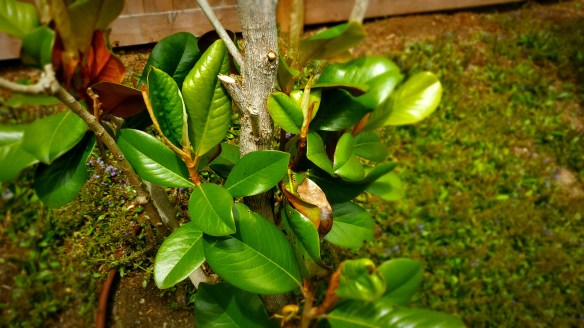
With so much loss and future uncertainty, the backyard foliage coming into its spring livery offers a more hopeful contrast. The heathers have had their brief bloom and are now settled into their seasonal greenness. The azaleas and barberrys are showing a robust hint of great promise, while the coneflowers seem content to keep their secrets a bit longer. The lavender, rosemary and woolly thyme have all increased their hold on the open space, and appear lush and verdant in the intermittent rain. I marvel at the new growth on our gem magnolias. These young trees were severely battered by last winter’s snows to the point where all three are several feet shorter than they were last year at this time, and are still missing many of their previous branches. We weren’t sure they would even survive.
Our resident squirrel stares at me briefly from his perch atop one of our landscaping rocks, then quickly retreats and sprints his way effortlessly up a sheer stretch of fencing. I am instantly jealous of his apparent immunity to gravity. Back in my mountaineering days I was a decent rock climber, but unlike our squirrel, I seemed to plateau at a certain level of difficulty. The American system of climbing grades is based off the Yosemite Decimal System (YDS), which ranges from class 1 (hiking over flat ground) to class 5 (technical rock climbing), and then provides further incremental gradations for class 5 depending on increased difficulty. A climb in the 5.0 to 5.7 range is considered easy, 5.8 to 5.10 is considered intermediate, 5.11 to 5.12 is hard, and only a handful of the world’s most elite climbers can complete anything of the 5.13 to 5.15 variety.
As a “weekend warrior” when it came to climbing, I could consistently top out routes up to 5.8, but could never successfully complete anything 5.9 or higher. After being frustrated with this for a while, I sought out an instructor at a local climbing gym to see if I could push through this ostensible barrier. After watching me climb several routes, he reached the following conclusion: I didn’t seem to trust my feet. When I asked what that meant, and what I could do to work on it, I very clearly remember him putting his hands on his hips, furrowing his brow, staring me straight in the eye, and saying, “Today, I am going to challenge your definition of a good foothold”.
I had been taught that rock climbing in particular could be broken down into three constituent things: Vision – the bigger-picture puzzle-solving skills to see a way to the top and the sequence of moves required to get there, Mechanics – the ability to understand and use the laws of physics and gravity to assist you in skillfully maneuvering and manipulating your body over the required sequence of moves, and Conditioning – the ability to apply strength when strength is needed, flexibility when flexibility is needed, and the endurance to ration both of these over the time necessary to complete the climb. I had never really considered the trust aspect.
What began was a process of reviewing my footwork mechanics – ensuring my weight was securely held by my arms and the leg opposite the one I was about to move, quickly and smoothly placing the ball or toe of my free foot on the new hold, rotating the foot towards the wall to lock the hold, then shifting my weight to the new hold to free up my other limbs to move – and then practicing these mechanics on progressively smaller and smaller sizes of footholds. I spent hours in the gym practicing, mostly on holds no more than a few feet off the ground. After a few weeks of consistent practice, I was able to advance from “requiring” several exposed inches of rock to support my foot to being comfortable on fractions of an inch, and I ultimately completed several 5.9 routes. As much as the mechanics were critical, I found that that they were almost secondary to trust – the simple, compelling belief that the preparation and placement I had done would actually hold my weight.
My coffee is finished, and I begin the physical and mental transition back to work, taking with me the fresh lessons from both the magnolias and the memories of climbing. Everything, no matter how badly damaged or beset by circumstance, can begin to find its way back. Trips can be rescheduled. More intimate personal connections with family, friends and colleagues will return. The challenge to our contemporary definition of a good foothold has been forced abruptly upon us, and now we must embrace both hope and grief as we rediscover our ability to trust our own feet beneath us.
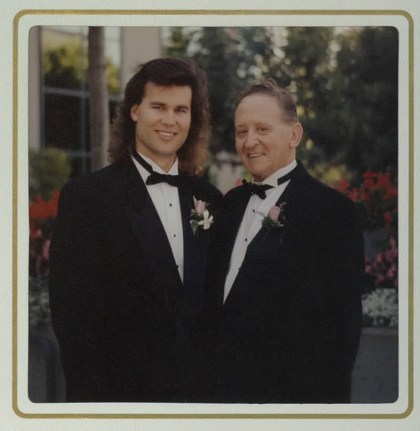 My father and I at my wedding in September 1993. This would
 Somewhere Near There