
The driving time from Florence to Rome was just under four hours with an adequate stop for lunch, and our route followed the A1 south out of Tuscany and down through Umbria and into Lazio, where Rome is the capital. Enrico kept up his patter from the front of the bus, with balanced themes of territory, history and culture. Of particular interest was the medieval city of Orvieto, located to the west of the A1 just over half the distance from Florence to Rome. The high volcanic plateau on which it sits was immediately apparent as we passed, with clusters of stone buildings lining the edge above the valley. In addition to its striking Gothic cathedral, the city is also known for producing white wine (the famous Orvieto Classico appellation, made from vineyards spread across the hills around the town), and we made a mental note to consider a visit for a future trip.
As we neared our destination, Enrico went deeper on the history of Rome, which is both convoluted and bloody. There were two consistent conflicts which have shaped its legacy. The first is the idea of imperial rule versus a vaguely representative government in the form of the Roman Senate. Although representative in nature, the Senate was primarily made up of Rome’s landowning aristocratic class and not the general population, and would rightly be considered oligarchic by modern standards. The other and more highly contentious struggle was religious vs. secular, as for roughly fifteen centuries, the history of Rome has been deeply intertwined with the history of the papacy. Even after Italy became politically united in 1861 with Turin as its capital, Rome remained a separate papal state. Only after French protection of the Pope collapsed during the Franco-Prussian War a decade later did Italy become truly geographically united with the annexed territory of Rome being named as the nation’s permanent capital.
Jess had visited Rome with her family back in 1969, but I had only ever been to the airport. On our trip three years ago we flew into Rome, then drove up the coast before turning inland to Tuscany. Back in 2020 we had been scheduled to vacation here for a week, but the complications of the global pandemic had spoiled those plans. For me, this was to be the most important part of the trip.
Like Florence, the itinerary left no time to settle into the hotel upon arrival, but unlike Florence, it was impractical to walk to the start of our scheduled tour. The city (comune) of Rome is almost five hundred square miles, compared to the roughly forty square miles of Florence. Given that scale difference, our hotel here was about a twenty-minute drive north to where we would meet our next set of local guides, so we all re-boarded the bus.
First up on the tour was the Foro Romano (Roman Forum), the political, religious, and civic center of ancient Rome. We entered from the south side, near the western edge, and steadily made our way east along the Via Sacra. The first thing that struck me was that the topography seemed very uneven, with the footings of the buildings and temples here occupying different heights. Our guide explained that the location, in the lowlands between two of Rome’s traditional seven hills (the Palatine and the Capitoline) and directly adjacent to the Tiber River, made it subject to repeated flooding. Both destruction from the flooding and the silt accumulation over time led to the Forum structures being built and rebuilt over and over at varying heights — some have foundations or access doors as high as forty feet above the lowest current excavated ground level.
The Forum ruins were extensive, and there really weren’t many plaques or other devices designed to help visitors understand what they’re looking at, so in one sense having a guide was helpful. Still, there was so much history here that I quickly tired of the running commentary — “That’s the Palatine Hill where Rome was founded on April 21st in 753 BC. This is the Temple of Divus Julius, where Julius Caesar was cremated. That is the Arch of Septimius Severus, built to commemorate the victories of Emperor Septimius Severus and his two sons, Caracalla and Geta, but later Caracalla murdered Geta and chiseled off any reference to him on the Arch. There is the Temple of Antoninus and Faustina, and you can see how it used to be clad in marble but the Church scavenged it all for their own buildings,” and on and on. The advertised pre-trip itinerary had said “Enjoy free time to wander through the Forum on your own”, but this very much didn’t happen, and I needed to keep reminding myself that the tour is the tour — it is neither bad nor good, and I always have the option to not participate.
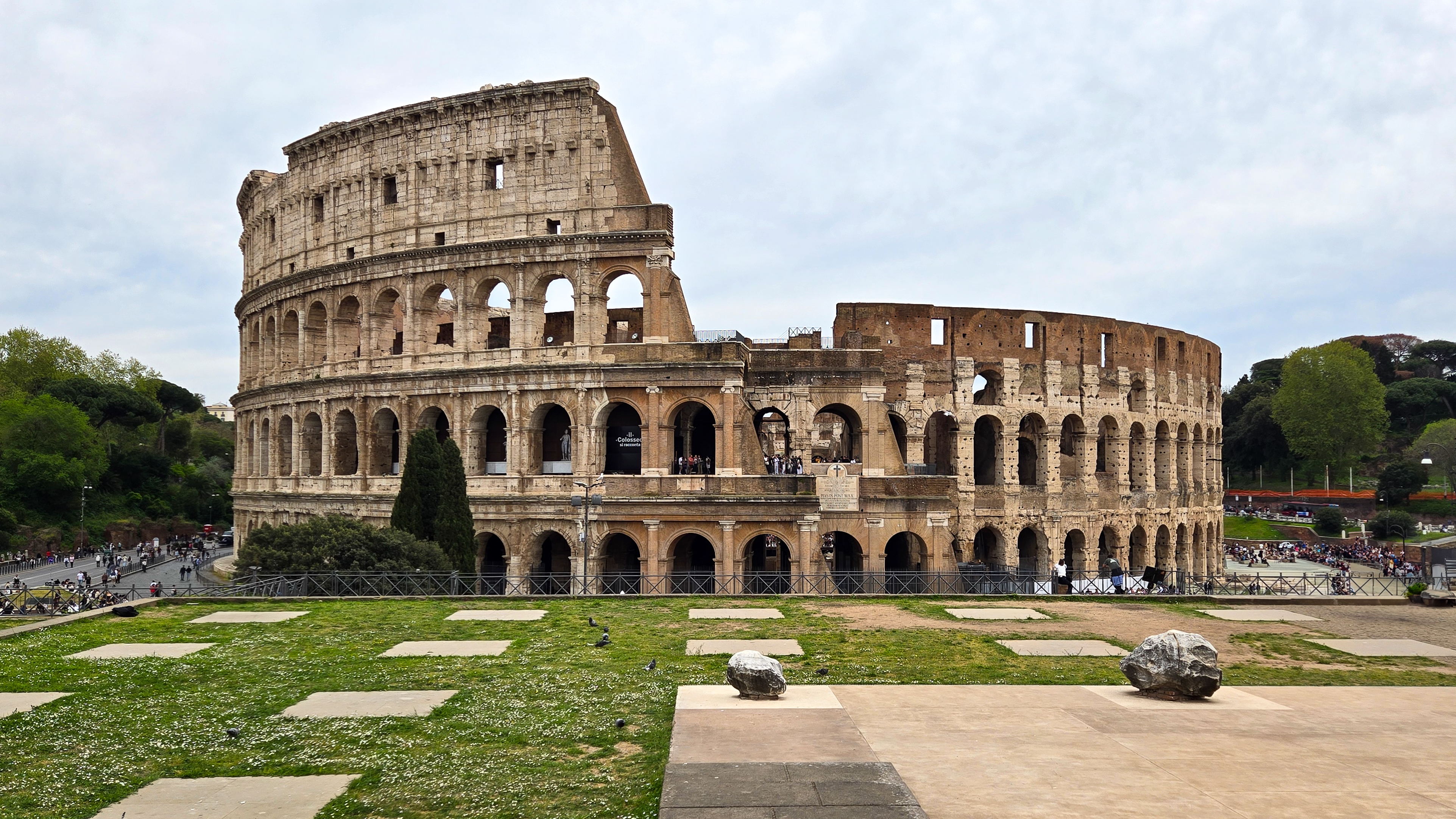
As we continued walking east, we could see people standing on an outcrop far above us, on the terrace level of the Domus Tiberiana on the northwest side of Palatine Hill. This was by reputation the best viewpoint for taking in the totality of the Forum, and in the back of my mind I was thinking that any tour had to include stopping there, but this was not the case. We continued east past the Forum Museum, emerging onto a terrace with a stunning view of the Colosseum.
We paused there, in one of those surreal moments where you suddenly find yourself in the presence of something of immense historical significance that you’ve seen in images all your life. In addition to the experiences of seeing many of the world’s great works of art, I’ve been fortunate to have had many of these moments in my travels related to great buildings and structures — Machu Picchu, the Parthenon, the Great Wall of China, and the Taj Mahal among them — and “iconic” doesn’t even begin to do them justice. “Transcendent” comes closer but still falls short.
The late afternoon crowds increased dramatically as we approached the nearby Arch of Constantine and then the Colosseum itself. Like Venice, it was difficult to imagine what high tourist season would be like. We had a specific time slated for entry, and we moved swiftly into the amphitheater and up several flights of stairs to the upper level. There were elevators available, but we used the same stone steps that denizens and tourists alike have trod for nearly two thousand years.
Despite the wear and erosion, the parallels to modern sports stadiums were obvious and striking, and — perhaps fueled by the many movie depictions of events taking place here — it wasn’t difficult at all to envision crowds in antiquity cheering on gladiatorial contests. “Stadium” has its roots in Greek, but “arena” comes directly from the Latin harena (“sand”), referring specifically to the sand spread across the floor of Roman amphitheaters like the Colosseum.
Much of the commentary from our guide focused on the construction. For example, not all the entryways that ring the building are the same. Some go in and down to the floor level, some ascend, and some pass straight through to intermediate levels, and no two adjacent entryways have the same approach. Seating in the Colosseum was by social and economic strata — a practice unchanged in modern arenas — and this remarkably sophisticated level of crowd management (in both strategy and execution) allowed for fairly rapid ingress/egress of all audiences. As a former aerospace structures engineer married to a civil engineer, I was fascinated by this, and asked the guide if this was based on an older building design or if it was an innovation unique to the Colosseum. I’m not sure if she completely understood me, as her response was to take a step backwards, put a hand to her chest, and exclaim, “Oh no, this was a Roman innovation”. I wasn’t inferring otherwise, but tabled the question as we had to move on.
We circled the upper level, pausing at either end of the long dimension of the oval, then descended for a floor-level view across the shorter aspect, then it was time to leave. We stopped at the Arch of Constantine for a group photo, then walked past the ancient chariot-racing venue of the Circus Maximus and back to the waiting bus.
Despite everything we had already done and seen, the featured excursion was a night tour of Rome’s other principal landmarks. Some of these sights were inaccessible to larger buses, so after a quick dinner at the hotel we divided up into smaller vans and set off. The tour began at St. Peter’s Square in Vatican City. Here again, I felt the same surreal sense of familiarity from all the various movie scenes that have used this location, but arriving after dark provided a fresh perspective. Enrico served as our guide, and there was much less talking in our ears. The square was also relatively uncrowded — a welcome respite after the congested tours of the Forum and Colosseum.
Even though the Pope wasn’t currently in residence, there were numerous crowd control barricades in the piazza, and a large gallery of chairs in front of St. Peter’s Basilica. As beautiful as the Basilica was — especially lit up at night — I was particularly drawn to the surrounding colonnades, where massive Tuscan columns arranged in four deep rows formed sweeping semicircular arms around the piazza.
After exploring and taking photos for about twenty minutes, we gathered back in the vans and moved east across the Tiber to Piazza Navona. Like the Forum, this square has seen many incarnations, but without the flooding-induced irregularities in elevation. Originally a stadium, then ruins quarried for building materials, then a public space and showcase for Baroque Roman architecture, Piazza Navona is now a vibrant gathering place, with shops and restaurants lining the edges of the square. Even at night it was crowded, though the average age here seemed noticeably younger than at the Vatican. There was also the persistent pestering of vendors selling glow-in-the-dark novelties that bounced, spun, or flew, giving the otherwise lively atmosphere a more overtly touristy feel. This was our shortest stop of the evening, and after admiring Bernini’s famous Fontana dei Quattro Fiumi (Fountain of the Four Rivers) in the center of the piazza for a few more minutes, we moved on.
Our next stop was the Pantheon, just a few blocks away, and our parking location allowed us to pass by another Bernini statue — the Elephant and Obelisk adjacent to the church of Santa Maria sopra Minerva. I had long been curious about the Pantheon, mostly for its engineering as the world’s largest unreinforced concrete dome, but I was unprepared for encountering it in person. You don’t approach it from a distance. The piazza is comparatively small, and the surrounding streets are narrow, so you turn a corner and are abruptly confronted by the massive portico and the scale of the structure behind it. Illuminated at night, amid a relatively quiet crowd, the ornate Corinthian capitals projected a sense of power and authority quite different from the openness of St. Peter’s sweeping colonnades. Even Emperor Hadrian, who rebuilt the Pantheon roughly a century after its original construction, was so impressed by the facade inscription — “Marcus Agrippa, son of Lucius, built this in his third consulship”— that he preserved it. I would have welcomed the night tour ending there, but there was more to see.
The Trevi Fountain was only about a mile away, but took some time to reach via Rome’s narrow, convoluted back streets. The drivers clearly knew where they were going, but to us it seemed like an exorbitant number of turns, and we arrived about nine forty-five. The city has begun charging a nominal fee to access the lower bowl immediately adjacent to the fountain, but this fee typically ends at nine each night. Tonight, however, the lower bowl was closed off altogether until ten for one of the sporadic, unscheduled closures necessary to keep the fountain clean. It’s estimated that the total number of coins thrown into the fountain daily likely reaches into the tens of thousands, with a monetary value of roughly three to four thousand euros a day.
At ten o’clock sharp, the staff removed the walkway barrier to the lower bowl, and what can only be described as a human stampede ensued — dozens and dozens of people pushing and shoving each other to get down next to the fountain. Some of our group were in their midst, but Jess and I weren’t really interested in partaking in the coin-tossing ritual and wanted no part of the unruly crowd behavior, so we were content to stay along the upper rail.
Not long after, a pair of young girls rather rudely elbowed their way to the rail in front of us. I brushed it off as just an ill-mannered approach to getting a clearer view of the fountain, but then one girl started photographing the other with her phone, as the first began moving through a clearly rehearsed set of poses. Not one or two or five poses — I counted sixteen. Back to camera. Front to camera, Head to the left. Head to the right. Facing up. Facing down. Playing with her hair. Making heart shapes with her fingers. Click click click it went on, then they switched places and repeated the process, though I lost interest in counting the poses for the second girl. After the photos, I expected (hoped?) that they would take a moment to just appreciate the fountain, but after the last shutter click they quickly moved on.
We had seen milder versions of this behavior at every other tourist spot, where one half of a couple would strike a purposeful pose in front of something, the other would take a picture, then they would look at it together, and invariably do a couple more takes. As a somewhat practiced photographer, I absolutely know that sometimes it takes a few shots to get what you’re looking for. Intellectually I understood that these two girls had their own reasons for being there and were entitled to their own experience, but I was struck by what appeared to be their total disregard for the actual fountain — it was relegated to some sort of backdrop for their photo shoot. In the moment I couldn’t help but be judgmental, but I also felt sad for them. This appeared to make the case for what social media has done to our society and our youth in particular, where everything — including our perception of self-worth — is now about clicks and likes and follows. For my part I certainly took a few photos, but for me, the fountain was the subject and not the background or a prop. I mostly just wanted to stand there and enjoy this sculptural marvel.
The final stop of the night was at the Spanish Steps in the upscale Campo Marzio neighborhood. Their formal name is the Scalinata di Trinità dei Monti (“Stairway of Trinità dei Monti”), named for the church at the top of the stairs, but they are known eponymously for the Piazza di Spagna (“Spanish Square”) at their base and adjoining the nearby Spanish Embassy. Consistent with the other sites, the staircase was beautifully illuminated at night. The crowd was also much smaller than at the fountain, and local officials appeared to have suspended enforcement of the “no sitting” rule after dark, as there were numerous people perched about on the various levels. The rule was implemented back in 2019 to protect restoration work completed in 2016 and as part of broader efforts to control behavior around major Roman monuments. But even here, among the relaxed and mostly seated crowd, there were two young women engaged in full body choreography — doing handstands and wheelbarrows on the steps while a male companion dutifully filmed them. By this point we were all pretty much exhausted, and I was very much in a mood about the photo antics, so I fear I gave the Spanish Steps short shrift, absent my full and deserving attention. Having been to seven of Rome’s most famous landmarks in a single day, and with an early bus ride awaiting us in the morning, the entire group went straight to bed after returning to the hotel.
The next day was a “free” day, in that there were no official outings planned as part of the base tour. But as part of the tour company’s approach to all free days, there were additional excursions available at incremental cost. Visiting the Vatican Museum had been an important objective for us in planning, and we had reserved this excursion very early in the process. The entire group had actually signed up for this offering, so we piled on to the bus once again and headed back to St. Peter’s.
Unlike the previous night where the smaller vans had allowed us to park right across the street from the Square, the full-size coach required parking some distance away and walking. Even with our expedited entry tour tickets, we still had to wait nearly a half hour to enter the museum, and again had to split into two separate groups to meet the crowd control requirements. Of course, our waiting times paled in comparison to other groups crowding the sidewalks, which can stretch to more than six hours for those visitors who hadn’t already purchased tickets.
After being connected with our local guide and with our headsets once again in place, we headed to the museum grounds. There were spaces on the tour where either talking was prohibited or there wouldn’t be a spot to stop due to the crowds, so the tour actually began outside. Much of the detail we covered there centered on the previously mentioned conflict between religious and secular ideas, including the theme of nudity in the depiction of religious scenes and themes, where the Renaissance celebration of idealized physical forms ran afoul of more modest religious inclinations. Moving into the museum proper was much like the Pitti Palace in Florence, where it was a seemingly endless succession of rooms and halls, each with all available space filled with exhibits. There are more than four miles of galleries and corridors, displaying around twenty thousand of the museum’s nearly seventy thousand cataloged works at any given time.
It also matched and exceeded the Pitti in sheer opulence, which prompted a bit of a visceral reaction from me. On the one hand, they were preserving and curating these priceless works and making them available for public viewing, but I couldn’t come to any rational reconciliation of this collection with the doctrine of apostolic poverty. This was, admittedly, a gross oversimplification, so where I as a skeptical observer might say that this is Italian cultural history that ended up in Church hands, a principled apologist might point out that much of the acquisition was done over centuries in Rome, where “Italian,” “Roman,” and “papal” culture were so intertwined that separating them cleanly is often impossible. There is also the patrimonial aspect, where works of art and architecture were commissioned for worship, education, and the glory of God, not for the private comfort of clergy. Accordingly, a pope couldn’t sell off any of Michelangelo’s frescoes and distribute the proceeds to the poor in the way an individual might liquidate personal assets, so these are held in cultural trust. These seeming contradictions remain unresolved, but even in the face of cogent explanation, they nonetheless left a bad taste in my mouth.
The crowds were also overwhelming. Every room was an absolute sea of people, with museum staff everywhere forcefully encouraging people to keep moving. In the Pio-Clementine section of the museum, renowned for its extensive collection of classical Greco-Roman sculptures, I paused briefly to take in the Conca di Nerone (“Basin of Nero”) — a huge basin carved from a single block of red Egyptian porphyry — when another tour guide shouldered me out of the way, waving her red flag and shouting to her headset-less group. My collective take on this and the other sights from the last twenty-four hours was that the art and architecture were amazing, but the experience of seeing them was anything but.
We eventually made our way to the small stairway that led down to the Cappella Sistina, which I was looking forward to seeing. The stairwell was lined with placards cautioning visitors in multiple languages to be respectful as this was a functioning chapel, and that talking, wearing hats, and taking photos were all expressly prohibited. After years of seeing close-up reproductions of the ceiling and the Last Judgment painting behind the altar, I, like many visitors, was a bit surprised by how relatively small the space seemed. Each of Michelangelo’s nine main ceiling panels is nearly ten by twenty feet, yet at close to seventy feet above us they gave the impression of being much smaller. It was also new to me that he didn’t actually paint these for nearly thirty years after the construction of the chapel by its namesake Pope Sixtus IV, and that he painted standing up — not lying on his back on scaffolding as is so often depicted. Nevertheless, it was remarkable to be standing there, in the very room where the College of Cardinals meets in conclave to select popes. The experience was marred only by the (either rude or inattentive) minority of visitors who insisted on talking and taking pictures despite the group of docents running around dissuading them.
The class of ticket associated with our tour allowed us to exit the museum directly to the Basilica of St. Peter, and not have to backtrack through all the galleries and go around. Not that they are intended to be compared, but St. Peter’s eclipsed everything we had seen in Venice and Florence in both scale and grandeur. Humans throughout history have erected some of our most opulent structures in honor of our religious deities, but this was beyond that — a Renaissance and Baroque statement of papal power, wealth, and artistic ambition. To me, the tour seemed to pick up speed here, as though we were on a deadline, when after the endless exhibits of the museum I felt more like lingering here.
The headset allowed me to continue hearing what the guide was saying, but I began to lag behind and stray from his prescribed path as I spent additional time walking around Bernini’s Baldacchino di San Pietro, the monumental bronze canopy over the papal high altar which marks the traditional location of St. Peter’s tomb. I also stood for some time in front of Michelangelo’s Pietà. It’s easy to toss around superlatives like “breathtaking”, but, the emotion conveyed by the statue aside, I simply couldn’t grasp how someone could sculpt this level of realistic detail in marble — especially the graceful folds in the fabric of Mary’s garment. In an unfortunate counter-example of human expression, the Pietà has been displayed behind protective bulletproof glass since 1972 when it was attacked with a hammer by a mentally ill man.
Exiting the basilica marked the end of the official tour, and from there Enrico walked us back through St. Peter’s Square — now bursting with daytime crowds — and across the street to an “authentic” Vatican gift shop. This seemed like an extraordinarily superficial postscript to the relative sanctity of the space where we had just been. The endless assortment of crucifixes and rosaries made sense to me at one level, as these are used in the practice of the religion, but the rest just seemed like trinkets. Further, you could have your purchases “blessed by Vatican officials (not the Pope)” and delivered to your hotel, which brought to mind a number of highly irreverent logistical scenarios — did they bless entire rooms of items at once or sit in front of a conveyor belt while purchases were paraded past them? Regaining a small sense of contrition, Jess did buy a very nice black rosary as a gift for a devout Catholic professional colleague of hers, and opted to have it blessed.
We had some free time available before we had to catch the bus back to the hotel, and many of the group had lunch in a cafeteria-style restaurant attached to the gift shop. To cap off our meal, Jess and I took the opportunity to sample some traditional Roman maritozzi — slightly sweet enriched buns split open and filled generously with whipped cream. These were delicious and not overly sweet, as the whipped cream was more savory than its American counterpart. These were unadorned, though variations have raisins or nuts baked into the roll and are often sprinkled with powdered sugar. Italian cuisine is highly regional, and maritozzi were one of a number of Roman specialties we were interested in trying.
After lunch I went back across the street to get some additional photos of the Square in daylight. I had noticed the prevalence of what appeared to be Egyptian obelisks throughout the city, and the Vatican Obelisk here was yet another example. There had been another on top of the elephant statue in the Piazza della Minerva to the south of the Pantheon, another in the center of the fountain directly in front of the Pantheon entrance, and yet another in the fountain at Piazza Navona.
Both Enrico and our Vatican guide had made the somewhat sweeping claim that “Rome has more ancient Egyptian obelisks than all of Egypt”, but having always been fascinated by ancient Egypt, I found the observation oddly unsettling. Part of this was wondering whether the claim was actually true, but the larger discomfort was a lingering sense of “Why is this here?” I recalled my experience of looking at the Luxor Obelisk in the center of Place de la Concorde in Paris, which raised the same question. Both installations suggested colonialism at first blush, but for Rome the characterization is less distinct. These monuments have stood in Rome for nearly two thousand years — including the period when Egypt was under Roman rule — and became part of the city’s landscape long before concepts such as national patrimony or cultural repatriation existed. Here, as back in the Vatican collection, I was left conflicted.
The first drops of an afternoon rainstorm were beginning to fall as we loaded back on the bus, but by the time we reached the hotel the rain had dissipated. At one point when we were checking weather before leaving the States, there was some level of rain forecast for every day of the trip, but so far the weather had been perfect — neither too hot nor too cold for exploring. The afternoon was more unscheduled time, so Jess and I took a walk in the area around the hotel to decompress a bit from the morning. A few blocks away, we found a small neighborhood coffee shop, and sidled up to the bar for an afternoon espresso. Directly across the street was a pasticceria, and so we also indulged in some chocolate-dipped shortbread biscotti. This kind of outing, walking unhurriedly about and discovering local businesses, is precisely the kind of experience we prioritize when traveling, so this was a nice change from the compressed schedule of the Vatican tour. We also found a commercial laundry (“lavanderia”). It had originally been our plan to pack lighter and do small bits of laundry in hotel sinks as we go, then do a larger load here in Rome to get us through the rest of the trip, but the hotel laundry prices were outrageous (e.g., almost $15 USD for a single pair of pants), so we had been considering other options.
There was no group dinner planned, but the other offered excursion was an evening walking food tour of Trastevere, a historic neighborhood known for its restaurants, cafés, and nightlife. Trastevere (from “trans Tiberium” — “across the Tiber” in Latin) was named for its location across the Tiber River from Rome’s civic and political center, and is one of those Italian words that consistently throws me. Correctly pronounced “trahs-TEH-veh-reh”, my English and Spanish background make me want to put the emphasis on the second to last syllable (i.e., “trahs-teh-VEH-reh”). I seem to stumble more frequently on multisyllabic verbs ending in “ere” than I do on “are” or “ire” endings. There is no hard and fast Italian grammatical rule about this, but “ere” verbs seem to have a higher incidence of stress on the third-to-last syllable. I have certainly been corrected more than once, but to me trying and failing innocuously in real-world situations is an essential part of learning a language, and I welcome the corrections.
Pronunciation aside, we met up with our local guide Elena, and headed into Trastevere’s narrow streets lined with restaurants, trattorias, cafés, and bars. We started at Pizza Trilussa, a small restaurant that sold pizza over the counter by the kilo as opposed to by the slice or by the whole pie. Here we sampled pizza bianca, a Roman flatbread baked without tomato sauce and typically seasoned with only olive oil and salt, though sometimes cured meats like prosciutto or mortadella are added. We then moved on to Appetito, another counter service establishment that sold supplì in addition to a variety of pizzas. Another quintessential Roman specialty, supplì are deep-fried rice croquettes. They are traditionally filled with tomato-seasoned rice and mozzarella cheese, though there are multiple variations on this theme. In addition to the maritozzi, supplì had definitely been on our list to try, and they didn’t disappoint.
As a bit of a break or intermezzo, we gathered just outside Bar San Calisto to taste Aperol spritzes, which also enjoy tremendous popularity in the States and are a favorite of Jess’. Previously I thought that this was just a specific cocktail, but Elena went through the origin and history of spritzes in northern Italy. Starting with German-speaking Austrian soldiers who tempered local wines with water to suit their tastes, the spritz evolved over time into the familiar blend of sparkling wine, bitters, and soda. Hence the derivation from the German spritzen (“to spray” or “to splash”). Any bitter aperitivo can be used, and here Campari and limoncello spritzes were very common, along with the more recent variation of the Hugo Spritz, which uses the sweeter elderflower liqueur.
Many of the area’s gathering places illuminated their facades with warm white fairy lights woven through the ivy that covered much of the neighborhood, lending the evening a warmth that complemented the food. Walking through Trastevere, I thought to myself, “This is the Italy I love. If I ever moved to Rome, I’d want to live here.”
We were far from done, and moved on to La Norcineria di Iacozzilli, a butcher shop specializing in pork products (the self-declared “best porchetta in Rome”) and owned by the same family for multiple generations. Over wine on the sidewalk, we sampled prosciutto and various aged Parmesan and pecorino cheeses, then moved inside to taste the specialty of the house. Porchetta is a traditional Italian pork preparation in which a deboned pig or pork cut is heavily seasoned and roasted until the skin is crisp and the meat remains moist and flavorful. The Lazio version emphasizes garlic, rosemary, fennel, and crisp crackling rather than the liver-based stuffing found in some other regional traditions. Served in generous portions over a rustic bread and topped with a bit of fried pork skin, this was mouthwateringly delicious.
The next stop was Eggs restaurant. As the name (curiously in English) implied, eggs of all sorts — chicken, quail, duck, goose and fish — featured prominently in their menu. We were there to taste what some consider the definitive entree in the four classic pasta dishes of Rome, and the one most aligned with their pursuit: pasta carbonara. This quartet begins with cacio e pepe — literally “cheese and pepper”, a deceptively simple preparation of pecorino romano cheese, black pepper, and pasta. The other three dishes build from there. Gricia takes cacio e pepe and adds browned guanciale (seasoned and cured pork jowl). Amatriciana takes gricia and adds tomato, and finally carbonara takes gricia and adds egg. While there are multiple opinions in culinary circles as to which types of pasta work best with each of these dishes, Eggs served the carbonara with mezze maniche rigate — a shorter version of rigatoni, with ridges allowing the creamy texture of the sauce to cling. The sauce — essentially grated pecorino romano and starchy pasta water — was amazing, but was a bit heavy on the pepper. Also, while I’m very familiar with pasta cooked al dente (“to the tooth”, meaning the pasta isn’t cooked soft, but still has a bit of “bite” to it), here they intentionally serve it al chiodo. Primarily a Roman/central Italian preference, al chiodo (“to the nail”) is even less cooked than al dente, and it was a bit tough for my American palate.
The last stop of the tour was an artisanal gelato shop. The name (“Otaleg”) sounded strange until Enrico and Elena explained that it was simply “gelato“ spelled backwards. With a focus on intense, authentic flavors and the use of seasonal raw materials, the gelato here was unquestionably the best we’d had so far, and a delicious finish to the night.
There were again no official outings planned for the next day, but the offered excursion was to tour the subterranean catacombs below St. Peter’s and to see the Basilica di San Paolo fuori le Mura (“Basilica of Saint Paul Outside the Walls”), which along with St. Peter’s, the Archbasilica of Saint John Lateran, and the Basilica of Saint Mary Major comprise the four major papal basilicas in Rome. Its unusual name came from the fact that the church was built over the traditional tomb of Saint Paul, which lay outside Rome’s ancient city walls.
All of this definitely sounded intriguing, but we decided that we had seen enough churches for one trip and opted not to participate. Elena had actually alluded to this the prior night when asking about our experiences so far, quipping that Italy “has more churches than people”. Instead, we had a leisurely breakfast and dropped a load of laundry off at the lavanderia, the entirety of which cost less than a single pair of pants at the hotel. Much like Florence, our plan was to see one sight at a relaxed pace in the morning, find an interesting place for lunch, and then see one additional sight in the afternoon.
I knew as soon as I saw the exterior of the Pantheon on the night tour that I would need to see the inside as well, so this was our objective for the first half of the day. As Jess and I get older, we talk more and more about “things we have aged out of”, and for me, one of those things is “standing in line”. Consequently, I had purchased “skip the line” tickets off the Pantheon website the night before, and we were able to walk right in.
In the catalog of architectural forms, round is difficult. It is much simpler to create square or rectangular bricks and use them to create square or rectangular buildings. Curved domes are difficult, let alone creating a dome that remains the largest of its kind in the world. It was actually the largest dome of any kind in the world for well over a millennium until it was surpassed in the fifteenth century by Brunelleschi’s dome on the Duomo in Florence — itself an innovative double-shell dome design. Protecting interiors from the weather is hard, but the builders here chose to leave a circular hole in the ceiling nearly thirty feet in diameter, with a subtly crowned floor containing drainage holes to channel away the rain that regularly falls through the Oculus. In addition to providing the only source of interior light, the Oculus contributed to significant weight reduction at the apex of the dome. Even the granite portico columns — each nearly seventy tons in weight — were quarried in and transported from Egypt rather than being made of local marble.
Every design element seems to reflect a choice of ambition over practicality, and success in any one of these endeavors would have been a serious challenge. Yet the Pantheon architects chose to combine all of them at once, and the result is a remarkable union of aesthetic appeal and engineering prowess. From a preservation standpoint, there’s no question that the Pantheon benefited from being converted to a Christian church in the seventh century. In doing so, it avoided much of the material scavenging that befell many of the “pagan” temples that honored traditional Roman deities as we had seen in the Forum. Nonetheless, the building has withstood nearly two thousand years of continuous use. From the exterior columns to the huge, ancient bronze entryway doors to the Oculus and the multitude of unique construction details, everything about this building made an impression on me, and I was thankful to be able to explore it at my own pace.
The plan for the afternoon was to see Castel Sant’Angelo, a massive cylindrical fortress that began as the mausoleum of Emperor Hadrian and later served as a papal fortress. Sitting about a mile northwest and across the Tiber from the Pantheon, it seemed to offer an opportunity to stroll through more back streets away from the overtly touristy spots and find somewhere for lunch. But unlike the Trastevere neighborhood across the river to the west, this area on the border between the Parione and Ponte districts seemed to actually get more touristy as we neared the Castel. This made a degree of sense, given that this was a central point amidst Piazza Navona, Castel Sant’Angelo, and the Vatican, but worked against our desire to find something more off the beaten path. Eating and drinking establishments became more prevalent, with sandwich boards showing offerings in photos subtitled in English, and purveyors became more aggressive in trying to steer you towards their business as opposed to the one next door, but we found what looked like a quiet corner café.
One of my pet peeves in traveling internationally is to be greeted in English or handed menus in English by default prior to any actual conversation. Again, I relish the opportunity to practice my language skills, and while I may need to fall back on English, I don’t like to begin there. Here, the hostess started with “Right this way, guys…”. Even when I asked in my best Italian if we could have a table outside on the patio, she answered in English. I don’t assume anything intentionally patronizing on the part of the restaurateur, and I’m absolutely certain that there are characteristics in dress, manner and/or speech that clearly mark us as tourists, but it still feels like a bit of a brusque reminder that we are visitors. After being seated, we discovered that at the adjoining table were two Americans, and we became privy to every detail of their conversation as they jabbered away loudly in New York accents.
These things aside, we had a delicious lunch along with my first Campari spritz. I was curious to try one because I haven’t ever really liked Campari, but the prosecco cut the sharp bitterness to an enjoyable medium. We also ended on a good note, as my entire conversation with the waitress about where and how we paid the bill took place in Italian.
The approach to the Castel from the south was directly across the aptly named Ponte Sant’Angelo, and a spirited scirocco wind was blowing. Enrico had told us all that the sciroccos actually whip up and deposit sand from North Africa here, and I both saw particles in the background of some of my photos and felt the grit in my throat. The bridge was crowded with visitors, souvenir vendors and scam artists. The three main tourist swindles are the “friendship” bracelet, the three-card monte card game, and the street artwork scam. In the bracelet scam, the practitioner offers a small “free” gift like a woven bracelet, but as soon as it is accepted they begin to demand payment or to make a scene, the idea being to create enough commotion to coerce the victim into handing over money. The card game is one in which an operator places three playing cards face down on a flat surface — traditionally two losing cards and one winning card — and invites bystanders to follow the winning card as the cards are shuffled. Through sleight of hand, the winning card is never where it appears to be, and accomplices in the crowd pretend to be ordinary spectators and may appear to win money to encourage participation. In the artwork con, the scammer spreads drawings, prints, paintings, or posters on the ground or pavement and usually directly where pedestrians would naturally walk. If a passer-by inadvertently steps on a drawing or brushes against one, the scammer immediately claims the item has been damaged and demands compensation. This actually happened to one of our group in the crowded streets of Florence, where the scammer actually grabbed her arm to try and prevent her from walking away without paying something. Fortunately, she was able to escape without further incident.
In addition to the proliferation of pickpockets, all the guidebooks and travel literature warn tourists to be wary of these schemes, but ultimately they work because people fall prey to them. We had seen variations on these everywhere, but given the crowd and the relatively narrow lateral space on the bridge, it was all very concentrated there.
Along with the Pantheon tickets, we had also pre-purchased timed entry tickets for the Castel, and were able to enter directly, walking up the spiraling interior stone ramp. The monument itself has a fascinating history. Its characteristic cylindrical core once housed the remains of Emperor Hadrian and several other imperial burials, but at some point during the decline of the Western Roman Empire and the building’s conversion into a fortress, the urns and remains disappeared. Their whereabouts remain unknown. Wrapped around the core is a shell of medieval and Renaissance fortifications, and above that sit the later papal apartments and terraces.
According to the medieval tradition, during a plague in the sixth century, Pope Gregory the Great saw a vision of the Archangel Michael atop the mausoleum. Michael was sheathing his sword, signaling the end of the plague. The building thereafter became associated with the archangel and acquired the name Castel Sant’Angelo (“Castle of the Holy Angel”).
Perhaps by defensive design, perhaps due to its history as a structure on which later structures were added directly on top in birthday-cake fashion, the Castel is a bit of a warren of courtyards, staircases and corridors that comprise its six distinct levels. The lower levels are blunt and functional, perhaps befitting a mausoleum, while the upper courtyards and rooms take on the ornateness more associated with papal trappings. The edifice itself is interesting and historically significant, but for me the most satisfying part of the experience was the panoramic views of Rome from the upper levels. Just below the rooftop level is a covered exterior walkway that rings the entire fortress, and the rooftop itself has unobstructed views to the east, west and south.
There is a large bronze statue of St. Michael sheathing his sword at the top of the roof-level terrace, facing south towards the heart of Rome. The visual effect, however, was somewhat dampened by the presence of a large aerial antenna and its guy wires in the immediate background. Although this statue has been in place since 1753, it replaced a previous marble statue with bronze wings that was itself over two hundred years old. This older statue now stands on a pedestal in a lower courtyard, and of the two, I actually preferred it. The marble lends St. Michael a more lifelike quality, and his stance and countenance have more of an air of paused and calm authority, while the rooftop bronze seems like an animated figure caught in motion with his hair and wings flying.
This was a rewarding end to our exploration of Rome’s major landmarks, and after catching a cab back to the hotel we headed to the lavanderia to collect our clothes. Although the cost was substantially less than the hotel, the commercial process was a bit rough on some items, and everything had the pronounced smell of some floral detergent. We have run into this in other countries, and wondered if the “fragrance free” movement was more of an American thing. We did laundry in our apartment in Cortona on the last trip, and had to scour the local supermarket to find anything with little or no scent.
Clean laundry in hand, we headed back to the café where we had enjoyed coffee the previous day, but found it closed. Of course there were no days or hours of operation posted on their door, and from our previous experience we knew that it wasn’t at all unusual for a store like this to be closed on a Tuesday. It was bewildering at the beginning of our first visit to Italy to discover that the local bank, grocery store, gelato stand, and coffee place all kept hours that seemed both random and different from each other, but after a few days we settled into the rhythm and adjusted our patronage accordingly. Fortunately there was another café just down the street at which I could partake in my afternoon espresso ritual.
For our last night in Rome, there was a group dinner planned at Da Meo Patacca back in Trastevere, and we once more boarded the bus. After the food tour I was looking forward to experiencing another restaurant in Trastevere, especially since the tour agenda billed it as “an elegant four-course dinner”, but it didn’t quite live up to the advance portrayal. The restaurant seemed like a bit of a neighborhood fixture, but I believe our experience was one specifically curated for the tour groups that seemed to be the exclusive clientele on this night. It was another fixed menu, with strolling folk musicians. Like our previous group dinners, the food was palatable but unremarkable, especially given our prior gastronomic adventures in the district. I also think my mood just wasn’t suited to the intent. This was a very satisfying day steeped in history and contemplation, and what I really wanted was a quiet, delicious dinner with our friends and other group members who would be departing tomorrow and not coming with us on the next leg of the tour. This felt more like a canned “dinner and a show” at a retirement home. It may have been authentically Roman, but it was inconsistent with my experience of Rome over the past three days.
The evening took a lighter turn as the majority of the group gathered later in the hotel bar for a last glass of wine together. In addition to the hugs and goodbyes and promises to stay in touch, there was a lot of discussion about our favorite sights. For all of us, Rome’s enduring sobriquet of The Eternal City was both accurate and well-deserved.
 Somewhere Near There