Despite only having been in Venice for less than forty-eight hours, it was time to head for Florence, and after a hurried breakfast at the hotel the group shuffled on to a vaporetto in various stages of jet lag. The practical guideline for travel acclimation is one day per time zone, and we were only on day two of being nine hours ahead of Seattle. This time the boat ride did little to jolt us into sentience.
Instead of heading to the south waterfront as it had yesterday, the vaporetto took us clockwise around to the northwest side of the island to the Port of Venice, where a tour bus was waiting. We loaded and set off immediately, following the SR11 highway on the Ponte della Libertà — the lone direct road connection between the mainland and the island for both vehicles and trains. Enrico shared that due to the high costs of living in Venice (along with fewer options for things like everyday groceries), many people choose to live on the mainland and take the train over and back each day for work.
From his front seat with the microphone, Enrico kept up a running dialogue on the passing landscape. Politically and geographically, Italy is composed of twenty different regions, each roughly the equivalent of an American state. Venice is the capital city of the region of Veneto, the eight-largest region, bordering the Adriatic Sea to the east and extending about a hundred and twenty miles inland to its western boundary at the Lombardy border. When most people think of “alpine”, they tend to think of Switzerland, Austria or perhaps even southern Germany, but with nearly a quarter of the Alps within its borders, Italy is arguably one of the most alpine of the eight countries bordering this mountain range.
Heading south on the A1, we passed from Veneto into Emilia-Romagna and through its capital city of Bologna. Here Enrico commented on the importance of the contributions made by the nearby cities of Modena and Parma to the culinary world, being noted for balsamic vinegar and Parmesan cheese, respectively.
We passed from Emilia-Romagna into Tuscany, and the topography turned into postcard views of rolling hills and cypress groves. There was a soothing flow to the countryside, with graceful and orderly rows of vineyards dotted with terracotta-topped stone farmhouses. Of my three prior trips to Italy, two were spent nearly exclusively exploring Tuscany. In addition to Florence, we have also visited Cortona, Siena, Vinci, Lucca, Pisa, Arezzo, and San Gimignano, so these vistas were both familiar and comforting. Again Theroux: “The only way to know a place is to go there slowly.”
Soon we were seeing highway signs for Florence, or rather for Firenze, as English historically exonymized many European city names, anglicizing Firenze as Florence, rendering Venezia as Venice, etc. The phenomenon isn’t unique to Italian place names, but I feel it more acutely here — something of the musicality intrinsic to Italian feels like it gets lost in the adaptation, while I don’t feel the same about reforging “München” as “Munich”. English is also very much not alone in this practice. To wit, Munich in Italian is “Monaco di Baviera”.
We entered the city from the northwest and made our way to the hotel at the northern edge of central Florence. In keeping with the pace of the itinerary, after dropping our luggage we headed south on our walking tour, opting to take the local streetcar for the first part to cut down on some of the steps. The streetcar dropped us off right next to the Galleria dell’Accademia di Firenze, which houses Michelangelo’s incomparable statue of the biblical David. This wasn’t part of the tour, though several in the group had already made separate plans to visit. The street adjacent to the Accademia, however, led straight to the magnificent Cattedrale di Santa Maria del Fiore, known colloquially as simply “the Duomo,” where we would meet our local guide and start our tour.
Having seen the Duomo on two previous occasions, it was no less breathtaking, but this time I was less intent on photographing it than I was in listening to its history via our local guide. I think the biggest thing I learned that wasn’t obvious from simply walking around it was that the current marble facade isn’t the original — this was added more than four hundred years after the completion of the initial structure.
While we walked around the periphery, we didn’t go inside. Entrance was free, but this also meant that our hosts couldn’t pre-order tickets for a certain entry time. There were also hundreds of people in the line that stretched around the building. As on my prior visit, much of the northeastern flank of the Duomo was undergoing restoration and was walled off to the public by plywood up to the second story.
In my first visit here, I had photographed the head of an angel framed in a niche or recess on the side of a building in the central district, and in my notes I had identified it as being an architectural detail on the Duomo. In my last visit, I had been unable to locate this same bust, and assumed it must have been hidden by the protective plywood. On this trip I was again unable to locate it. This fostered doubts about it being located on the portion of the Duomo under restoration, as its background lacked the green and white marble characteristic of not only that section, but of the overall exterior. I showed the photo to both our tour host and our local guide, and neither had any idea where it might have been.
From the Duomo we moved south to the Piazza della Signoria, the seat of civic government in Florence, and one of my favorite spots in the city. My attraction lies in the multiple outdoor statues scattered throughout the piazza, including a replica of the David. As the guide began walking the group through the history of local government, I wandered off to take pictures. Since we would not be seeing the actual David on this trip, it was enough to see the replica, and there are several other impressive statues here. I particularly like both the Fountain of Neptune and the Medici Lions. Now as before, I found the fountain striking in its scale and ornateness. The statue at the center of the fountain — ostensibly Neptune, in full and imposing Renaissance musculature — actually has the facial features of Cosimo I de’ Medici, the Florentine duke and benefactor who commissioned the fountain. According to our guide, the fountain is often interpreted as a Renaissance political monument disguised as a mythological fountain, but to me that doesn’t detract from its grandeur.
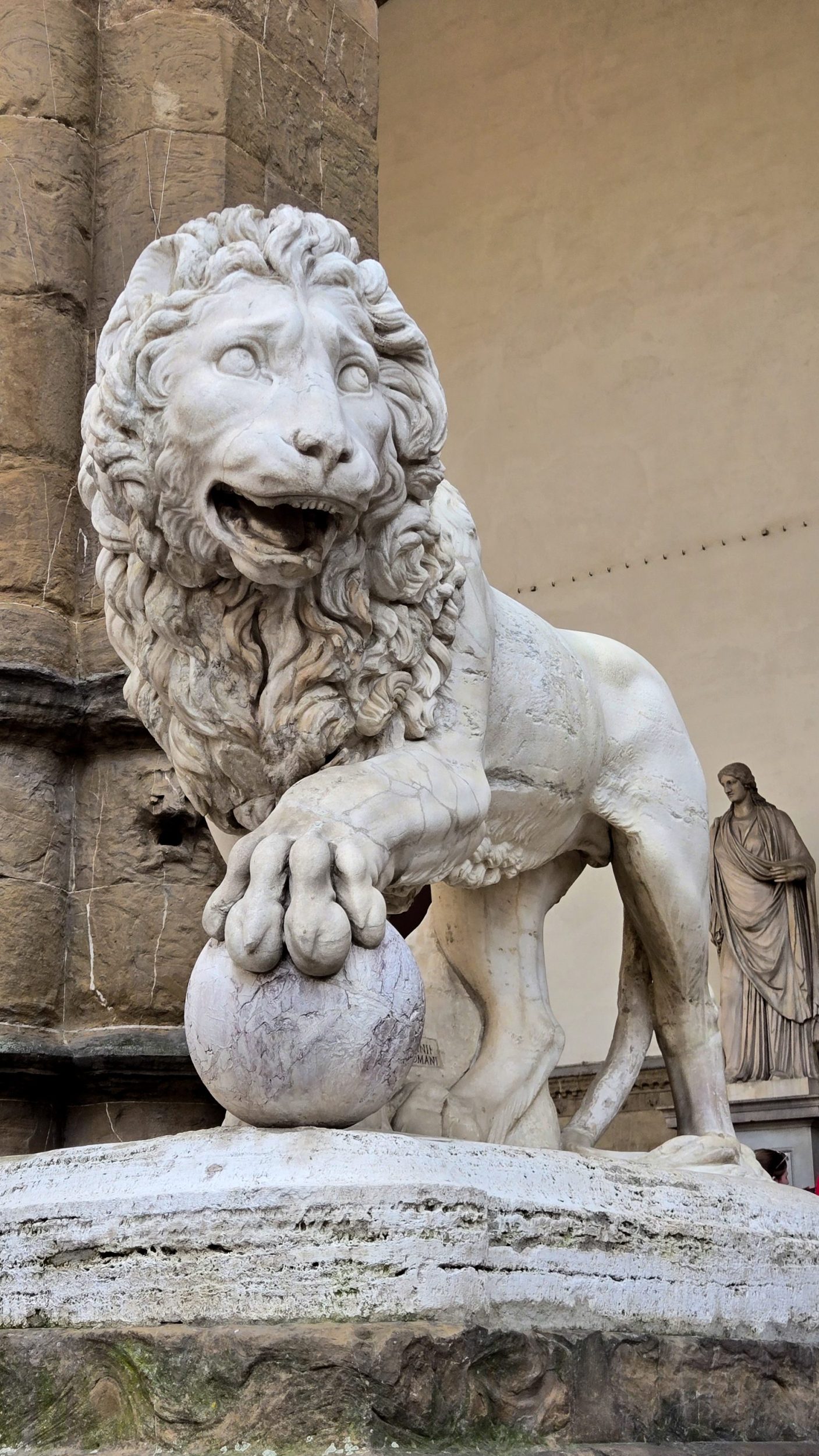
The Medici Lions are a pair of stone lions that sit on opposite sides of the portico in front of the Loggia dei Lanzi. While they are quite similar in appearance, the two lions differ in age by more than a millennium. The one on the right as you face the Loggia dates from Roman times, while the one on the left was sculpted by Flaminio Vacca in 1598 to intentionally mirror and balance the Roman one in this setting. I first saw them twenty years ago, and found them intriguing for a very personal reason. They are each depicted with a paw atop a sphere or globe, symbolic of power and dominion. Astrologically, Jess is a Leo and to my mind is fully capable of running the world, so to me these pieces embody her power. As with “Ilysa’s Bridge” in Venice, these will always be “Jess’ Lions”.
From the Piazza we continued southwest to the Arno River for a brief view of the Ponte Vecchio. To me, the east vista where we stopped isn’t as picturesque or photogenic as the west side — especially now under the harshness of the midday sun. But here again, we were forced to move on at the speed of the tour. From the bridge it’s a short walk to the Galleria degli Uffizi, which houses an extraordinary collection of Renaissance painting and sculpture.
As with the Accademia, we wouldn’t be visiting the Uffizi this trip. This tour was structured to trade depth for breadth, and focused on what it considered the high points. There simply wasn’t time to explore a museum of this size, though it was floated as a possibility for “free time” the following day. As I have written about on several other occasions, I have an ongoing fascination with a particular work in this museum — Leonardo da Vinci’s “Annunciation”, his painting depicting the angel Gabriel announcing to Mary that she will bear the Son of God. I’ve seen it in person twice before, and — even in a room with several of Da Vinci’s other paintings — I was immediately drawn to it in a way that I can’t even begin to explain. This wasn’t a print of this painting in a book, this was the actual painting on wood panels that da Vinci’s hands created over five centuries earlier, and it spoke to me both intellectually and emotionally on multiple levels — artistic, religious, and historic. The import of the illustrated moment (even if I don’t accept the religious canon), the associated and alluring possibility that angels existed and once spoke directly to us, the incomprehension at how Mary could be expected to react to this proclamation, all combined to leave me standing there in silence. At the same time, having seen the Mona Lisa at the Louvre in Paris, I can honestly say that I didn’t have the same reaction. It was equally fascinating to see this icon of western art in person, but it didn’t impact me at nearly the same emotional level. By comparison, the Winged Victory of Samothrace had an equally powerful effect on me, and it remains my favorite work in the Louvre.
Paralleling the Duomo, a significant portion of the exterior of the Uffizi was behind plywood as protection during a decades-long process of restoration and updating. On the exterior walls near the entrance, there is a statue gallery with standing figures of notable Renaissance artists, scientists, and thinkers. Many were covered up by the construction, but I did manage to get a photo of Da Vinci’s likeness as we walked past.
The next stop was the Piazza di Santa Croce, the square adjoining the Basilica di Santa Croce. Here we parted ways with the local guide, and Enrico led us to a local pelletteria — a maker and seller of leather goods — where we were given a brief presentation on leatherworking and given tips for spotting quality products versus cheaper goods in the local marketplaces. After a bit of shopping and the requisite coffee and gelato, we headed back to the hotel. Several of us met in the courtyard of the hotel for a relaxing glass of wine before walking around the corner to our scheduled dinner. Dinner was good, but not on the spectacular level of my prior experience here, and I was beginning to understand that the restaurant experiences for this tour were curated to accommodate thirty-plus people with varying dietary needs and preferences at a single seating.
Between the hotel and the restaurant, there was a covered walkway that fronted a row of small bars and pastry shops (pasticcerie), with outdoor tables full of locals talking, drinking and smoking. That kind of relaxed, vibrant social activity in the evenings was very much central to our prior Italian experience, and a few of us made a point of stopping there on the way back from dinner for a much-needed break from the pace of the day.
The well-practiced choreography of this tour was now fully evident: Go to a place, have a local guide walk you through some of the major sights and local history, see an example of artisanal wares for which the area is known (with, of course, the attendant opportunity to purchase said goods), and have a fixed-menu meal featuring local cuisine. Enrico has done this same tour several times, and it’s clearly a system — he knows all the hoteliers, all the guides, all the shopkeepers where we stop, and all the restaurant owners. It was truly a fast-moving “highlights” tour, and we were beginning to chafe a bit at the schedule. We certainly had the option to not participate in the tours and demonstrations, but those were part of what we had already paid for. In addition to the very full base schedule, there were numerous additional options and excursions available for additional cost (e.g. the private gondola ride in Venice). The main excursion offered for the following day was a trip to the nearby medieval hill town of San Gimignano, and while the majority of the group had signed up for this, we had chosen not to. We actually really love San Gimignano, but we had already been there three times and wanted to have a more relaxed day in Florence.
While it would have been nice to see the Annunciation or the authentic David again, this is the dilemma created by limited time — to see the things we enjoy and/or which move us again, or choose to be open to new choices and new experiences. We chose a modest agenda with some new elements — sleeping in (as much as lingering jet lag would allow), visiting the Pitti Palace and the adjacent Boboli Gardens in the morning and the Basilica di Santa Croce in the afternoon, with random strolling, shopping and eating in the interim. We had known about these attractions from prior trips, but hadn’t previously taken the opportunity to see them. The Pitti Palace is a massive Renaissance palace on the other side of the Ponte Vecchio from central Florence that became the principal residence of the powerful Medici family, and the Gardens are expansive formal gardens on the adjacent hillside.
The Palace itself was visually stunning, but somewhat overwhelming in its opulence. Like the Duomo and other structures here, the scale defies easy capture, and I soon lost interest in taking pictures — what do you focus on when every room is full of art — furniture, statuary, and decorative objects — and every aspect of each wall and ceiling is covered in beautiful paintings? I had read that April and May were good months to visit the Gardens, but other than a few small gatherings of apple and pear trees, there wasn’t much yet in actual bloom. They’re not primarily flower gardens, they’re much more structural and architectural — known for their sculptures, fountains, and sweeping views over Florence. Even so, there were entire beds of what were clearly roses without a single early bloom. Even the Fountain of Neptune (clearly a common visual theme here) was closed, drained, and surrounded by construction. Similarly, the historic Kaffeehaus at the top of the gardens was also shuttered. Nonetheless, we could appreciate the scale and ambition of the grounds, and the unhurried nature of our walking suited our appetite for the day.
We knew the area around the Piazza di Santa Croce was a good place to shop for jewelry — particularly gold — and Jess had a specific style of bracelet she was interested in, so we headed back in that direction. After some leisurely shopping, we went into a small shop that had something promising in their window display. I thought the large black vault next to their counter looked somewhat familiar, but I was completely turned around regarding our location. We had actually crossed back onto the Ponte Vecchio from the south side (we had only ever entered from the northern central Florence side), and were actually standing in the same exact store (the Oreficerie Del Ponte Vecchio) where we had purchased jewelry on both our previous trips. The first trip I had bought Jess a small fleur-de-lis charm (the symbol of Florence), and the second time I bought a replacement. The original piece, along with nearly all of her jewelry, had been stolen in a home break-in a few years later.
Buoyed by this serendipity — and a successful purchase — we had lunch at a cafe on the Piazza and then toured the Basilica. While much smaller in stature than the Duomo, it was still an impressive Gothic cathedral. But what made it truly special is that it contained the tombs and memorials of many of Italy’s most influential historical figures, including Michelangelo, Galileo, and Machiavelli. There were also cenotaphs honoring both Da Vinci (buried in Amboise, France) and Dante (buried in Ravenna on Italy’s eastern coast).
Having studied Galileo (as well as his Polish counterpart Copernicus) as part of my aerospace education, it was truly moving to be standing in front of his grave. As with the presence of the Annunciation, this was not abstract — this was the past made real. It’s not that Americans have no sense of history, it’s that our association with antiquity in particular is limited and only obtained through study or travel. Florentines, by contrast, spend their daily lives in immediate physical proximity to this legacy, and the collective works of these individuals are their direct cultural inheritance. I found that difficult not to admire, and perhaps even envy.
With our exploration for the day complete, we paused for an espresso on the Piazza, where I felt the first moments of actual relaxation for this trip. My Italian was also beginning to find its footing, as I was using each encounter with a waiter or shopkeeper as an opportunity to practice.
We shopped our way back to the hotel, admiring the Duomo one last time and stopping for a glass of chianti at one of Florence’s many “wine windows” — small arched openings built into Renaissance-era buildings that were originally used to sell wine directly to people on the street. In addition to leather and gold, Florence is also known for its tradition of artisan paper and bookbinding, and Jess found some lovely decorative wrapping paper.
There was no included group dinner for that night, so we took our four local friends out to a restaurant very near our hotel that we had experienced on our last trip. Antica Trattoria da Tito is a very casual dining environment (the interior walls are covered in hand-written graffiti) with hearty, delicious Tuscan food and a playfully irreverent staff. The sign at the entrance lists the “rules” against ordering coffee drinks with milk (they are only open for lunch and dinner — past the eleven AM cultural cutoff for milk in coffee), asking for meat to be cooked any way besides rare, and “other tourist bullshits”. We managed to slip in without a reservation, and enjoyed what was for me the best meal of the trip so far. Our friends had, unsurprisingly, loved San Gimignano, and we traded stories of our respective day over bruschetta, wild boar ragu, ricotta tortellini, and steak Florentine, accompanied by a superb red wine and finished with a generous shot of limoncello. In keeping with the spirit of the day, we then headed back to the row of cafes for our final evening in Florence, rounding out the night in true Italian style with more wine, Aperol spritzes, storytelling, and laughter.