
The ability to traverse great distances quickly can lead to what the travel writer Paul Theroux called “parachuting in” to new places. He disdained air travel for the most part, preferring to approach more slowly by road or rail to get a sense of how his destination sits in the surrounding geographic context — entering a city slowly and from its periphery as opposed to being suddenly plunked down in the middle of it. This is the approach of the unhurried traveler with the luxury of time, not the one on a fixed schedule. For this trip, we were decidedly the latter.
Group travel is not typically our style, yet we were joining friends for a ten-day tour of Italy with stops in Venice, Florence, Rome, and Sorrento. My travel philosophy has always been “If you try to see everything, you risk experiencing nothing,” which left me with some reservations about the ambitious itinerary. Even so, the trip offered the chance to see parts of Italy I hadn’t seen before and to make our first trip with these friends.
With apologies to Theroux, less than fifteen hours after departing Seattle and with a quick stop in Frankfurt, we touched down in Venice. While I appreciate the capacity to reach distant locales quickly, I have long held that it is a disservice to the world’s great cities that our first view of them is often jet-lagged from the back seat of a careening taxi cab. Venice, in this respect, was a welcome exception. The Venice airport is located in the city of Tessera — about five miles north of the island of Venice. Our hotel was further to the southeast on the nearby island of Lido, and reaching it required a spirited twenty-minute jaunt by water taxi, or vaporetto (“little steamer,” from the original steam-powered versions). Straight line distances mean less here, as the islands and canals dictate irregular routes, and the fresh air and lurching about as the vaporetto navigated around other boats and their wakes helped to blunt the onset of jet lag.
Our first evening together was a welcome dinner at the hotel, where we met our host and guide (Enrico Schattermann, an exuberant forty-something from Naples), began getting acquainted, and went over the tour itinerary. The group numbered thirty-two travelers from the United States and Canada, ranging in age from forty to the late eighties. There were couples and singles, a pair of sisters, a mother traveling with her daughter, people celebrating birthdays and anniversaries, and widows and cancer survivors making their way forward. Enrico reminded us that this was a highlights tour, and we would be moving quickly and seeing lots of things — “monument snacks” he called them.
Enrico and I also had our first conversation in my halting Italian. I had dabbled with the language before our first trip to Tuscany almost twenty years ago, but before our most recent trip three years ago I had begun studying more seriously and was eager to practice. In my experience, language apps can give you a basic vocabulary and some grammatical footing, but they don’t necessarily prepare you well for the pace and complexity of an actual conversation, so the exchange was humbling. Enrico, though, was encouraging and patient.
After a mostly sleepless night — jet lag being the price we pay for such rapid relocation — and a quick breakfast at the hotel with a heretical cappuccino from an automatic machine, we boarded a vaporetto and headed to Venice proper. Local ordinances wisely disallow tour groups of more than twenty-five people, so at the dock we split into two groups and met a pair of local guides (Carlo and Rebecca) who spoke accented but certainly understandable English and would show us the city. We were also issued what Enrico called “whispers” — headsets that allowed him or a local guide to speak softly while the group could hear the commentary clearly despite the surrounding noise. Early April is considered shoulder season for tourists, but Venice was already teeming with visitors, with organized groups like ours everywhere. I’ve always considered the sight of a gaggle of tourists following a guide with a raised umbrella or flag to be a bit cliché, but here we were. We were all wearing name tags, but at least our guide didn’t have a flag.
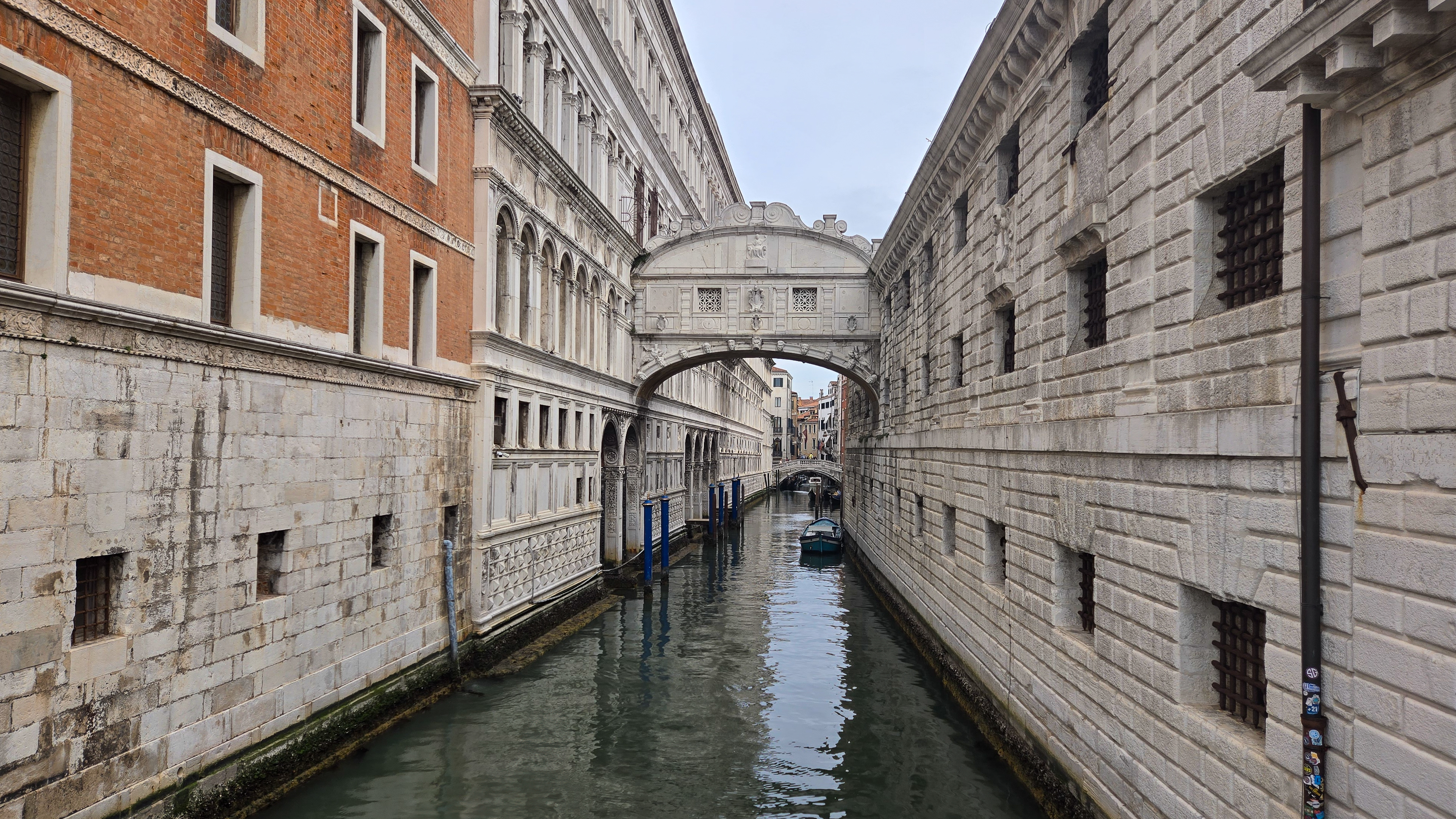
We immediately set off along the waterfront, stopping first to view the Ponte dei Sospiri (Bridge of Sighs). I had it in my head that this bridge was the titular inspiration for Robin Trower’s hit song and album, but in fact he took the term from the name of a racehorse he saw in a newspaper, whose name may or may not have been inspired by this notable span. The famous (and likely heavily romanticized) explanation for the name came from its function — connecting the court chambers in the Palazzo Ducale (Doge’s Palace) across a canal (the rio del Palazzo) to a prison — so condemned prisoners were said to have sighed as they caught their last glimpse of Venice through the small stone-barred windows on the passageway.
This was also where I had my first flash of impatience with the pace of the tour. Since the bridge straddles a canal that opens onto the larger lagoon, our vantage point was likewise on a small bridge (the Ponte della Paglia — literally the “Bridge of the Straw” after the straw trade that used to occur nearby), which did not offer much standing room for the increasing crowds. Americans generally prefer more personal space than is common in many other places, something I’ve been reminded of often in my travels. I knew the jostling was practical rather than personal, but it always takes me a little time to readjust.
I also believe that when it comes to photography in particular, there are only two kinds of people: those who take pictures of what they came to see, and those who take pictures of themselves in front of it. We are firmly in the first group, and for years we would go on entire trips and come home with no photographic evidence we had been there. I don’t begrudge the second group, but they definitely occupy more space in the moment.
My approach to photography has always been to study, compose, shoot, review, and then repeat. Twenty years ago I carried my big DSLR camera, multiple lenses, a full-size tripod, and all manner of gear all over Tuscany. I only use my phone camera now, but the process — which takes a bit of time — hasn’t changed. I also think it’s important not to spend my vacation looking at the world through a camera, so beyond whatever time I spend trying to capture a subject, I want to pause and simply take it in. Whatever my preferences, it quickly became clear that we weren’t going to spend much time here. I had just worked my way through the crowd to an unobstructed view and snapped one or two shots, and the guide was already moving on.
As we moved past the Palazzo Ducale to the Basilica and Piazza of San Marco, the routine repeated: stop, hear one or two facts, get a moment to “take your pictures,” then move on. After a slight ticket mix-up for the Basilica tour (Enrico had been given entry tickets for another group, so for this visit I was “Marco” and Jess was “Linda”), we were able to spend some time inside. Again, the tour was fairly brief, but the interior was stunning. I also began to appreciate the whisper units, as I could easily hear our guide over the other tour leaders shouting to their groups without headsets, disturbing the ostensible sanctity of the space.
Although I had never been there, Venice — and Piazza San Marco in particular — felt almost familiar from its use in films over the years: Bond films, The Italian Job, Ocean’s Twelve, Inferno, The Tourist, Mission: Impossible – Dead Reckoning, Indiana Jones and the Last Crusade, and many others. To the tour’s credit, I learned a great deal about how an entire city could be built on wooden piers across a scattering of islands, and about the substantial role Venice had played in international trade long before Italy became a unified country. The tour also made clear that alongside standard Italian — rooted in Tuscan/Florentine and adopted nationally after unification — there remain older related regional languages, including Venetian, Neapolitan, Sicilian, and others. Carlo also spoke Venetian, and we could hear subtle variations in his speech compared to Enrico, who grew up speaking Neapolitan.
Venice is also famous for its colorful hand-blown glass. After the Basilica tour, we left our local guides and moved on to a demonstration at one of the region’s oldest glass houses, Vecchia Murano. Nearly all the glassware is produced on the nearby island of Murano, but Vecchia Murano had a working furnace in Venice. There we watched one of their master craftsmen effortlessly turn a blob of molten glass into an ornate vase topped with a delicate horse in a matter of minutes. We then got a brief sales pitch on the quality and durability of their products, and we all flinched every time the presenter banged the glassware on the table to prove its robustness. Afterwards we toured their extensive showroom, a maze of collections and demonstration rooms where the same table-banging continued in several languages — clearly they were set up for the tourist trade. While we admired the artistry, much of it seemed too ornate for our style, and we moved on without buying anything.
After lunch at a nearby restaurant and a quick but expensive cocktail on the Piazza, our next activity was a gondola ride. While it had initially seemed like a predictably touristy excursion, I ultimately decided it was one of those quintessential but corny must-do experiences, and I signed the two of us up for a private ride. What I didn’t know was that we would be accompanied by two musicians — a vocalist and an accordion player. For around twenty minutes, we toured the canals with the gondolier expertly navigating even the tightest turns (becoming a professional gondolier is apparently an extensive process) while being serenaded with traditional songs like “Souvenir di Venezia” and “Volare.” For a short stretch we moved out into the Canal Grande, the main canal that bisects Venice in its meandering reverse-S course, but the water there was choppier because of heavy vaporetto traffic. The breaks between songs became opportunities to practice my Italian, and I learned that the accordion, a French word, is called a fisarmonica in Italian. This was all clearly an exercise for tourists, as we continually passed other gondolas doing the same thing, not to mention the sign in English for “Tips” at the disembarkation point, but it was enjoyable nonetheless, and I’m glad we took advantage of it.
From there, we all took a stroll back northeast along the Canal Grande to the Ponte di Rialto, or the Rialto Bridge, the stone bridge completed in 1591 that for centuries was the only bridge across the Grand Canal. While it was swarming with tourists, it was architecturally interesting and offered great views of the Canal to the north and south. Standing at the apex of the bridge, I was reminded of the comparatively short span of American cultural history. As we prepare to celebrate a mere two hundred and fifty years as a nation, this bridge alone is nearly twice as old, and even it sits among much older structures — parts of the Basilica di San Marco date from the eleventh century. I was repeatedly struck by how these monuments aren’t at all isolated — they are part of the fabric of the central city that thousands of Venetians experience every day.
After stopping at the Rialto, we had a few hours of free time before catching the vaporetto back to Lido. Many in the group chose to tour the Doge’s Palace or go to the top of the Campanile in Piazza San Marco, but we were already feeling a little tired of the crowds. Up until 2021, Venice permitted large cruise ships to dock right in the historic center, bringing tens of thousands more tourists to a city that already felt overcrowded. As busy as it was, Enrico noted that “this was nothing” compared to high season or before the cruise ship ban.
We decided to do a little exploring and shopping away from the main piazza, and to find some coffee off the beaten track. On a lark, I looked up the location of the bridge where Rebecca Ferguson’s character Ilsa Faust was killed in a fight in Mission: Impossible – Dead Reckoning Part One. I’ll freely admit I’m a huge fan of hers, and was disappointed to see her character killed off. Finding the bridge took a bit of doing, as it was a decent walk from the city center and an otherwise unassuming structure. Its real name is the Ponte dei Conzafelzi, though I will henceforth refer to it only as “Ilsa’s Bridge.” Some sources identify nearby Ponte Minich as the filming location, but that bridge lacks the ornate metal railing visible in the scene, so it may refer to the broader shooting area. I love the challenge of using technology — in this case ChatGPT, YouTube, and Google Maps — combined with personal experience to solve these little riddles.
Walking back toward the main square to reconnect with the group, we found a little café for a coffee, which inadvertently led to the first comical event of the trip. The restroom in the café was like many in these older buildings — some distance away through a labyrinth of hallways. It was a single-stall restroom, with an actual manual key rather than any sort of lever or handle that locked the door from the inside. When I went to unlock it to leave, the key suddenly spun freely and the door remained locked — the shaped working end of the key that operated the lock had completely sheared off. My first reaction was to fiddle with it in disbelief, but to no avail. My next thought was to text Jess and have her summon help, but my phone was back on the table in the dining room next to my empty espresso cup. There was a small window high on the back wall open to the street, but I couldn’t hear anyone passing by. I knocked on the door and called out a couple of times to see if I could attract the attention of anyone waiting, but there was no answer. Fortunately, after a few minutes I heard footsteps and then someone knocked on the door. I shook the door and tried to explain what had happened, but jet-lagged and trapped in a Venetian bathroom, I pretty much mangled it. What I meant to say was, “La chiave si è rotta” (“The key is broken”), but what came out was “La llave está rota” — the same phrase, but in Spanish. My Spanish is much better than my Italian, and because both languages share a common Latin origin and have many similarities, they often get tangled between my brain and my mouth. Usually it’s something innocuous like saying “por favor” (Spanish) instead of “per favore” (Italian) for “please,” but this time it was a whole sentence. Either way, I was promptly rescued from my misadventure, and the combined adrenaline and espresso saw us quickly reunited with the group, and we were soon headed back across the lagoon to our hotel.
When traveling, we prefer to explore the neighborhood around our accommodations, eating, drinking, and shopping locally. Even though we had to catch an early boat to the mainland to meet our bus to Florence, we walked the fifteen minutes or so down the waterfront to the central Lido business district in search of a casual dinner. We ended up meeting our four Northwest traveling companions for a delicious dinner of pasta, salad, and wine at an outdoor café. Tired but content from a very full day, we were rewarded with the sight of the sun setting over Venice as we made our way back to the hotel and our much-needed beds.
 Somewhere Near There