Catching Daylight
In the summer of 1977, I had only one goal: to be cool. As a young man a few months away from his thirteenth birthday, there were of course many aspirational definitions of cool. One was the fashion kind of cool, embracing the sartorial trends of the day in hopes of drawing the attention of the girls at school. This helps explain my predilection at that age for overly long hair, overly short cutoff jeans, and overly high white athletic socks. Shoes were another matter. Being one of four kids and living on acreage on the outskirts of a small town, our budget for shoes was both meager and divided, and our parents tended to steer us towards mostly functional footwear.
“Town” was the small farming community of Elk Grove, a mostly rural former stagecoach stop south of the California state capital of Sacramento. After several years in Sacramento proper, my parents had decided to move to this quiet little township that boasted fewer than 3800 residents in the 1970 census, and after about two years decided to move again about six miles out to the east end of Sheldon Road in the open country that surrounded the small civic center.
But even small country schools have social trends, economic strata, ruthless peer pressure, and children struggling to find a way to just fit in; to belong. I did well academically, but this was no basis for cool if you didn’t have wardrobe to back it up. When the hip shoes became brown suede oxfords with wavy plastic bottoms, I was still sporting the plain black Keds I’d worn for (what seemed like) an eternity. When I finally convinced my parents that my standing in school and my future success depended on me getting the right shoes, they eventually relented. I remember the day I showed up to school proudly displaying my new oxfords — made by Kinney, with the “GASS” logo (an acronym of Kinney’s “Great American Shoe Store” tagline) molded into the bottom, only to find that the cools kids were now wearing blue athletic shoes with a white swoosh on the side. It appeared that the combination of our financial circumstances and the need to have shoes that could stand up to heavy outdoor chores would dictate that I would always be at least one fad behind, and that this kind of cool would be difficult to achieve.
As pressing as my footwear needs were, the latter part of the seventies was also marked by the disintegration of my parent’s marriage. In just a few short years, they had shifted from building their dream home in the country to becoming precariously estranged. This particular summer marked nearly a year since my father had moved out in what they called a “trial separation”. I look at their struggles now with adult sensibilities, but at the time I had no experience or even the vocabulary to process what they were going through, and consequently I mostly found ways to ignore or escape their foundering reality.
Fortunately, life in the country offered ample avenues of escape. Our house was situated in the middle of a rectangular parcel of land that ran north/south off of Sheldon. The property was approximately three acres in square footage, though technically an acre is (perhaps archaically) defined as a rectangular area measuring one chain (sixty-six feet) by one furlong (six hundred and sixty feet), while our land was nearly nine hundred feet long by about a hundred and fifty feet wide. The southern or “back” third of the property – the rough equivalent of a single acre — was fenced off for livestock, as was the northern or “front” third aside from the driveway, which left the middle third open for the house and yard. After dodging the cattle and/or sheep we regularly kept on the back acre, you could also hop the very back fence into another large field that adjoined our property. The field was large enough that my father and uncle often took us skeet shooting there, and it was also home to a wide array of rodents and snakes. I remember bringing home two large gopher snakes I had tracked and killed in this field, only to discover that my father was actually deathly afraid of snakes.
This field also contained a huge oak tree just a few yards from our fence. I spent countless days and hours in this tree, climbing up to branches thinner than my wrist, gyrating on the tire swing we rigged to a large overhanging branch, and just hanging out in the nook of the trunk where the major limbs converged and contemplating my juvenile universe while trying to avoid the ubiquitous red ants. Further south and over yet another fence was a set of railroad tracks. Many pennies met their untimely and compressed end on these tracks, accompanied by intense (and largely fact-free) debate as to whether a penny could actually derail a full-size locomotive. A short walk southeast along the rails led to a large warehouse paralleling the tracks that housed the local feed and tack shop – Sheldon Feed and Supply. At any given time we had some combination of a few Polled Hereford cattle, Suffolk sheep, pigs, chickens, rabbits, ducks, and geese to go along the with the family dog and various cats, and “going to the feed store” was a routine occurrence. Here was where we bought nearly everything to keep our growing ranch running – bales of hay and huge bags of pelletized food for the larger animals, bales of straw for bedding, the grainy chicken feed (and ground oyster shells to make their egg shells stronger), food troughs and water bubblers for our menagerie of smaller animals, steel fence posts, wire fencing (both the large-meshed “hog wire” and the smaller, honeycombed “chicken wire”), rope, tarps, and all manner of tools. The best part of the feed store was the Coke machine, a true chest-type dispenser with refrigerated Coca-Cola in glass bottles. After putting in a quarter, you lifted the lid, grabbed the top of an available bottle by the tips of your fingers and guided it along the metal rails to the corner mechanical flaps where you pulled it up and out. A quick flick under the bottle opener and you could sit in the shade on the loading dock and watch the business of farm commerce unfold with bored adolescent indifference.
If I tired of the fields, trees and tracks to the south, I could traipse around the neighbor’s property to the east of us through the thick groves of foxtails to a rainwater-fed lowland we called The Swamp. In retrospect it was probably highly unsanitary if not outright unsafe to swim there, but it offered a refreshingly muddy way to cool off from the California Central Valley heat in the absence of a swimming pool. There was also a wide variety of bugs, birds, turtles and crayfish (which we called “mudbugs”) to harass with rocks and sticks in the way that young men seem compelled to do. On a dare I once crawled through a culvert from The Swamp to another fetid, brackish pond that lay on the opposite side of Sheldon, which bent south at Excelsior Road on its way to meet Grant Line Road towards the Sheldon Feed and Supply.
The property to the west of us was owned by a family named Torgerson, who primarily used it to graze horses and raise alfalfa hay for sale. At harvest, the pungent and slightly earthy scent of the freshly-cut alfalfa would drift over our property for days as it lay drying before being baled. Fenced, flat and featureless, it offered no real opportunities for adventure other than occasionally feeding the horses across the fence. During my parent’s separation my mother went back to college at night to earn an updated teaching credential, and the older Torgerson girls would watch us on the evenings she attended classes.
Nearly three hundred feet of gravel driveway connected our house to Sheldon Road, which provided a first-rate bicycle racetrack. At twelve, I was just beginning to be allowed to ride my bike to school and around the spread-out neighborhood. As an added thrill, our eastern neighbor’s aggressive Australian Shepard would leap from his perch on their steps and chase us down the driveway, barking until he lost interest in us amidst the dust our bikes kicked up or was called to heel by his owner — an older gentleman named Frank Butler. Frank and his wife (the dog’s name was Prince, but the wife’s name now escapes me completely) lived on a tract nearly identical in size and shape to ours, except that their house was situated north on the parcel, just off the road, and the remaining acreage was divided into various pens and training paddocks for the stately Arabian horses they raised. Many ranches in the Elk Grove area bred and raised horses, mostly Appaloosas, Pintos, Quarter Horses, Morgans, and Palominos. The electrified fence that surrounded most of the Butler’s pens provided additional fodder for youthful dares.
The first six trees lining the driveway were older almond trees that were on the property when we moved there. Their brilliant white blossoms in spring were beautiful, but their relatively short height, fragile branches, and rough, scaly bark made them less than ideal for climbing. In our first few years there my parents planted nearly thirty more trees along the driveway, both to provide shade for the driveway and to prevent soil runoff from the natural drainage ditch that bisected the front acre.
The copious outdoor recreation aside, the house itself also offered ways to isolate myself from the marital turmoil that seemed to pervade our lives. This was the first house in which I had my own room, and I could close off the world by shutting the door to the hallway and sliding shut the vinyl divider to the space occupied by my older brother’s room. My walls were adorned with science fiction movie posters and pop culture pinups, and various model airplanes I had painstakingly constructed hung from the ceiling. An added feature was the Nutone intercom system my parents had opted to have installed. In our main living room was a wall-mounted console that contained an AM radio, a set of switches that corresponded to each room in the house, and a record player that actually folded up into a cavity in the wall. You could use the intercom to converse with any or all the rooms, and you could also broadcast the radio or record player to any selected rooms. I soon discovered that I could load the record player with up to ten of my favorite albums (each album would drop down the spindle into position to be played as soon as the preceding album had finished), set the intercom for just my room, and raise the volume to the point where my parents and siblings would complain. AM and FM radio at that time wasn’t as differentiated as it is today, and nearly every station offered a wide variety of programming. I could hear John Denver, Crystal Gayle and even Sammy Davis Jr. on the same station as Peter Frampton, the Steve Miller Band and the Eagles. I filled my room and my ears with these artists along with Kiss, Boston, Ted Nugent, Led Zeppelin and Aerosmith – a far cry from my mother’s preference for the Kingston Trio, Andy Williams and Herb Alpert. In the days when our television had to be manually adjusted between the seven channels we actually received (with an additional manual adjustment of the antenna for better reception), this was pure magic.
In addition to working on models, most of my time in my room was spent reading. I was a voracious reader, and devoured everything from borrowed library books on lasers and spaceflight to monthly selections from the Science Fiction Book Club (all of which I still own) to various magazines. Even as a pre-teen I subscribed to multiple periodicals, including Starlog (a fledgling sci-fi publication started in 1976), National Geographic (which in addition to its educational value offered titillating images of topless native women) and Boy’s Life (the official magazine of the Boy Scouts of America). But the mag that occupied most of my attention was Skateboarder. Driven by a surfer ethos that combined the laid-back Southern California beach lifestyle with a healthy dose of punk rebellion, skateboarding as a sport was just beginning to take off. Skateboarder offered page after page of long-haired SoCal rebels cranking their way through public parks, viaducts, and emptied-out backyard pools with their ever-expanding repertoire of gravity-defying tricks playing out on any available patch of concrete. For me, the beaches of Malibu or the urban Los Angeles skate scene might as well have been on a different planet, but I was fascinated nonetheless. Day after day I would lay on my bed listening to the music coming through the small, tinny intercom speaker in my room and reading about the exploits of Tony Alva, Doug “Pineapple” Saladino, Stacy Peralta, Shogo Kubo, Tom Inouye, Micki Alba and others, and imagining myself pumping up the vertical walls of a pool and “catching air” – actually jetting up and out of a pool clutching the edge of my board and then reentering in a smooth graceful arc.
I was reasonably good at many sports, but not overly athletic. At this age baseball was my clear sport of choice, though the filled-out body that would eventually bring me some high-school conference-level success in both baseball and wrestling was still a few years away. In 1977 my physique remained trapped in a kind of lanky, coltish awkwardness, but it seemed to mirror the skaters I saw in the magazines – these weren’t musclebound jocks, these were skinny punks. In this comparison I found both inspiration and a potential path to cool: I would become a skateboarder.
The first and most immediate barrier was that even with some limited exposure to the sport, I really didn’t know how to ride a skateboard. Despite growing up near the Sacramento River Delta and only about two and half hours from Lake Tahoe, I had never skied on water or snow, let alone surfed, which according to my magazine research was the natural transition sport to skateboarding. Undaunted, I decided that my roller skating experience would be sufficient. The nearby town of Franklin (a scant seven miles southwest of Elk Grove) had a roller rink – King’s Skate Country – which had been a staple of school field trips and birthday parties for years. A session at the rink consisted of various kinds of skating activities called out by a disc jockey that played the accompanying music – separate skate sessions for boys and for girls, rounds just for couples, rounds only for skating backwards, reverse skate (moving around the rink clockwise instead of the usual counterclockwise), games like Red Light / Green Light (in which you made your way on skates laterally across the rink, moving only when the DJ said Green Light! and freezing when they said Red Light! – any kind of movement on Red Light got you eliminated) and Limbo tournaments where you had to duck and skate under an adjustable bar that got set progressively lower.
Even here the hierarchies of proficiency presented themselves – beginner couples moved around the rink simply holding hands. The more experienced couples would skate with one arm around the waist of their partner and the others clasped together in front of them. This required their legs to move in unison, lest their skate wheels collide and send them tumbling onto the hard, urethane-coated wood rink floor. The most advanced couples were those that could skate facing each other like ballroom dance partners, with one partner moving with his or her back towards the direction of travel. This required moving in tandem with the added difficulty of one partner skating backwards. The top of the skating social pyramid, however, were the roller hockey players. In addition to their superb skating skills, honed through years of playing competitive hockey on roller skates, they also had cool-looking team jackets that proclaimed them members of a fairly exclusive brotherhood. Yet another avenue of hip where I was unable to trespass, let alone belong. In addition to not playing hockey, I never mastered skating backwards and never lasted many rounds in Limbo. But what I could do is to go around the rink at relatively high speed – “Speed Skate” was always my favorite round. Accordingly, I figured that my familiarity with moving along on wheels and using my body to control turns could be parlayed into the skills necessary for skateboarding.
I wasn’t totally unfamiliar with skateboards themselves, either. When we lived “in town”, among the four children we owned two secondhand skateboards, and had brought them to the country with us. One was a small plywood board on which you could barely place both feet, with small aluminum wheels containing steel ball bearings that allowed the wheels to turn – very similar to our lace-up “outdoor” roller skates. The other was a slightly longer fiberglass board that had a little more room and a little bit of flex you could feel when you stood on it. It, too, had essentially metal roller skate wheels, which was the principal limitation of this type of construction. Being small and hard, these wheels tended to trap any small bit of debris the rider encountered against the ground rather than rolling over it. If the debris was hard, like a small bit of wood or stone, this would stop the forward turning of the wheel. The same was true of our skates, but if one wheel of one skate stopped, you had the potential of quickly moving the other foot forward and catching your balance. This was not true of these skateboards – any wheel skid would send the unlucky rider sprawling forward with essentially no warning. Having led to a few bloodied knees, these boards were only used sparingly and were why – despite my skating experience – I hadn’t yet developed any real feel for skateboarding.
The next obstacle was that, unlike the streets and sidewalks of our more urban setting, the house in the country offered very little in the way of places to skate. The only relatively flat, paved surface of any size nearby was at our local elementary school, about a two-mile bike ride away. Even though the distance was manageable, most surfaces at the school were coarse asphalt that was nearly impossible to ride, especially as a relative beginner. On the east side of our house, immediately outside the garage, sat a twelve foot by twenty foot pad made of poured concrete. I think my parents put it there with the intent of using it for parking, but they always parked their cars on the gravel in front of our house or the continuation of the gravel driveway than ran past the parking pad to the edge of our back yard. In our years there, the pad had been used mostly for holding the contents of our garage when it needed sweeping or hosing out, but also occasionally for play – bouncing tennis balls against the garage door, serving as the court for a basketball hoop mounted on a post at the southern end, and even providing a small skating rink. This, then, would be my skateboard training ground.
I had pretty much learned to stay balanced and upright on the board when the wheels would actually turn, but this was nearly as problematic on the parking pad as it was on the school’s asphalt. Even when I swept it clean from the dirt and gravel that would inevitably find its way from the driveway, there was still the problem of the wooden dividers that sectioned the pad and served as stress-relief joints in the concrete. While they produced a moderate and tolerable thump-thump under our roller skates, they tended to catch the skateboard wheels and send me stumbling. Worn-out jeans and skinned knees were more a part of everyday life in the country, but it quickly became clear that if a change of venue couldn’t be found, then a change of equipment was in order.
With money earned from my weekly allowance (based on the successful completion of the many chores needed to keep an agrarian household functioning) and my summer job of working in a neighbor’s orchard, I bought a new skateboard at a local garage sale. It was about the same size as the fiberglass one we already owned, but was made of molded plastic and had slightly larger urethane wheels, which were more forgiving on uneven surfaces. This allowed me to actually begin to skate in small ovals on the pad, with two or three quick push-offs with my foot along the length of the pad to prepare for the tight turn at either end. I quickly moved from doing simple loops around the pad to adding in a few tricks and maneuvers gleaned from Skateboarder. I started with simple slalom turns, using my hips to turn the board left and right in small repeated chicanes that combined to form an elongated, serpentine motion. Where the pro riders in the magazines did seemingly insane slalom courses down steep streets, weaving in and out of a line of obstacles – usually orange traffic cones – in timed competitions, I was content to string together one or two turns around bits of scrap lumber or the previously unwelcome small stones I had set spaced out in a single-file line.
I then graduated to kick turns, shifting my back foot and my weight to the very trailing edge of the board (the tail) to raise the forward wheels off the ground and turn the front, or nose, of the board in alternating directions. From here there was a natural evolution to three-sixties – keeping the nose of the board in the air and seeing how many times I could spin around in a complete circle. The learning curve here was a bit steeper, and practicing three-sixties often sent the board skittering away while I fell backwards. The seats of my shorts were now seeing more wear than my knees, but I took this as a sign of my maturing skills.
As invested as I was in learning these basic moves and tricks – collectively called freestyling in the skater lingo – I was beginning to get a bit bored with it all occurring on the flatness of the pad. I longed for the opportunity to leave the horizontal world – skating down into a pool and actually achieving enough speed to scale the vertical deep-end wall and catch some air or run the axles of my board along the coping in a move called a grinder. Grinders could be either frontside or backside, depending on whether the front or back of your body faced the wall of the pool during the move. Skateboarding at the time was generally uncharted territory, and skaters made up tricks and the associated nomenclature as they went along. Terms like Ollies, inverts and handplants peppered the Skateboarder articles. The axle housings themselves became known as trucks, ostensibly after railroad cars. The trucks on a railroad car consist of an assembly of wheels, axles, bearings, and suspension, which pivots flexibly underneath the deck and chassis of a railroad car. The layout on a skateboard is conceptually nearly identical, though none of my skateboards to date had any form of suspension. All these tricks and the tantalizing possibilities of the vertical world seemed out of reach until once again Skateboarder provided inspiration: To extend my skills and move beyond the flat confines of the pad, I needed to build a ramp.
As often occurs in rural environments, you make do with what you have. My father’s other faults aside, he was both industrious and resourceful. For a businessman (a glazier by trade), he proved himself quite adept at building fences and chicken coops and rabbit hutches and pen shelters to keep our animals out of the sun and rain. I never learned what inspired him and my mother to move to the country (both are now gone, so the question fades unanswered), but perhaps this was part of the draw for him – to work with his hands on his own land. Whatever the motivation, he was prone to keeping building materials around, and with his departure I felt free to use these resources for my own purposes. Around the back of the house I found a four by eight foot sheet of plywood in relatively good condition that would form the basis of my new endeavor.
My first attempt was to align the short edge of the plywood with the center of the driveway-side edge of the parking pad, raise the board up about thirty degrees to the ground, and block the higher end up with other scrap lumber. This met the technical definition of a ramp, but there were two key flaws. First, the angle at which the plywood met the concrete was too severe, and threw me headlong onto the ramp on my first attempt. After picking splinters out of my palms and making a second run in which I elevated the nose slightly as I hit the ramp, I discovered that the plywood flexed too much under my weight. This caused any momentum I had to evaporate, and I never made it more than a few feet up the ramp. I played with digging the edge a little further down and adding support to the middle of the ramp, but could make no further progress. After further study of photos of makeshift backyard ramps in Skateboarder, it occurred to me that what I needed was some curvature in the ramp. This would put the “takeoff” edge of the ramp closer to level with the parking pad for a more continuous transition, and would more closely approximate the curved bottom edge of a concrete pool.
Plywood by its very nature doesn’t want to bend, so I had to resort to a bit of ingenuity combined with brute force. After several unsuccessful approaches to getting the plywood to bend and hold its new shape, I ultimately succeeded by soaking the plywood with a garden hose to make it more pliable, loading the heaviest thing I could find (in this case, our garden rototiller combined with several large logs from our woodpile) onto the middle of the ramp to induce a curve, and then nailing the bent plywood to a post anchored in the gravel below the ramp. While not a thing of particular grace or beauty, and without enough length or bend to achieve a true vertical surface, it nonetheless appeared to be a bona-fide skateboard ramp on par with some of the photographs I had seen, and I set about conquering it.
Mastery proved elusive, replaced instead with a slow, tedious process of increasing frustration and pain. No matter how much speed I could get up, I could never seem to get more than halfway up the ramp before my inertia would fail and I would have to do a rapid hundred and eighty degree kick-turn and descend. Falls were frequent, and I had taken to wearing pads for my elbows and knees. The pros in the magazines didn’t seem to bother with helmets, so nether did I, and it was probably a small caliber miracle that I didn’t break any bones or sustain any major head trauma.
Day after day I plied the ramp with no apparent improvement, until one afternoon I spied a kid walking slowly down our driveway with something under his arm. When he got closer I realized two things: I had no idea who this was, and the thing he was carrying was a skateboard. Not just any board, but something right out of the magazines. It was nearly a foot longer than mine, and made from some kind of dark, polished wood. I recognized the Independent brand of trucks from ads in Skateboarder, and they sported big, red urethane wheels that were easily twice the diameter of mine.
He was taller than me and clearly older, and was wearing shorts that appeared to have been made as shorts rather than having been converted to shorts by shearing off the legs of a pair of jeans. Above the shorts was a Left Bank velour shirt, the kind most of my contemporaries would only wear for school picture day. In the v-shaped neck opening was a strand of puka shells. He introduced himself as Kevin, Frank Butler’s grandson. He had been sent to stay with his grandparents for a few weeks (“in the country”, he said almost derisively). He had seen me and my ramp, and was wondering if he could give it a shot. My first reaction was to reflect on the strangeness of him having brought his skateboard from wherever he lived to a place that had very little odds of having suitable surfaces, but I didn’t say anything. On the one hand, he smelled of city and of money, but on the other I was dying to see how that skateboard performed, and I told him to go ahead. He strolled casually to the far end of the pad, then did a few quick pumps and shot up the ramp. On his first run the nose of his board cleared the far end of the ramp during his kick turn. On the second run he actually caught air, grabbing the side of his board with his hand to guide it around for the landing. He came down smiling, rode back to the far edge of the pad, dismounted and gave me a quick chin-up nod, indicating that it was my turn.
I was somewhere between mesmerized and stupefied. I had never actually seen anybody catch air in real life, let alone right outside my garage. His mechanics also threw me. I rode with my right foot on the tail and my left foot forward – facing to the right of the direction I was moving. He rode with his right foot forward. While I approached the ramp from the left side, then kick-turned clockwise to descend on the right side, he did the complete opposite. In baseball, left-handed pitchers used to be a bit of a novelty and became known as southpaws – the same with left-hand dominant boxers. In skateboarding, right foot forward riders were also somewhat unusual and were called goofy-footers. Goofy-foot also applied to right foot forward surfers, but there is some controversy about whether it originated from a 1930’s Walt Disney film in which the animated dog character Goofy surfed with his right foot forward, or if it just derived from the older and quintessentially American expression goofy, meaning ridiculous, silly, nutty, etc. Etymology and equipment envy aside, one thing was clear — Kevin wasn’t goofy, he was cool.
Rattled, I lined up and made my run. I made the same feeble ascent up half the ramp that I had made hundreds of times, punctuated by the loud thunk of my front wheels returning to the ramp as opposed to his smoothly rolling reentry. I skated sheepishly back to the far side of the pad and awaited his critique. Rather than commenting, he just made another run. Following another beautiful liftoff – I could see all the way to Sheldon road between the end of the ramp and the edge of his board – he made another perfect landing. We spent another few hours trading runs and not talking, until his grandfather called down the driveway — in tones just a few degrees more pleasant than when he called his dog — that it was time for dinner.
Kevin came shuffling down the driveway the next afternoon as well, and we took up the alternating run rhythm where we had left off the previous day. After one of my more dismal attempts, Kevin made an unpleasant face. I thought he was going to say something snarky or derisive, but instead he asked if he could try a run with my board. I happily obliged. He put one foot on the board, then eyed the ramp and shoved off. Instead of his usual gravity-defying ascent, he managed to get about a third of the way up the ramp before the board shot out from beneath him. He landed on his feet in the gravel next to the ramp in such a casual fashion that a bystander would have thought that the entire maneuver was intentional. He retrieved the board and walked back to the far side of the pad making the same unpleasant face. Still silent, he set off towards the ramp again. He made it about the same distance up, but was able to stay aboard and make a noisy, awkward turn to descend. It was the only clumsy maneuver I would ever see him make. He skated back to me, and said simply, “This board sucks…try mine”. I declined, worrying that I would somehow break it and never be able to pay for it, but he insisted. I acquiesced, and took a few warm-up laps around the pad to get used to it. The ride was nothing short of amazing. Between the large wheels and the suspension in the trucks, I never even felt the wooden dividers. But the most astonishing thing was how fast I seemed to be able to go – there was no feasible comparison with my smaller plastic board.
Once I had a bit of comfort with the way his board moved, I backed up and took a run at the ramp. To my surprise (and delight), I easily made it more than halfway up the ramp. After a relatively smooth turn I skated back to Kevin, sporting a massive grin. He smiled and gave me another quick chin-up nod in wordless acknowledgment. From that point we alternated runs, but both used his board.
Over the next few days this process repeated, and I slowly made it closer and closer to the top edge of the ramp. On the day that Kevin announced would be his last before returning to his parent’s home (I don’t think I ever caught where this was, but his limited conversation implied that it was some distance), I was determined to lift off the ramp the way he could. Despite my best effort, I couldn’t seem to get anywhere close – I was hopelessly earthbound. On my last run on his board, I finally managed to get the at least the front wheels past the edge of the ramp. As I handed his board back to him and thanked him for its use, he said, “Well, you didn’t catch any air, but you caught some serious daylight on that last one!” With that, he turned and headed back up the driveway. I would never see him again.
In the days that followed, I returned to my plastic board and a clipped-wing exploration of the lower third of the ramp. Later my high school and college physics classes would give me concepts and formulas to explain what I knew intuitively from my flailing – speed was essential. Rolling on flat ground you were mostly fighting the friction between your wheels and the ground and a negligible amount of air resistance, but once you moved up an incline like a ramp, gravity comes into more significant play. Inertia is a function of both mass and speed, so the higher the speed the higher the inertia. This is somewhat intuitively apparent, but what isn’t as obvious is the energy component. In classical physics, the kinetic energy of a body, or the energy a body possesses due to its motion, is also a product of mass and speed, but is a function of the speed squared, so a doubling in speed is a quadrupling of kinetic energy. For a certain mass, a certain kinetic energy is required to overcome both the friction and gravity, which in turn requires a certain minimum speed. With my board’s small wheels and heavy friction on the concrete and plywood, there was simply no way to get up enough speed in the limited distance of the parking pad for me to make a serious attempt at the far edge of the ramp.
It was clear that I needed another equipment upgrade, and with a newfound confidence in my skating skills I returned to my magazines for more research. Based on my fresh experience with Kevin’s rig, I now had a much more refined sense of what I was looking for. I priced out the components I wanted, and convinced my mother to make up the difference between what they cost and what I had on the promise of more chores and future earnings from my orchard labors. I further convinced her to write a check to be sent with my order form to a post office box address in Los Angeles – not something she was used to doing.
In a few short weeks my new board arrived. The board itself, or the deck, was a 27” solid oak board made by Sims, one the leading skateboard manufacturers of the time. It was a “taperkick” model, which meant the tail had a built-up section of wood to give additional leverage on turns and maneuvers that required the nose to be raised. I had added the extra-wide “full” trucks from the Tracker Truck Company – rapidly becoming famous for their suspension and smooth ride. Wheels in those days ranged in diameter from about 45mm to about 75mm (one of my first exposures to the metric system), and were made in a variety of compounds for different stickiness or grip for different skating applications and styles. I wanted something in a medium diameter (large enough for overcoming the roughness of my skating environment, but not as large as those used purely in downhill skating) and with a harder compound made for a combination of speed and grip, so I had ordered a set of 60mm “Hot Juice” wheels in neon orange from the OJ (“Orange Juice”) Wheel company.
Within minutes of assembling this new instrument of diversion I was out doing laps on the pad and adjusting the suspension, and I quickly renewed my acquaintance with the upper portions of the ramp. Bolstered by this success, I kept at it into the evening hours, and almost every day for the remainder of the summer I would find time to go out and get a few runs in. Pumping and turning, further and higher. Pushing against gravity. Pushing against my parents. Pushing against the cool kids. Pushing. While I never did catch any true air, I got to the point where I could reliably get three wheels off the end of the ramp during my turn. Over time my movements became smooth and practiced, and I began to feel a hint of what the skaters in the magazines called flow – the seamless and almost meditative interaction of the rider, the board and the ramp, where the universe slows down and narrows in to just the singularity of the next move and a free and unencumbered sense of motion.
As all summers do, this one gave way to fall and school and other distractions, and my time on the ramp became sparser as the changing weather brought more domestic distress. A separation would become a nasty and contested divorce. There would be divisions of property and court-ordered visitations. In the coming precipitous fall from middle class grace the house would be sold (with the ramp still standing), and we would move away from our town, our schools, our friends, and our community. Yet in the midst of the burgeoning chaos, skateboarding had provided a welcome distraction. Practiced in solitude outside my house it never brought the social acknowledgment I hoped it would, but I was still too young to understand the folly of that kind of thinking. What skateboarding did bring was not only a welcome escape, but also intense excitement and the deep, personal satisfaction of accomplishment – another seed of self-esteem that, given time, would eventually lessen the need to find acceptance elsewhere. There were other seeds – a first leap from the high-dive platform at the community college pool where we learned to swim, a first “real” kiss outside a junior high school dance (thank you Kelly Robinson, I owe you immeasurably) – but to a large degree my ability to recognize and appreciate my own self-worth really began to take shape here, in a music-saturated bedroom and on a rectangular concrete stage. Months of dreaming, of trying and failing and trying again, the aid of a stranger I only knew for a few days, practice and more practice, all culminating in sublime moments of near perfection, catching daylight on a small town summer afternoon.
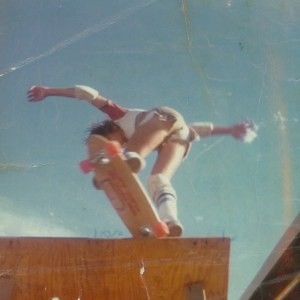
Catching Daylight, Summer 1977
Coda: Memories are wondrous and powerful things, but as the Chinese proverb goes, “The palest ink is better than the best memory”. As my readers will attest, I feel a fierce gravitational attraction to the autobiographical narrative, and this piece was inspired by finding the photograph above while sorting through my “childhood box” during our recent move. A fleeting but tangible instant of cool, captured forever. I don’t actually remember who took the photo, but the rips and crinkles attest to the innumerous timed I have held it and simply stared at it in a sort of recollective awe. I also found the photo below, which gives a better sense of the pad and the ramp:
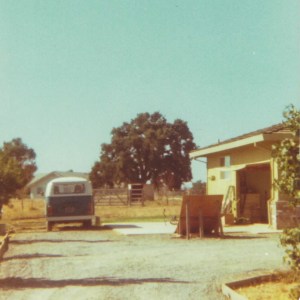
Although the perspective is foreshortened, the large oak in the background is the one I described, and the house to the left is the first of several to be developed on the adjacent property to the south – not the first or only harbinger of change. This was taken in December 1979, just days before we piled the last of our belongings in that blue and white Volkswagen Bus and drove away for the final time.
From the views offered by the latest satellite mapping the house at 10460 Sheldon Road still exists, though there has been significant growth and development in the area. The town of Elk Grove itself has grown to a population of over a hundred and sixty thousand people, and by most reports has long lost any resemblance to the quiet town of my youth. In the outlying areas, entire subdivisions occupy what I remember as open fields. The new houses are mansions compared to the older and relatively austere farmhouses, but the overall locale appears to have retained pockets of its former rural character. Sheldon Feed and Supply still operates (they even have a Facebook page), though the last time I visited nearly 20 years ago the Coke machine had long since been removed. What looks like a large barn now sits roughly where our pigpen and chicken coop once stood. The trees along the driveway have reached heights unimaginable to a child who saw them planted and spent hours weeding and watering them. The front and back acres are still pasture, and the large oak over the south fence still stands, though now nestled in someone else’s back yard. On the east side of the house the concrete parking pad still sits in its gray patience, awaiting the dreams and imagination of yet another generation.

 Somewhere Near There
Trackbacks