Snow Day
As acclimated as we Northwesterners are to rain, snow is a different matter entirely. The rain may fall on the just and unjust alike, but it appears to have no lasting or transformative effect on their character. Snow, on the other hand, is the great equalizer. The just and the unjust, the sacred and the profane, all are afforded at least the outward guise of innocence under new-fallen snow. Unfortunately, this lovely initial veneer often quickly turns into substantial civic inconvenience and even danger — Seattle and surrounds are simply not built to function in snow. This reality often goads the rest of the nation into making light of Seattle’s ostensibly excessive preparations when a snowstorm of any magnitude is projected as it is for today and into tomorrow.
I believe we live in an era in which we all tend to take ourselves a bit too seriously, so on many levels I genuinely appreciate the national attention ridiculing our preventative measures for a storm only expected to drop 4-6” of new snow. While there’s no question that other areas regularly get hit with much more severe weather and higher snowfall in particular, there is actually a bedrock of validity beneath our otherwise overhyped preparation. The biggest contributing cause to all the clamor and tumult is that this doesn’t happen too often here. Seattle averages only about three snow days a year (with an average accumulation of about 5 inches), so this naturally engenders a few consequences. First, it simply isn’t economically feasible for any local municipality to maintain a fleet of snowplows and sand trucks (salting isn’t allowed here for environmental reasons) capable of dealing with any sort of major storm. If they did, the populace would complain – and rightly so — about the cost of supporting something used so infrequently. Topography also makes large-scale plowing impractical. Seattle is nestled among both hills and waterways, but the same widely-varying terrain that restricts and inhibits the building of roads and bridges also make it difficult to clear existing roads under any kind of icy conditions.
If you take the fifty cities in the US with the largest populations, and re-rank them by the difference in elevation between their highest and lowest locations, Seattle ranks 15th with a net 520 feet between its highest and lowest point (sea level, in our case). Five cities ranked above Seattle are coastal California cities, and with the possible exception of Cincinnati (13th), I don’t associate any higher-ranked city with significant annual snowfall in its metropolitan area. For some comparisons, New York is 20th, Boston is 27th, Detroit is 43rd and Chicago is 44th. Not looking to pick any fights, but it seems like our loudest critics are denizens of relatively flat environs, and I guarantee that an icy ride down one of Seattle’s steeper hills (some with up to an 18% grade) under snowy conditions would make the most weather-hardened midwestern driver cringe.
Our latitude also seems to enable fallen snow to hang around for a while, with patches lingering in the shadows and on the northern edges of buildings and long-parked cars. I find that people tend to forget just how far north Seattle actually is. Sitting at 47° 36′ north, Seattle is generally considered the northernmost major city in the contiguous 48 states, and the low and sparse winter sunlight is often insufficient to aid in melting. For all its heavy winter reputation, the northernmost point in all of Maine is 47° 28′ north, whereas Washington state continues still further north to join the borders of Idaho, Montana, North Dakota and Minnesota along the 49th parallel. To be fair, the Northwest Angle in Lake of the Woods County, Minnesota, lays claim to the northernmost point of the contiguous 48 states at 49° 15′.
There are a few additional circumstances that could possibly increase the impact of the present impending blizzard, which is now being called “a once every decade or two occurrence.” While the overall amount of snow forecast is moderate, it is predicted to fall fast and hard in a relatively short period (~24 hours). It’s also the second storm this week. Four days ago we received 6-8 inches on our property (roughly 20 miles north of downtown Seattle), while slightly less fell in the city proper. With high temperatures hovering near freezing all week, much of this snow remains. This means surface temperatures are still near freezing, and any new snow will stick and begin to accumulate almost immediately. This storm is expected to hit in the middle of the peak Friday commute. Anyone familiar with Seattle already knows our traffic woes, and this won’t help. Complicating things further is that this week marks the opening of the new Highway 99 Tunnel, which just replaced the aging, above-ground roadway structure known as the Alaska Way Viaduct. This is one of only two north/south freeway passages through the city, and traffic at this location is already slower as drivers adjust to the new route.
One of the phenomena that invariably attends any regional forecast of snow is our local news media seeming to overreact with nonstop weather alerts and tense, highly-animated forecast coverage. This appearance of hyperbole feeds the national skepticism and draws out local cynics as well, who lampoon these broadcasts and the situation at large with intentionally embellished expressions like “snowmageddon” and “snowpocalypse”. Because the reality is that neighborhood-level non-arterial streets aren’t likely to be cleared, there is the very real risk that emergency service vehicles will not be able to reach most residences should something happen. This, combined with the general population just not being used to dealing with snow on a recurring basis, to my mind warrants some degree of repetition and perhaps even a hint of bombast as the repercussions of underpreparing could potentially be severe. For this storm, however, social media appears to have played a significant role in upping the ante even further. With the intensifying aspects layered on the already breathless media reporting, locals appear to have made a run on nearby stores for both groceries and items like firewood, snow shovels and de-icing chemicals. As a result, many stores were caught off guard and ran out of such staples. Photos of bare, ransacked shelves and long checkout lines began to permeate Twitter and Facebook, which prompted yet another layer of intense local news coverage, which drove more people to stores in search of basic supplies, which drove more social media posts (with new cynics and reactionaries piling on), and so on in a self-perpetuating frenzy. It never seemed to quite reach the panic stage, but there was clearly an element of urgency.
For myself, I love to cook on snowy days and had planned on stopping by a store this morning to pick up a few things. My experience with the lingering ice after a northwest snow also indicated I might not be able to do my normal Sunday shopping. The copious images of shortage led me to believe I wouldn’t be able to get the things I needed, and so I ventured out last night and perhaps contributed to the problem. Many shelves were in fact empty and lines were certainly longer than usual, but I was largely able to find what I wanted. It may fall as expected, or it may all be a bust. Either way, we took basic precautions in case we are snowed in and/or lose power. Our cars are gassed up and we have spare batteries for flashlights. We have shelter and sustenance for ourselves and our animals. Looking outside, the first flakes have now begun to fall. One of nature’s most intimate and perfect moments is the instant rain turns to snow. The sky moves in, low and heavy, and the temperature drop is palpable. We witness the extemporaneous transformation of water into ice, and the noisy splatter of rain is replaced with the hush of these small crystalline miracles alighting without sound. When merely wet, the visual horizon retains all its details, savory and otherwise, but all is rendered pristine under the benediction of fresh snow. For now, we watch in warmth and anticipation.
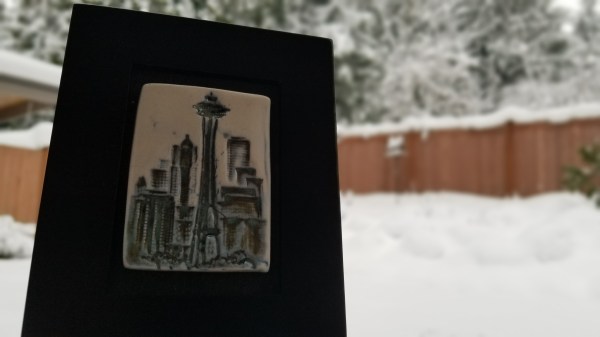

 Somewhere Near There