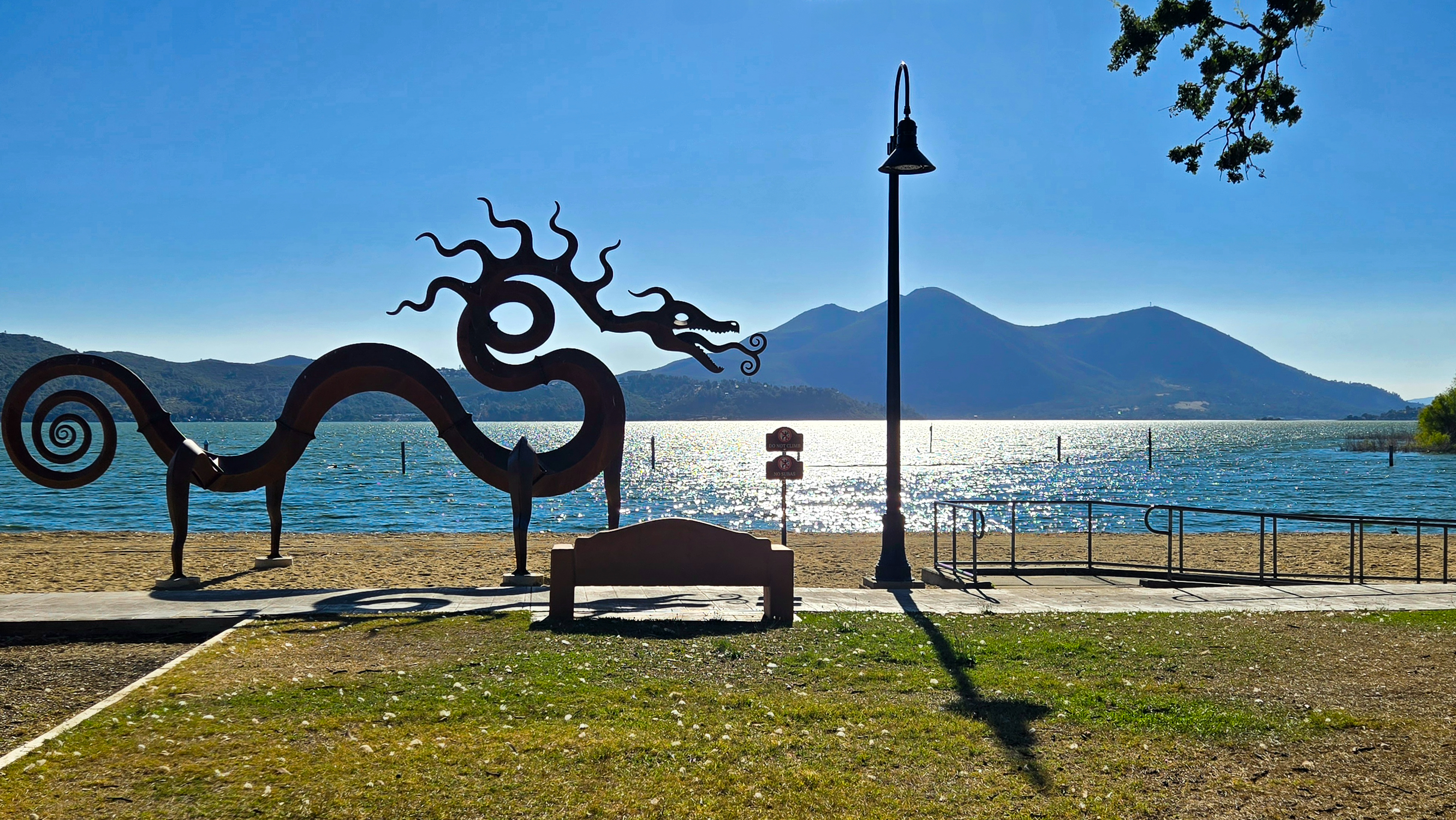
I have always had a chip on my shoulder when it comes to Clear Lake. This is not to say that I have no fond memories of the place or didn’t form any enduring relationships there; it’s that this was not where I was born, or grew up, or even visited prior to living there. It’s where I was unwillingly relocated at age fifteen as the consequence of my parents’ divorce. Having put her elementary school teaching career on hold to have children, my mother was now compelled to reenter the workforce. She didn’t want to leave our small-town home of Elk Grove in northern California’s Sacramento Valley, but Konocti Unified School District a few counties away was one of the very few school districts that were hiring at the time. In December 1979, midway through my freshman year in high school, she loaded all four kids and our dog in our blue and white VW bus and moved us the 120 miles to Clear Lake.
In reality, I only spent about three and a half years there. Enough to finish high school and part of the following summer as I focused on my plans to leave, and my entire senior year was really a tensioning slingshot designed to achieve this exit. I came back a few times during my early college years in Santa Rosa and Yuba City, but most return visits were transactional: graduations for my two younger siblings, my younger brother’s wedding, and two high school class reunions. I was there for a week to care for my mom when she developed lung cancer shortly after her retirement, and then again during the final days of her life in May of 2012. I was there twice in 2015 — another reunion and a celebration of life for a high school coach. This most recent trip was for yet another reunion, and was my first visit in over a decade.
It had been sixty degrees and raining when I flew out of Seattle, while it was over a hundred when I landed in Sacramento. The drive up to the lake from the airport was likewise hot and dry. For our first six months at the lake, while my mother was simultaneously looking for a house she could afford and prepping our previous home for sale, we all piled in the van every Friday afternoon and wound our way east on Highway 20 to Interstate 5 and south to Elk Grove, then retraced the route every Sunday evening. Years later, driving those same roads alone, I would run Highway 20 or the cut up Rumsey Canyon faster than I had any business driving them. I never understood why, as I was in no hurry to be there. Now, even with the numerous roadway revisions over the years to address seasonal flooding, every turn and grade still seemed familiar, and my focus had clearly shifted to arriving safely rather than quickly.
Regardless of where I was coming from, each time I drove to the lake I would turn west off Highway 53 onto Lakeshore Boulevard and do a slow loop through the commercial district down to and along the shoreline to Olympic Drive, then back up to 53 and on to wherever I was headed. The business landscape varied with each trip, with some establishments seeming to remain perpetually unchanged, while most others turned over, and some buildings disappeared altogether. It was more out of a retrospective curiosity and not any sense of nostalgia, but it was also a visible economic barometer for the town. Some years it seemed vibrant and alive, with new businesses open and people bustling about, while others it seemed stagnant or declining with businesses closed and buildings boarded up.
This trip, as always, I made the returning ritual drive down Lakeshore. Past the pharmacy that was once a fast-food restaurant where I worked briefly. The ballfield where I played a few seasons of Little League. The boat ramp from where my siblings and I launched to spread my mother’s ashes in the lake. The miniature golf park and arcade where we spent endless afternoons. The school where my mother first taught. The church where we held her memorial. I knew these landmarks well, but mere familiarity isn’t connection or attachment. Economically it was impossible to tell if the city was coming or going. Everything looked old and worn in the July heat, and the pungent algae smell from the lake seeped through the air conditioning in the rental car.
That smell, omnipresent but appreciably worse in hotter years, was yet another unpleasant memory. Our initial residence at the lake was a friend’s cabin on the water out past the post office in Clearlake Park. While “cabin on the water” has a scenic, almost romantic lilt to it, this was nothing more than a double-wide mobile home with nowhere near enough room for the five of us. It drew its water directly from the lake, and even if we cleaned the pump filter every day, the water had a noticeable, vaguely fetid smell and a slight metallic taste that left its scent on our bodies and clothes and its taste in our food. Even when we moved to the Highlands Village neighborhood in what would later become incorporated into the city of Clearlake, the algae smell bloomed in the water in summer.
This reunion, like all of them so far, was a series of wonderful reconnections. Lunch beforehand with old friends who were unable to attend the actual reunion. A casual small group get-together at a lakeside bar the night before. Unhurried chats with my oldest and dearest friend from this episode of my life. A tour of our high school the morning before, though the present incarnation of Lower Lake High School bore scant resemblance to what I knew. The event was focused on Lower Lake alumni from 1980 to 1984, but with an open hand extended to surrounding years. Hosting multiple graduation years together made sense, as no individual class goes through school in a vacuum. I’ve also found that the importance of the specific year in which you graduated has diminished as we have all melded into a communal family of alumni.
There were many people there whom I had seen at prior reunions, and many others that I have kept in touch with via social media, but that didn’t take anything away from how special it was to see them again in person. There were also delightful surprises — people I hadn’t seen in forty-five or more years that I didn’t know were going to be there. Some attendees looked eternally youthful, while most of us were showing some signs of age now that we were all in our late fifties and early sixties. There was a lot of looking at name tags and searching memories, with the spark of recognition finally igniting when we saw a certain smile or mannerism, or heard a familiar voice coming from an otherwise unfamiliar face.
There was also a sobering reminder of our contemporaries who hadn’t made it this far. Some I had known about, as my class (1982) lost a number of classmates to accidents relatively soon after graduation, but there were several more I learned about that night. They were acknowledged during the program, and silently commemorated by a display of their senior yearbook portraits — optimistic smiles frozen in adolescence, just as we remembered them.
For most of us, this brief period decades ago is the only thing we have in common. Whatever separate paths we have taken since, we will always share those crucible years. This alone is enough to keep us gathering together at regular intervals, even as the years stretch out, reunion attendance wanes, and the memorial table grows.
One of the common conversational threads of the weekend was that for a lot of people, the lake is still home, or a destination that they love coming to, or even a place they’ve considered retiring to. Some couldn’t think of living anywhere else, and I don’t begrudge them this association in the slightest. If anything, I envy them that, while my lake story remains one of dislocation. Part of me understands the attraction. Visually, the lake and surrounding region have an undeniable rustic beauty, especially as vineyards continue to replace the nondescript outlying fields. For some, it has also been home for successive generations. On the campus tour we heard from classmates whose parents and whose children had all graduated from Lower Lake. The reunion itself was held at a ranch passed down through generations and currently owned by a pair of brothers I went to school with.
I’ve often thought that I learned my occasional sardonic tone from my mother, and it’s probable that her early aversion to the lake only compounded mine. Every time we made that Sunday return drive, as we passed the sign marking the entrance to Lake County from Colusa County, she would invariably make some kind of disparaging remark. Most often it was, “Welcome to Lack County.” But over time, something in her shifted. While her initial move there was one of economic survival, at some point she had developed the means to leave, but chose not to. As I observed in her eulogy when touching on her enormous capacity to absorb adversity, matched only by her willingness to give of herself:
“This is the combination that allowed her to rise above her circumstances time and again. This is the recipe that allowed her to put down solid roots wherever she found herself. To raise her children in love. To find immense satisfaction in her career. To forge lifelong friendships. And here among the heat, the dust and the algae, it allowed her to find contentment.”
Whether this eventual contentment was merely resignation or a true and sincere appreciation now seems irrelevant, and I believe that it was actually her connections to the people around her that gave her this deeper acceptance of the physical place.
My experience of Clear Lake began with and because of my mother, but it is also evident that it has survived her. Sacramento will always be my birthplace, and Elk Grove will always be the answer I give when asked about my hometown. Equally, Lower Lake will always be my high school. While I share my mother’s affinity for the people I know from my time there, unlike her I have yet to fully let go of my animus surrounding the location. But in small, quiet moments — watching the early morning sunrise over the lake before the heat rose, sitting on a waterside bench in the park for a conversation with my mother, walking slowly away from the reunion venue into complete darkness under a brilliant star-lit sky — there was what felt like progress. Not exactly a melancholic pull or an unsettled ache, but something tangible and tied inexorably to the landscape itself. Perhaps a slight softening; the slightest step forward on a broader path to reconciliation.